

AZ-3451 |
Catalog No.GC18152
 One-Click Copy Product Info
|

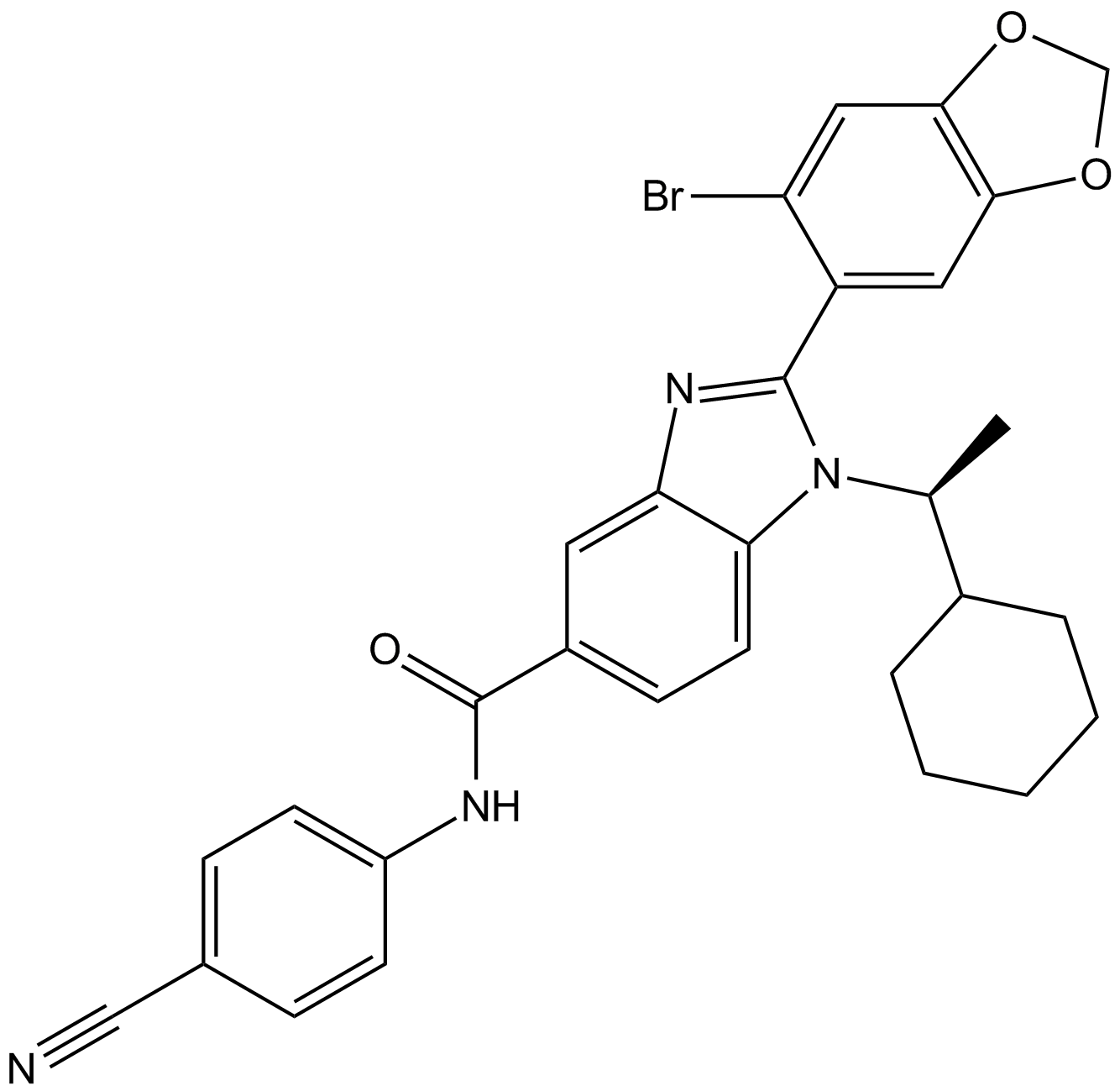
AZ-3451 is a protease-activated receptor-2 (PAR2) antagonist.
Products are for research use only. Not for human use. We do not sell to patients.
Cas No.: 2100284-59-9
Sample solution is provided at 25 µL, 10mM.
_1-3.$$$39978408@51.jpg');)
_1-9.$$$38538795@65.jpg');)
_1-9.$$$39112701@51.jpg');)
_1-7.$$$37316672@70.jpg');)
_366-372.$$$36198801@70.jpg');)
.$$$38565142@65.jpg');)
_1867-1883.$$$33248023@67.jpg');)
_eads6055.$$$39977546@45.jpg');)
_eadm9805.$$$40080571@45.jpg');)
_eadj3020.$$$39666821@45.jpg');)
_1-20.$$$39757301@28.jpg');)
_1-24.$$$38898113@28.jpg');)
_273-287.$$$36806353@46.jpg');)
_1-16.$$$37156877@44.jpg');)
_1-19.$$$37460805@44.jpg');)
_1291-1307.$$$34518654@46.jpg');)
AZ-3451 is a protease-activated receptor-2 (PAR2) antagonist. PARs are irreversibly activated by proteolytic cleavage of the N-terminus, exposing a tethered peptide ligand that bind to and activates the transmembrane receptor domain (TMD), thereby triggering cellular signaling cascades in response to inflammatory and other stimuli. AZ-3451 binds to a remote allosteric site outside the helical bundle of the PAR2, preventing the conformational rearrangements required for receptor activation and signaling[1].
In vitro, AZ-3451 (10μM; 48h) effectively inhibited PAR2 expression in primary rat chondrocytes and prevented IL-1β (10ng/mL)-induced inflammatory responses, cartilage degradation, and premature senescence[2].
In vivo, AZ-3451 (50μg/mL; 100μL; intra-articular injection; twice weekly for 8 weeks) significantly alleviated osteoarthritis progression in a rat post-traumatic osteoarthritis model, with reduced cartilage damage, increased proteoglycan content, and decreased chondrocyte apoptosis[2]. AZ-3451 (10mg/kg; s.c.; administered 30min prior to treatment) significantly reduced PAR2 agonist-induced paw edema and decreased mast cell and neutrophil activation in rats[3].
References:
[1] Cheng, Robert K Y et al. “Structural insight into allosteric modulation of protease-activated receptor 2.” Nature vol. 545,7652 (2017): 112-115.
[2] Huang X, Ni B, Xi Y, Chu X, Zhang R, You H. Protease-activated receptor 2 (PAR-2) antagonist AZ3451 as a novel therapeutic agent for osteoarthritis. Aging (Albany NY). 2019;11(24):12532-12545.
[3] Kennedy, Amanda J et al. “Protease-activated receptor-2 ligands reveal orthosteric and allosteric mechanisms of receptor inhibition.” Communications biology vol. 3,1 782. 17 Dec. 2020.
| Cell experiment [1]: | |
Cell lines | Primary rat chondrocytes |
Preparation Method | Primary rat chondrocytes were derived from the knee joint cartilage tissue of 1-week-old Sprague-Dawley rats. Up to approximately 80% confluences, cells were treated with 10μM AZ-3451 in the presence or absence of 10ng/mL IL-1β. |
Reaction Conditions | 10μM; 48h |
Applications | 10μM AZ-3451 can effectively inhibit PAR2 expression in chondrocytes. IL-1β increased the inflammatory cytokines and catabolic genes expression, including iNOS, COX2, MMP1, MMP13 and ADAMTS5, while treatment with AZ-3451 alleviated this process. Decreased Collagen II, aggrecan and SOX9 expressions induced by IL-1β were also inhibited by AZ-3451. The IL-1β-treated chondrocytes exerted higher SA-β-gal activity and p16INK4a protein expression compared with the control group, while PAR2 antagonist AZ-3451 significantly prevented this process. |
| Animal experiment [1]: | |
Animal models | Sprague–Dawley rats |
Preparation Method | The rat post-traumatic osteoarthritis (PTOA) model was induced by surgical destabilization of the anterior cruciate ligament (ACLT) on the right knee. The rats were randomly divided into three groups. The sham group underwent sham operations with no ligament transection and treated with vehicle (physiological saline). The PTOA group underwent operations and treated with vehicle. The PTOA/AZ-3451 group underwent operations and treated with AZ-3451. For intra-articular injection, AZ-3451 was dissolved in physiological saline (50μg/ml) and rats were given an intra-articular injection (100μl) of AZ-3451 or vehicle twice a week following surgery. Rats were sacrificed at 8 weeks post-OA surgery from each group. |
Dosage form | 50μg/ml, 100μl; intra-articular injection; twice a week for 8 weeks |
Applications | AZ-3451 treatment group exerted the less cartilage damage and the richer proteoglycan compared to the PTOA group. |
References: | |
| Cas No. | 2100284-59-9 | SDF | |
| Chemical Name | (S)-2-(6-bromobenzo[d][1,3]dioxol-5-yl)-N-(4-cyanophenyl)-1-(1-cyclohexylethyl)-1H-benzo[d]imidazole-5-carboxamide | ||
| Canonical SMILES | BrC1=CC2=C(OCO2)C=C1C3=NC4=CC(C(NC5=CC=C(C#N)C=C5)=O)=CC=C4N3[C@@H](C)C6CCCCC6 | ||
| Formula | C30H27BrN4O3 | M.Wt | 571.46 |
| Solubility | Soluble in DMSO | Storage | Store at -20°C |
| General tips | Please select the appropriate solvent to prepare the stock solution according to the
solubility of the product in different solvents; once the solution is prepared, please store it in
separate packages to avoid product failure caused by repeated freezing and thawing.Storage method
and period of the stock solution: When stored at -80°C, please use it within 6 months; when stored
at -20°C, please use it within 1 month. To increase solubility, heat the tube to 37°C and then oscillate in an ultrasonic bath for some time. |
||
| Shipping Condition | Evaluation sample solution: shipped with blue ice. All other sizes available: with RT, or with Blue Ice upon request. | ||
| Prepare stock solution | |||

|
1 mg | 5 mg | 10 mg |
| 1 mM | 1.7499 mL | 8.7495 mL | 17.499 mL |
| 5 mM | 350 μL | 1.7499 mL | 3.4998 mL |
| 10 mM | 175 μL | 875 μL | 1.7499 mL |
Step 1: Enter information below (Recommended: An additional animal making an allowance for loss during the experiment)
 g
μL
g
μL
Step 2: Enter the in vivo formulation (This is only the calculator, not formulation. Please contact us first if there is no in vivo formulation at the solubility Section.)
Calculation results:
Working concentration: mg/ml;
Method for preparing DMSO master liquid: mg drug pre-dissolved in μL DMSO ( Master liquid concentration mg/mL, Please contact us first if the concentration exceeds the DMSO solubility of the batch of drug. )
Method for preparing in vivo formulation: Take μL DMSO master liquid, next addμL PEG300, mix and clarify, next addμL Tween 80, mix and clarify, next add μL saline, mix and clarify.
Method for preparing in vivo formulation: Take μL DMSO master liquid, next add μL Corn oil, mix and clarify.
Note: 1. Please make sure the liquid is clear before adding the next solvent.
2. Be sure to add the solvent(s) in order. You must ensure that the solution obtained, in the previous addition, is a clear solution before proceeding to add the next solvent. Physical methods such as vortex, ultrasound or hot water bath can be used to aid dissolving.
3. All of the above co-solvents are available for purchase on the GlpBio website.
Quality Control & SDS
- View current batch:
- Purity: >98.00% Appearance: A solid
- COA (Certificate of Analysis)
- SDS (Safety Data Sheet)
- Datasheet
Average Rating: 5 (Based on Reviews and 37 reference(s) in Google Scholar.)