

Neurokinin A TFA (Synonyms: Substance K TFA; Neurokinin α TFA; Neuromedin L TFA) |
Catalog No.GC61486
 One-Click Copy Product Info
|

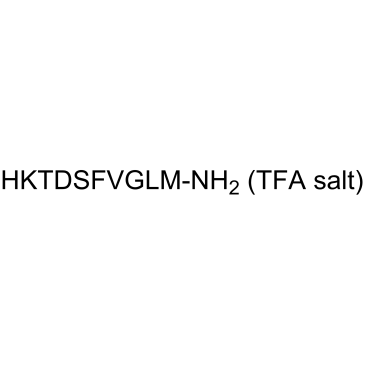
Neurokinin A TFA is an endogenous tachykinin neuropeptide and a potent selective agonist of the neurokinin 2 receptor (NK2R).
Products are for research use only. Not for human use. We do not sell to patients.
Cas No.: 2828433-19-6
Sample solution is provided at 25 µL, 10mM.
_1-3.$$$39978408@51.jpg');)
_1-9.$$$38538795@65.jpg');)
_1-9.$$$39112701@51.jpg');)
_1-7.$$$37316672@70.jpg');)
_366-372.$$$36198801@70.jpg');)
.$$$38565142@65.jpg');)
_1867-1883.$$$33248023@67.jpg');)
_eads6055.$$$39977546@45.jpg');)
_eadm9805.$$$40080571@45.jpg');)
_eadj3020.$$$39666821@45.jpg');)
_1-20.$$$39757301@28.jpg');)
_1-24.$$$38898113@28.jpg');)
_273-287.$$$36806353@46.jpg');)
_1-16.$$$37156877@44.jpg');)
_1-19.$$$37460805@44.jpg');)
_1291-1307.$$$34518654@46.jpg');)
Neurokinin A TFA is an endogenous tachykinin neuropeptide and a potent selective agonist of the neurokinin 2 receptor (NK2R)[1-2]. Neurokinin A TFA can be used in research related to gastrointestinal disorders, chronic visceral pain, asthma, and overactive bladder syndrome[3-4].
In vitro, K562 hematopoietic progenitor cells were stimulated with Neurokinin A TFA (10nM) for 16 hours. Neurokinin A TFA inhibited the expression of cell cycle activators Cdk2 and Cyclin A, upregulated p53 and p21 expression, activated Smad4 via a non-classical pathway, and induced TGF-β1 production at the translational level, primarily through NK2 receptor activation[5]. Human keratinocytes and mouse PAM 212 keratinocytes were treated with Neurokinin A TFA (0.1–100nM) for 3–48 hours. Neurokinin A TFA directly induced nerve growth factor mRNA expression and bioactive protein secretion via NK1 and NK2 receptors, promoted neurite outgrowth in PC-12 cells, and upregulated epidermal keratinocyte nerve growth factor protein expression in mouse skin through capsaicin-induced neuropeptide release[6].
In vivo, Neurokinin A TFA (1μg/site) was injected into the gingival tissue of C57BL/6 mice with ligation-induced periodontitis (twice daily for 5 days). Neurokinin A TFA did not significantly induce osteoclast activation or immune cell infiltration[7]. Sprague Dawley rats were administered Neurokinin A TFA (1.0–100μg) via intrathecal injection (5 minutes after a single injection). Neurokinin A TFA induced NK-1 receptor internalization in spinal cord dorsal horn superficial layer (lamina I) neurons by activating the neurokinin-1 receptor (NK-1R), with an EC₅₀ value of 210μM[8].
References:
[1] Gerard NP, Eddy RL Jr, Shows TB, et al. The human neurokinin A (substance K) receptor. Molecular cloning of the gene, chromosome localization, and isolation of cDNA from tracheal and gastric tissues. J Biol Chem. 1990 Nov 25;265(33):20455-62.
[2] Munekata E. Neurokinin A and B. Comp Biochem Physiol C Comp Pharmacol Toxicol. 1991;98(1):171-9.
[3] Regoli D, Rhaleb NE, Dion S, et al. Neurokinin A. A pharmacological study. Pharmacol Res. 1990 Jan-Feb;22(1):1-14.
[4] Wiesenfeld-Hallin Z, Xu XJ. The differential roles of substance P and neurokinin A in spinal cord hyperexcitability and neurogenic inflammation. Regul Pept. 1993 Jul 2;46(1-2):165-73.
[5] Ricardo M, Trzaska KA, Rameshwar P. Neurokinin-A inhibits cell cycle activators in K562 cells and activates Smad 4 through a non-canonical pathway: a novel method in neural-hematopoietic axis. J Neuroimmunol. 2008 Nov 15;204(1-2):85-91.
[6] Burbach GJ, Kim KH, Zivony AS, et al. The neurosensory tachykinins substance P and neurokinin A directly induce keratinocyte nerve growth factor. J Invest Dermatol. 2001 Nov;117(5):1075-82.
[7] Siddiqui YD, Nie X, Wang S, et al. Substance P aggravates ligature-induced periodontitis in mice. Front Immunol. 2023 Apr 14;14:1099017.
[8] Trafton JA, Abbadie C, Basbaum AI. Differential contribution of substance P and neurokinin A to spinal cord neurokinin-1 receptor signaling in the rat. J Neurosci. 2001 May 15;21(10):3656-64.
| Cell experiment [1]: | |
Cell lines | K562 cells (human hematopoietic progenitor cell line) |
Preparation Method | K562 cells were maintained in RPMI 1640 medium supplemented with 10% fetal calf serum (FCS) at 37°C, 5% CO₂. K562 cells were treated with Neurokinin A TFA at 10nM for 16 hours. |
Reaction Conditions | 10nM; 16h |
Applications | Neurokinin A TFA significantly suppressed cell cycle activators Cdk2 and Cyclin A, while upregulating inhibitors p53 and p21 in K562 cells. Neurokinin A TFA also induced TGF-β1 production at the translational level and activated Smad4 via a non-canonical pathway independent of TGF-β receptor signaling. |
| Animal experiment [2]: | |
Animal models | Sprague Dawley rats |
Preparation Method | Rats were anesthetized with sodium Pentobarbital (50mg/kg; i.p.) and received intrathecal injections of Neurokinin A TFA (1.0–100μg) or Substance P (SP) between S1-S2 vertebrae. Rats were subjected to noxious thermal (hindpaw immersion in 51°C water for 2min) or mechanical (hemostat pinch for 15sec) stimulation. Inflammatory conditions were induced by subcutaneous injection of complete Freund's adjuvant (CFA) into the hindpaw 2 days prior to stimulation. |
Dosage form | 1.0–100μg; intrathecal injection; single administration. |
Applications | Neurokinin A TFA induced NK-1 receptor internalization in spinal cord lamina I neurons with a dose-dependence identical to substance P (EC₅₀≈210μM). The selective NK-1 receptor antagonist GR 205171 (10mg/kg; s.c.) completely blocked Neurokinin A TFA-induced NK-1 receptor internalization but had no effect on SP-induced internalization. Under inflammatory conditions, Neurokinin A TFA mediated nearly all NK-1 receptor internalization in deep dorsal horn (laminae III-VI) neurons. |
References: | |
| Cas No. | 2828433-19-6 | SDF | |
| Synonyms | Substance K TFA; Neurokinin α TFA; Neuromedin L TFA | ||
| Formula | C52H81N14F3O16S | M.Wt | 1247.34 |
| Solubility | DMSO: 100 mg/mL (80.17 mM) | Storage | Store at -80°C |
| General tips | Please select the appropriate solvent to prepare the stock solution according to the
solubility of the product in different solvents; once the solution is prepared, please store it in
separate packages to avoid product failure caused by repeated freezing and thawing.Storage method
and period of the stock solution: When stored at -80°C, please use it within 6 months; when stored
at -20°C, please use it within 1 month. To increase solubility, heat the tube to 37°C and then oscillate in an ultrasonic bath for some time. |
||
| Shipping Condition | Evaluation sample solution: shipped with blue ice. All other sizes available: with RT, or with Blue Ice upon request. | ||
| Prepare stock solution | |||

|
1 mg | 5 mg | 10 mg |
| 1 mM | 801.7 μL | 4.0085 mL | 8.0171 mL |
| 5 mM | 160.3 μL | 801.7 μL | 1.6034 mL |
| 10 mM | 80.2 μL | 400.9 μL | 801.7 μL |
Step 1: Enter information below (Recommended: An additional animal making an allowance for loss during the experiment)
 g
μL
g
μL
Step 2: Enter the in vivo formulation (This is only the calculator, not formulation. Please contact us first if there is no in vivo formulation at the solubility Section.)
Calculation results:
Working concentration: mg/ml;
Method for preparing DMSO master liquid: mg drug pre-dissolved in μL DMSO ( Master liquid concentration mg/mL, Please contact us first if the concentration exceeds the DMSO solubility of the batch of drug. )
Method for preparing in vivo formulation: Take μL DMSO master liquid, next addμL PEG300, mix and clarify, next addμL Tween 80, mix and clarify, next add μL saline, mix and clarify.
Method for preparing in vivo formulation: Take μL DMSO master liquid, next add μL Corn oil, mix and clarify.
Note: 1. Please make sure the liquid is clear before adding the next solvent.
2. Be sure to add the solvent(s) in order. You must ensure that the solution obtained, in the previous addition, is a clear solution before proceeding to add the next solvent. Physical methods such as vortex, ultrasound or hot water bath can be used to aid dissolving.
3. All of the above co-solvents are available for purchase on the GlpBio website.
Quality Control & SDS
- View current batch:
- Purity: >99.00% Appearance: A solid
- COA (Certificate of Analysis)
- SDS (Safety Data Sheet)
- Datasheet
Average Rating: 5 (Based on Reviews and 7 reference(s) in Google Scholar.)