

AZD-9574 |
Catalog No.GC64099
 One-Click Copy Product Info
|

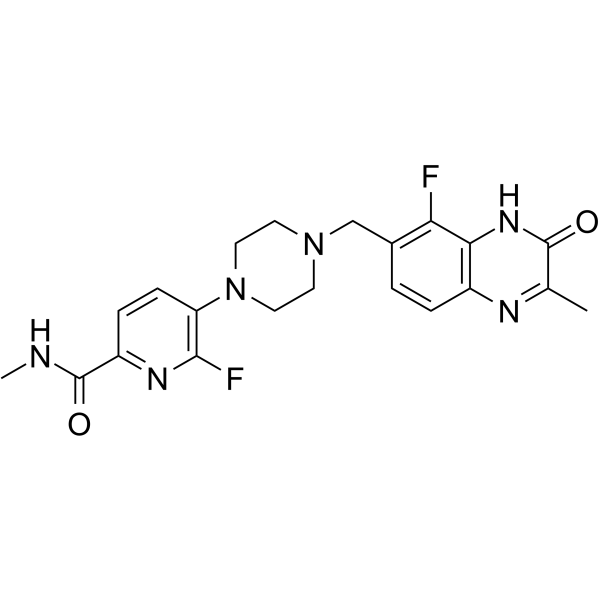
AZD-9574 is a novel, blood-brain barrier permeable PARP1 inhibitor that selectively inhibits PARP1 at single-strand break (SSB) sites.
Products are for research use only. Not for human use. We do not sell to patients.
Cas No.: 2756333-39-6
Sample solution is provided at 25 µL, 10mM.
_1-3.$$$39978408@51.jpg');)
_1-9.$$$38538795@65.jpg');)
_1-9.$$$39112701@51.jpg');)
_1-7.$$$37316672@70.jpg');)
_366-372.$$$36198801@70.jpg');)
.$$$38565142@65.jpg');)
_1867-1883.$$$33248023@67.jpg');)
_eads6055.$$$39977546@45.jpg');)
_eadm9805.$$$40080571@45.jpg');)
_eadj3020.$$$39666821@45.jpg');)
_1-20.$$$39757301@28.jpg');)
_1-24.$$$38898113@28.jpg');)
_273-287.$$$36806353@46.jpg');)
_1-16.$$$37156877@44.jpg');)
_1-19.$$$37460805@44.jpg');)
_1291-1307.$$$34518654@46.jpg');)
AZD-9574 is a novel, blood-brain barrier permeable PARP1 inhibitor that selectively inhibits PARP1 at single-strand break (SSB) sites[1-2]. AZD-9574 can be used in research related to breast cancer and advanced solid malignancies[3-4].
In vitro, AZD-9574 (0.1nM–40µM) was incubated with homologous recombination repair-deficient (HRD) cancer cells (such as MDA-MB-436, DLD-1 BRCA2-/-, and SKOV3 BRCA2-/- cells) for 72 hours to 13 days. AZD-9574 significantly inhibited cancer cell colony formation, increased γH2AX signaling, induced G2-M phase cell cycle arrest, and enhanced the synergistic anti-tumor effects of TMZ[5].
In vivo, AZD-9574 (3mg/kg/day) was orally administered to C57BL/6 mice bearing H3K27M diffuse midline glioma (using H3K27MPP cells) in combination with 2Gy radiotherapy (administered 1 hour before each radiation fraction, for 6 consecutive days). AZD-9574 significantly prolonged the overall survival of the mice and enhanced intratumoral NK cell infiltration and activation[6]. AZD-9574 (0.6–3mg/kg) was administered once daily by oral gavage for 7 consecutive days to mouse models bearing patient-derived (H3F3A K27M, TP53R248W, ATRX-deficient) or genetically engineered (H3F3A K27M; Trp53⁻/⁻) diffuse midline glioma orthotopic xenografts. AZD-9574 significantly extended the survival of these mice and effectively inhibited the growth and recurrence of orthotopic tumors within the mouse brain[7].
References:
[1] Johannes JW, Balazs AYS, Barratt D, et al. Discovery of 6-Fluoro-5-{4-[(5-fluoro-2-methyl-3-oxo-3,4-dihydroquinoxalin-6-yl)methyl]piperazin-1-yl}-N-methylpyridine-2-carboxamide (AZD9574): A CNS-Penetrant, PARP1-Selective Inhibitor. J Med Chem. 2024 Dec 26;67(24):21717-21728.
[2] Zhou X, Chen K. Discovery of novel radioligand [18F]AZD9574 for selective imaging of PARP1 in the CNS. Acta Pharm Sin B. 2025 Oct;15(10):5489-5490.
[3] Lynce F, Lin NU. From Serendipity to Intention: Development of Brain-Penetrant PARP1-Selective Inhibitors. Clin Cancer Res. 2024 Apr 1;30(7):1217-1219.
[4] Patel JS, Zhou X, Chen J, et al. A novel 18 F-labeled brain penetrant PET ligand for imaging poly(ADP-ribose) polymerase-1. bioRxiv. 2025 Nov 3:2025.11.01.686021.
[5] Guo Y, Li Z, Parsels LA, et al. H3K27M diffuse midline glioma is homologous recombination defective and sensitized to radiotherapy and NK cell-mediated antitumor immunity by PARP inhibition. Neuro Oncol. 2025 Sep 17;27(8):2129-2146.
[6] Staniszewska AD, Pilger D, Gill SJ, et al. Preclinical Characterization of AZD9574, a Blood-Brain Barrier Penetrant Inhibitor of PARP1. Clin Cancer Res. 2024 Apr 1;30(7):1338-1351.
[7] Chen X, Zhang S, Yang L, et al. Zeaxanthin dipalmitate-enriched wolfberry extract improves vision in a mouse model of photoreceptor degeneration. PLoS One. 2024 May 20;19(5):e0302742.
| Cell experiment [1]: | |
Cell lines | A549 (human lung carcinoma cell line, PARP1+/+/PARP2+/+), A549 PARP1-/- (isogenic knockout), A549 PARP2-/- (isogenic knockout), DLD-1 (human colorectal carcinoma cell line), DLD-1 BRCA2-/- (isogenic knockout), MDA-MB-436 (human breast cancer cell line, BRCA1 mutant), SKOV3 (human ovarian carcinoma cell line), SKOV3 BRCA2-/- (isogenic knockout), UWB1.289 (human ovarian carcinoma cell line, BRCA1 mutant), SJ-G2 (human glioblastoma cell line), GBM39 (human glioblastoma PDX cell line). |
Preparation Method | Cell lines were maintained as per standard conditions. For PARylation assays, cells were treated with AZD-9574 at increasing doses. For colony formation assays, cells were seeded and incubated overnight, then treated with a titration of AZD-9574 (0.1nM to 40μM) for 8 to 13 days. For DNA damage and cell-cycle analysis, cells were treated with AZD9574 for 72 hours, with EdU added 1 hour before fixation. |
Reaction Conditions | 0.1nM to 40μM; 72 hours to 13 days. |
Applications | AZD-9574 demonstrated potent, selective inhibition of PARP1 (over PARP2 and other PARPs) in biochemical and cellular assays. AZD-9574 inhibited PARylation in various cell lines with single-digit nanomolar IC50 values. AZD-9574 induced PARP1 trapping on chromatin in a concentration-dependent manner but showed no PARP2 trapping. In HRD cancer cell lines (e.g., MDA-MB-436, DLD-1 BRCA2-/-), AZD-9574 exhibited potent anti-proliferative effects in colony formation assays, induced DNA damage (increased γH2AXSer139 foci), and caused cell-cycle arrest in the G2-M phase. Furthermore, AZD-9574 showed strong synergy with temozolomide (TMZ) in reducing cell viability in MGMT-methylated glioma cell lines (SJ-G2, GBM39). |
| Animal experiment [2]: | |
Animal models | C57BL/6 mice harboring syngeneic orthotopic H3K27M-mutant diffuse midline glioma (DMG) brainstem tumors (H3K27MPPcell line), immune competent mice |
Preparation Method | Mice were treated with RT (2Gy, days 0-2 and 4-6) in combination with AZD-9574 (3mg/kg) administered by oral gavage 1 hour before each fraction of radiation and continued for 6 consecutive days. |
Dosage form | 3mg/kg; oral gavage (p.o.); Once daily for 6 days. |
Applications | AZD-9574 in combination with RT significantly prolonged the median survival of mice bearing H3K27M mutant DMG tumors compared to RT alone (75 days vs. 42 days). The treatment enhanced intratumoral NK cell infiltration (frequency of CD3-NK1.1+CD45+cells) and increased NK cell activity, as evidenced by a higher proportion of TNF-α+, CD107a+, and IFN-γ+ NK cells. Furthermore, the combination therapy reduced tumor-associated macrophage numbers within the tumors. |
References: | |
| Cas No. | 2756333-39-6 | SDF | |
| Formula | C21H22F2N6O2 | M.Wt | 428.44 |
| Solubility | DMSO : 22.22 mg/mL (51.86 mM; ultrasonic and adjust pH to 4 with HCl); DMSO : 8.33 mg/mL (19.44 mM; ultrasonic and warming and heat to 60°C) | Storage | Store at -20°C |
| General tips | Please select the appropriate solvent to prepare the stock solution according to the
solubility of the product in different solvents; once the solution is prepared, please store it in
separate packages to avoid product failure caused by repeated freezing and thawing.Storage method
and period of the stock solution: When stored at -80°C, please use it within 6 months; when stored
at -20°C, please use it within 1 month. To increase solubility, heat the tube to 37°C and then oscillate in an ultrasonic bath for some time. |
||
| Shipping Condition | Evaluation sample solution: shipped with blue ice. All other sizes available: with RT, or with Blue Ice upon request. | ||
| Prepare stock solution | |||

|
1 mg | 5 mg | 10 mg |
| 1 mM | 2.334 mL | 11.6702 mL | 23.3405 mL |
| 5 mM | 466.8 μL | 2.334 mL | 4.6681 mL |
| 10 mM | 233.4 μL | 1.167 mL | 2.334 mL |
Step 1: Enter information below (Recommended: An additional animal making an allowance for loss during the experiment)
 g
μL
g
μL
Step 2: Enter the in vivo formulation (This is only the calculator, not formulation. Please contact us first if there is no in vivo formulation at the solubility Section.)
Calculation results:
Working concentration: mg/ml;
Method for preparing DMSO master liquid: mg drug pre-dissolved in μL DMSO ( Master liquid concentration mg/mL, Please contact us first if the concentration exceeds the DMSO solubility of the batch of drug. )
Method for preparing in vivo formulation: Take μL DMSO master liquid, next addμL PEG300, mix and clarify, next addμL Tween 80, mix and clarify, next add μL saline, mix and clarify.
Method for preparing in vivo formulation: Take μL DMSO master liquid, next add μL Corn oil, mix and clarify.
Note: 1. Please make sure the liquid is clear before adding the next solvent.
2. Be sure to add the solvent(s) in order. You must ensure that the solution obtained, in the previous addition, is a clear solution before proceeding to add the next solvent. Physical methods such as vortex, ultrasound or hot water bath can be used to aid dissolving.
3. All of the above co-solvents are available for purchase on the GlpBio website.
Quality Control & SDS
- View current batch:
- Purity: >98.00% Appearance: A solid
- COA (Certificate of Analysis)
- SDS (Safety Data Sheet)
- Datasheet
Average Rating: 5 (Based on Reviews and 6 reference(s) in Google Scholar.)