

Bacitracin |
Catalog No.GC10925
 One-Click Copy Product Info
|

Bacitracin is a polypeptide antibiotic produced by organisms of the licheniformis group of Bacillus subtilis var Tracy.
Products are for research use only. Not for human use. We do not sell to patients.
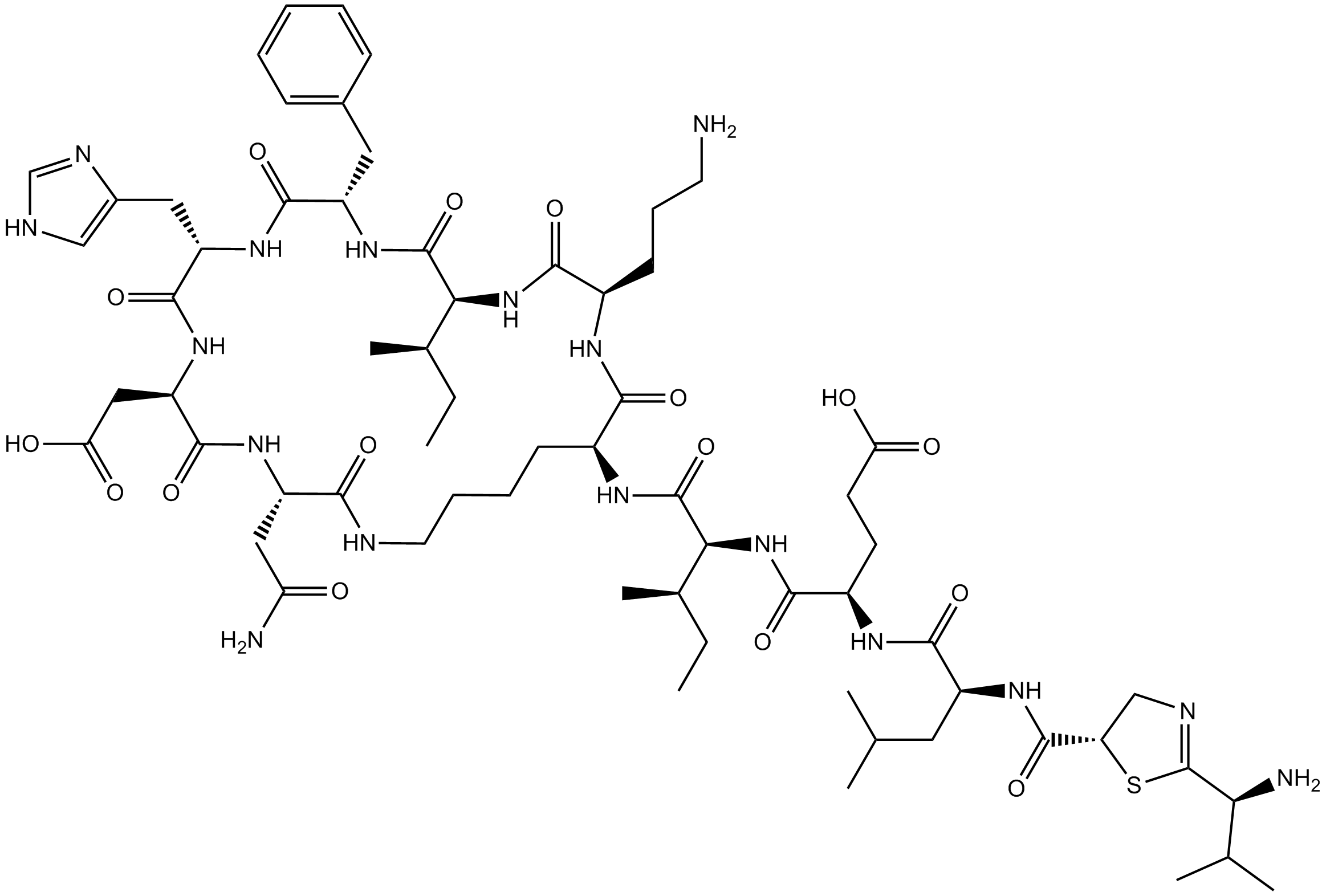
Cas No.: 1405-87-4
Sample solution is provided at 25 µL, 10mM.
_1-3.$$$39978408@51.jpg');)
_1-9.$$$38538795@65.jpg');)
_1-9.$$$39112701@51.jpg');)
_1-7.$$$37316672@70.jpg');)
_366-372.$$$36198801@70.jpg');)
.$$$38565142@65.jpg');)
_1867-1883.$$$33248023@67.jpg');)
_eads6055.$$$39977546@45.jpg');)
_eadm9805.$$$40080571@45.jpg');)
_eadj3020.$$$39666821@45.jpg');)
_1-20.$$$39757301@28.jpg');)
_1-24.$$$38898113@28.jpg');)
_273-287.$$$36806353@46.jpg');)
_1-16.$$$37156877@44.jpg');)
_1-19.$$$37460805@44.jpg');)
_1291-1307.$$$34518654@46.jpg');)
Bacitracin is a polypeptide antibiotic produced by organisms of the licheniformis group of Bacillus subtilis var Tracy[1]. Bacitracin inhibits cell wall biosynthesis and permeability through binding to the undecaprenyl pyrophosphate[2]. Bacitracin is typically used in the study of antibacterial mechanisms[3][4].
In vitro, treatment of human melanoma MeWo cells with Bacitracin (1mM; 48h) competitively inhibits dipeptidyl peptidase IV (DPP-IV) and aminopeptidase N (APN), reduces cell viability, and induces DNA fragmentation (sub-G₁ peak elevated to 24.3%) and cell apoptosis[5].
In vivo, Bacitracin (0-100mg/kg; i.m.; once daily for 12 days) markedly suppressed tumor growth, increased the percentages of apoptotic cells, decreased microvessel density and increased central necrotic area in MH134 hepatocellular carcinoma xenografts in C3H mice[6]. Bacitracin (20mg per mouse; p.o.; once daily for 7 days) lowers serum FITC-dextran levels, upregulates ileal ZO-1, JAM-A, occludin and colonic ZO-1, claudin-3, and claudin-4 mRNA expression, and reduces intestinal permeability in C57BL/10 mice[7].
References:
[1] Piepenbreier H, Sim A, Kobras CM, et al. From Modules to Networks: a Systems-Level Analysis of the Bacitracin Stress Response in Bacillus subtilis. mSystems. 2020;5(1):e00687-19.
[2] Economou NJ, Cocklin S, Loll PJ. High-resolution crystal structure reveals molecular details of target recognition by bacitracin. Proc Natl Acad Sci U S A. 2013;110(35):14207-14212.
[3] Buijs NP, Vlaming HC, Kotsogianni I, et al. A classic antibiotic reimagined: Rationally designed bacitracin variants exhibit potent activity against vancomycin-resistant pathogens. Proc Natl Acad Sci U S A. 2024;121(29):e2315310121.
[4] Si W, Wang L, Usongo V, Zhao X. Colistin Induces S. aureus Susceptibility to Bacitracin. Front Microbiol. 2018;9:2805.
[5] Méndez LR, Arrebola Y, Valdés-Tresanco ME, et al. Bestatin and bacitracin inhibit porcine kidney cortex dipeptidyl peptidase IV activity and reduce human melanoma MeWo cell viability. Int J Biol Macromol. 2020;164:2944-2952.
[6] Yu SJ, Yoon JH, Yang JI, et al. Enhancement of hexokinase II inhibitor-induced apoptosis in hepatocellular carcinoma cells via augmenting ER stress and anti-angiogenesis by protein disulfide isomerase inhibition. J Bioenerg Biomembr. 2012;44(1):101-115.
[7] Nevado R, Forcén R, Layunta E, Murillo MD, Grasa L. Neomycin and bacitracin reduce the intestinal permeability in mice and increase the expression of some tight-junction proteins. Rev Esp Enferm Dig. 2015;107(11):672-676.
| Cell experiment [1]: | |
Cell lines | MeWo (HTB-65) tumor cells |
Preparation Method | DPP-IV and APN activities present in the membrane of the MeWo (HTB-65) tumor cells were measured spectrophotometrically using L-Gly-Pro-pNA and L-Leu-pNA as substrates, respectively. 5×10⁴ cells per well were seeded, in a volume of 100μL of complete growth medium, in flat end 96 well plates and incubated with Bacitracin (1mM) in culture conditions for 48h. After this, the medium was removed, and 90μL of DMEM-F12 was added. To initiate the enzymatic reaction 10μL of L-Gly-Pro-pNA (0.7mM) or L-Leu-pNA (3mM) were added to each well. The reaction was done at 37°C for 30min. The formation of pNA was followed by absorbance at 405nm, inside a 96 well plate kinetic spectrophotometer. |
Reaction Conditions | 1mM; 48h |
Applications | Bacitracin inhibits DPP-IV and APN activities in the human melanoma MeWo cells. |
| Animal experiment [2]: | |
Animal models | C3H/He mice |
Preparation Method | 2.5×10⁶ viable MH134 cells suspended in 0.1mL of RPMI-1640 were injected subcutaneously to produce a bleb in the left flanks of the C3H/He mice. When the tumor volumes reached 0.5-1.0cm3 , Bacitracin was given i.m. for 12 consecutive days. Thirteen days after injecting Bacitracin (0, 10mg/kg, 50mg/kg, or 100mg/kg), the mice were sacrificed by exsanguination through cardiac puncture under general anesthesia (isoflurane inhalation). Tumor masses and liver tissues were then harvested, fixed in 10% formaldehyde, and cryopreserved for further analyses. |
Dosage form | 0-100mg/kg; i.m.; once daily for 12 days |
Applications | Bacitracin markedly suppressed tumor growth and increased central necrotic area in MH134 hepatocellular carcinoma xenografts in C3H mice. |
References: | |
| Cas No. | 1405-87-4 | SDF | |
| Canonical SMILES | CCC(C)C1C(=O)NC(C(=O)NC(C(=O)NC(C(=O)NC(C(=O)NCCCCC(C(=O)NC(C(=O)N1)CCCN)NC(=O)C(C(C)C)NC(=O)C(CCC(=O)O)NC(=O)C(CC(C)C)NC(=O)C2CSC(=N2)C(C(C)CC)N)CC(=O)N)CC(=O)O)CC3=CN=CN3)CC4=CC=CC=C4 | ||
| Formula | C65H101N17O16S | M.Wt | 1422.69 |
| Solubility | ≥ 228.9mg/mL in Water | Storage | 4°C, protect from light |
| General tips | Please select the appropriate solvent to prepare the stock solution according to the
solubility of the product in different solvents; once the solution is prepared, please store it in
separate packages to avoid product failure caused by repeated freezing and thawing.Storage method
and period of the stock solution: When stored at -80°C, please use it within 6 months; when stored
at -20°C, please use it within 1 month. To increase solubility, heat the tube to 37°C and then oscillate in an ultrasonic bath for some time. |
||
| Shipping Condition | Evaluation sample solution: shipped with blue ice. All other sizes available: with RT, or with Blue Ice upon request. | ||
| Prepare stock solution | |||

|
1 mg | 5 mg | 10 mg |
| 1 mM | 702.9 μL | 3.5145 mL | 7.0289 mL |
| 5 mM | 140.6 μL | 702.9 μL | 1.4058 mL |
| 10 mM | 70.3 μL | 351.4 μL | 702.9 μL |
Step 1: Enter information below (Recommended: An additional animal making an allowance for loss during the experiment)
 g
μL
g
μL
Step 2: Enter the in vivo formulation (This is only the calculator, not formulation. Please contact us first if there is no in vivo formulation at the solubility Section.)
Calculation results:
Working concentration: mg/ml;
Method for preparing DMSO master liquid: mg drug pre-dissolved in μL DMSO ( Master liquid concentration mg/mL, Please contact us first if the concentration exceeds the DMSO solubility of the batch of drug. )
Method for preparing in vivo formulation: Take μL DMSO master liquid, next addμL PEG300, mix and clarify, next addμL Tween 80, mix and clarify, next add μL saline, mix and clarify.
Method for preparing in vivo formulation: Take μL DMSO master liquid, next add μL Corn oil, mix and clarify.
Note: 1. Please make sure the liquid is clear before adding the next solvent.
2. Be sure to add the solvent(s) in order. You must ensure that the solution obtained, in the previous addition, is a clear solution before proceeding to add the next solvent. Physical methods such as vortex, ultrasound or hot water bath can be used to aid dissolving.
3. All of the above co-solvents are available for purchase on the GlpBio website.
Quality Control & SDS
- View current batch:
- Biological Activity: 77.0 U/mg Appearance: A solid
- COA (Certificate of Analysis)
- SDS (Safety Data Sheet)
- Datasheet
Average Rating: 5 (Based on Reviews and 37 reference(s) in Google Scholar.)