

BDP9066 |
Catalog No.GC33340
 One-Click Copy Product Info
|

BDP9066 is a selective inhibitor of myotonic dystrophy-associated Cdc42-binding kinase (MRCK), with an IC50 of 64nM for MRCKβ and Ki values of 0.0136nM and 0.0233nM for MRCKα/β in SCC12 cells.
Products are for research use only. Not for human use. We do not sell to patients.
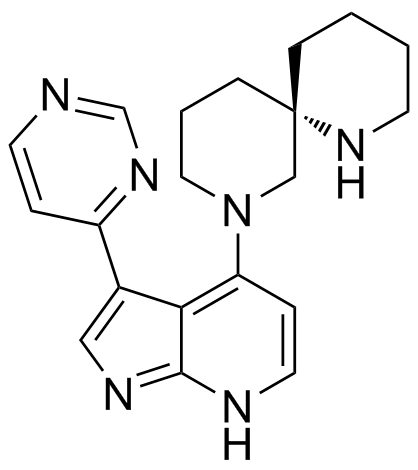
Cas No.: 2226507-04-4
Sample solution is provided at 25 µL, 10mM.
BDP9066 is a selective inhibitor of myotonic dystrophy-associated Cdc42-binding kinase (MRCK), with an IC50 of 64nM for MRCKβ and Ki values of 0.0136nM and 0.0233nM for MRCKα/β in SCC12 cells[1]. MRCK is a protein kinase that acts downstream of Cdc42. After being activated by Cdc42, MRCK promotes actin polymerization, stress fiber formation and cell membrane binding by phosphorylating downstream molecules such as myosin light chain 2 (MLC2), LIM domain kinase (LIMK), and myosin phosphatase target 1 (MYPT1)[2]. BDP9066 can be applied to the study of triple-negative breast cancer (TNBC), high-grade serous ovarian carcinoma (HGSC), and glioblastoma (GBM), and is a potential cancer chemotherapy drug[3].
In vitro, treatment of E2 and G7 cell lines with 250μM BDP9066 for 2 hours disrupted the actin-myosin cytoskeleton, inducing abnormal cell morphology to inhibit migration[4]. Treatment of HGSOC cells with 1μM BDP9066 for 24 hours increased the level of cleaved PARP in the cells, inhibited cell growth, induced apoptosis, and inhibited local adhesion signals, thereby impairing the globular formation of HGSOC cells[5]. In in vitro kinase assays, the EC50 values of BDP9066 for MRCKα and MRCKβ were 65nM and 72nM, respectively[5].
In vivo, when FVB mice were treated with BDP9066 (50μL; 80% (v/v) in DMSO; administered 4 times over 2 days) through skin application, the drug level in the skin of the mice was significantly higher than that in the blood, and the total tumor volume and mean papillary volume were significantly reduced, but the total number of papillomas was not different from that in the control group[1]. When mice carrying U87MG or G7 intracranial tumors were treated with BDP9066 (5mg/kg; twice daily; Monday to Friday; 4 weeks; subcutaneous injection), the tumor cell infiltration in the contralateral hemisphere of the irradiated mice treated with BDP9066 was not increased compared with the increase in the number of GBM cells in the contralateral hemisphere of the control mice after irradiation with 3 × 2 Gy[4].
References:
[1]. Unbekandt M, Belshaw S, Bower J, et al. Discovery of potent and selective MRCK inhibitors with therapeutic effect on skin cancer[J]. Cancer research, 2018, 78(8): 2096-2114.
[2]. Yamaguchi H, Chang L C, Chang O S S, et al. MRCK as a potential target for claudin-low subtype of breast Cancer[J]. International Journal of Biological Sciences, 2024, 20(1): 1.
[3]. McKinnon H J, Birch J, McDonald L, et al. A novel small molecule inhibitor of MRCK shows utility in blocking radiation induced invasion of glioblastoma cells in vitro and in vivo[J]. Cancer Research, 2018, 78(13_Supplement): 1933-1933.
[4]. Birch J L, Strathdee K, Gilmour L, et al. A novel small-molecule inhibitor of MRCK prevents radiation-driven invasion in glioblastoma[J]. Cancer research, 2018, 78(22): 6509-6522.
[5]. Kurimchak A M, Herrera-Montávez C, Brown J, et al. Functional proteomics interrogation of the kinome identifies MRCKA as a therapeutic target in high-grade serous ovarian carcinoma[J]. Science signaling, 2020, 13(619): eaax8238.
| Cell experiment [1]: | |
Cell lines | E2 and G7 cell lines |
Preparation Method | Cells were plated onto 6-well plates in triplicate per biological repeat. Twenty-four hours after plating, cells were treated with DMSO or 250μmol/L BDP9066 for 2 hours, followed by radiation treatment and media replacement. Cells were fixed after 2 to 3 weeks, stained with crystal violet, and colonies counted manually. Data were fitted using a linear quadratic model. |
Reaction Conditions | 250μM; 2h |
Applications | BDP9066 treatment disrupts the actin-myosin cytoskeleton, inducing an aberrant morphology that inhibits migration. |
| Animal experiment [1]: | |
Animal models | Mice bearing U87MG or G7 intracranial tumors |
Preparation Method | To test the efficacy of BDP9066 in inhibiting radiation-induced invasion in vivo, we established G7 intracranial tumors in four cohorts of mice: vehicle, BDP9066, RT + vehicle, and RT + BDP9066. Mice underwent T2-weighted MRI to confirm the presence and equivalence of size of tumors 11 weeks after tumor cell injection; treatment was commenced the following week. Mice in the RT cohorts received 3 × 2Gy whole brain RT over the course of 1 week. Twice-daily dosing of vehicle or BDP9066 was initiated at the same time as RT and continued for 10 days before sacrifice of the animals to ensure sustained inhibition of MRCK. Twice-daily dosing was chosen because, although the PK profile of BDP9066 showed good bioavailability, rapid clearance was also observed. A transient vasodilatory effect lasting 20 to 30 minutes was noted in some animals as evidenced by reddening of the ears. |
Dosage form | 5mg/kg; twice daily, monday to friday, 4 weeks; subcutaneous injection |
Applications | Increased numbers of GBM cells were observed in the contralateral hemispheres of mice in the “irradiated + vehicle” cohort. Importantly, irradiated mice that were treated with BDP9066 showed no increase of tumor cell infiltration to the contralateral hemisphere. BDP9066 penetrates intracranial GBM xenografts and inhibits radiation-induced infiltration of GBM cells in vivo. |
References: | |
| Cas No. | 2226507-04-4 | SDF | |
| Canonical SMILES | C12=C(N3CCC[C@@]4(CCCCN4)C3)C=CNC1=NC=C2C5=NC=NC=C5 | ||
| Formula | C20H24N6 | M.Wt | 348.44 |
| Solubility | Soluble in DMSO | Storage | Store at -20°C |
| General tips | Please select the appropriate solvent to prepare the stock solution according to the
solubility of the product in different solvents; once the solution is prepared, please store it in
separate packages to avoid product failure caused by repeated freezing and thawing.Storage method
and period of the stock solution: When stored at -80°C, please use it within 6 months; when stored
at -20°C, please use it within 1 month. To increase solubility, heat the tube to 37°C and then oscillate in an ultrasonic bath for some time. |
||
| Shipping Condition | Evaluation sample solution: shipped with blue ice. All other sizes available: with RT, or with Blue Ice upon request. | ||
| Prepare stock solution | |||

|
1 mg | 5 mg | 10 mg |
| 1 mM | 2.8699 mL | 14.3497 mL | 28.6993 mL |
| 5 mM | 574 μL | 2.8699 mL | 5.7399 mL |
| 10 mM | 287 μL | 1.435 mL | 2.8699 mL |
Step 1: Enter information below (Recommended: An additional animal making an allowance for loss during the experiment)
 g
μL
g
μL
Step 2: Enter the in vivo formulation (This is only the calculator, not formulation. Please contact us first if there is no in vivo formulation at the solubility Section.)
Calculation results:
Working concentration: mg/ml;
Method for preparing DMSO master liquid: mg drug pre-dissolved in μL DMSO ( Master liquid concentration mg/mL, Please contact us first if the concentration exceeds the DMSO solubility of the batch of drug. )
Method for preparing in vivo formulation: Take μL DMSO master liquid, next addμL PEG300, mix and clarify, next addμL Tween 80, mix and clarify, next add μL saline, mix and clarify.
Method for preparing in vivo formulation: Take μL DMSO master liquid, next add μL Corn oil, mix and clarify.
Note: 1. Please make sure the liquid is clear before adding the next solvent.
2. Be sure to add the solvent(s) in order. You must ensure that the solution obtained, in the previous addition, is a clear solution before proceeding to add the next solvent. Physical methods such as vortex, ultrasound or hot water bath can be used to aid dissolving.
3. All of the above co-solvents are available for purchase on the GlpBio website.
Quality Control & SDS
- View current batch:
- Purity: >98.00% Appearance: A solid
- COA (Certificate of Analysis)
- SDS (Safety Data Sheet)
- Datasheet
Average Rating: 5 (Based on Reviews and 38 reference(s) in Google Scholar.)