

BLU9931 |
Catalog No.GC10833
 One-Click Copy Product Info
|

FGFR4 inhibitor,potent and irreversible
Products are for research use only. Not for human use. We do not sell to patients.
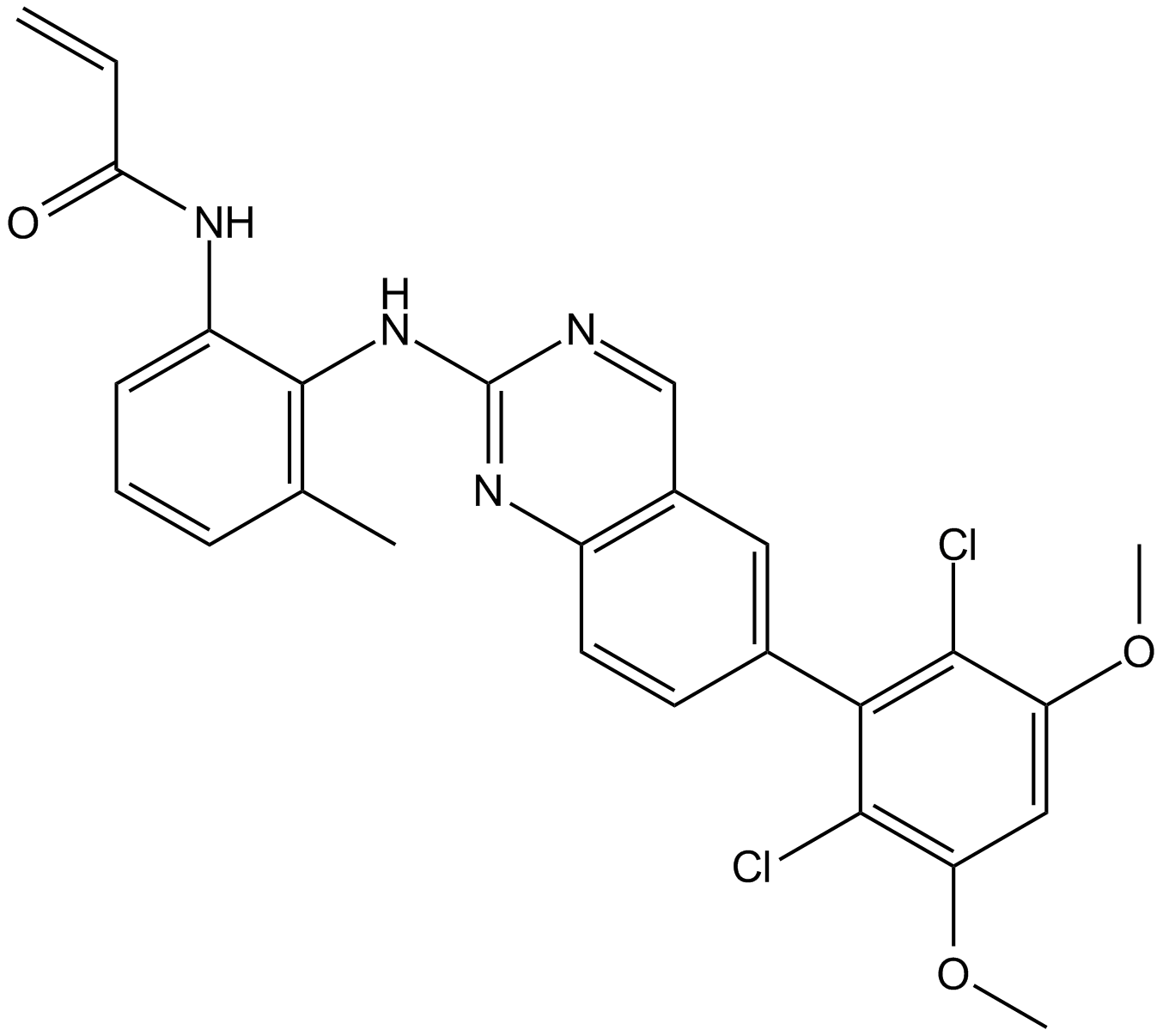
Cas No.: 1538604-68-0
Sample solution is provided at 25 µL, 10mM.
_1-3.$$$39978408@51.jpg');)
_1-9.$$$38538795@65.jpg');)
_1-9.$$$39112701@51.jpg');)
_1-7.$$$37316672@70.jpg');)
_366-372.$$$36198801@70.jpg');)
.$$$38565142@65.jpg');)
_1867-1883.$$$33248023@67.jpg');)
_eads6055.$$$39977546@45.jpg');)
_eadm9805.$$$40080571@45.jpg');)
_eadj3020.$$$39666821@45.jpg');)
_1-20.$$$39757301@28.jpg');)
_1-24.$$$38898113@28.jpg');)
_273-287.$$$36806353@46.jpg');)
_1-16.$$$37156877@44.jpg');)
_1-19.$$$37460805@44.jpg');)
_1291-1307.$$$34518654@46.jpg');)
BLU9931 is a potent and irreversible inhibitor of FGFR4. BLU9931 potently inhibited FGFR4 activity (IC50 = 3 nmol/L), but weakly inhibited FGFR1 (IC50 = 591 nmol/L), FGFR2 (IC50 = 493 nmol/L), and FGFR3 (IC50 = 150 nmol/L) activity.
Fibroblast growth factor receptor 4 (FGFR4) is the receptor of fibroblast growth factor 19 (FGF19), which is a tightly controlled hormone that regulates bile acid synthesis and hepatocyte proliferation in the normal liver. FGFR4 acts as a targeted therapy to treat patients with HCC whose tumors have an activated FGFR4 signaling pathway. BLU9931 is highly selective for FGFR4 versus other FGFR family members and all other kinases. BLU9931 binds within the ATP-binding pocket of FGFR4, forming a covalent bond with Cys552. The anilino-quinazoline core of BLU9931 makes a bidentate hydrogen-bonding interaction with the hinge residue (Ala553) of FGFR4, whereas the dichlorodimethoxyphenyl group occupies the hydrophobic pocket, providing FGFR-family selectivity. BLU9931 displayed significant binding to only two of the 398 wild-type kinases, FGFR4 (99.7% inhibition relative to DMSO control; Kd = 6 nmol/L) and CSF1R (90.1% inhibition relative to DMSO control; Kd = 2716 nmol/L) by KINOMEscan method. [2]
BLU9931 shows remarkable antitumor activity in mice bearing an HCC tumor xenograft that overexpresses FGF19 due to amplification as well as a liver tumor xenograft that overexpresses FGF19 mRNA but lacks FGF19 amplification.
References:
[1]. Hagel M, Miduturu C, Sheets M et al.First Selective Small Molecule Inhibitor of FGFR4 for the Treatment of Hepatocellular Carcinomas with an Activated FGFR4 Signaling Pathway. Cancer Discov. 2015 Mar 16. [Epub ahead of print]
[2]. Davis MI, Hunt JP, Herrgard S, Ciceri P, Wodicka LM, Pallares G, Hocker M, Treiber DK, Zarrinkar PP. Comprehensive analysis of kinase inhibitor selectivity. Nat Biotechnol. 2011 Oct 30;29(11):1046-51.
| Kinase experiment [1]: | |
|
FGFR1-4 biochemical assays |
FGFR kinase inhibition assays were performed at KM for ATP. Picomolar to low nanomolar concentrations of FGFR proteins were incubated in 1 × Kinase Reaction Buffer with 1 μM of CSKtide and 50 to 250 of μM ATP at 25 °C for 90 mins in the presence or absence of a dosed concentration series of inhibitor. All reactions were terminated by the addition of Stop Buffer, and plates were read on a Caliper EZReader2. IC50 values were fit with a four-parameter log[Inhibitor] versus response model with floating Hill Slope. |
| Cell experiment [1]: | |
|
Cell lines |
MDA-MB-453, DMS114 and Hep 3B cells |
|
Preparation method |
This compound is soluble in DMSO. General tips for obtaining a higher concentration: Please warm the tube at 37 °C for 10 minutes and/or shake it in the ultrasonic bath for a while. Stock solution can be stored below - 20 °C for several months. |
|
Reacting condition |
0.3 ~ 300 nM; 1 hr |
|
Applications |
In MDA-MB-453 cells, BLU9931 dose-dependently and effectively reduced phosphorylation of FGFR4 signaling pathway components, including FRS2, MAPK and AKT. In DMS114 cells, BLU9931 exhibited minimal reduction of phosphorylation in all FGFR1 signaling pathway components. In Hep 3B cells, BLU9931 also potently inhibited phosphorylation of the FGFR4 pathway components (except pAKT). |
| Animal experiment [1]: | |
|
Animal models |
Hep 3B tumor-bearing mice |
|
Dosage form |
10, 30 and 100 mg/kg; p.o.; b.i.d., for 21 days |
|
Applications |
BLU9931 dose-dependently inhibited the growth of Hep 3B tumors. At the dose of 100 mg/kg, BLU9931 resulted in tumor regression. Moreover, 2 of the 9 mice showed no signs of tumor 30 days after cessation of treatment. |
|
Other notes |
Please test the solubility of all compounds indoor, and the actual solubility may slightly differ with the theoretical value. This is caused by an experimental system error and it is normal. |
|
References: [1]. Hagel M, Miduturu C, Sheets M, Rubin N, Weng W, Stransky N, Bifulco N, Kim JL, Hodous B, Brooijmans N, Shutes A, Winter C, Lengauer C, Kohl NE, Guzi T. First Selective Small Molecule Inhibitor of FGFR4 for the Treatment of Hepatocellular Carcinomas with an Activated FGFR4 Signaling Pathway. Cancer Discov. 2015 Apr;5(4):424-37. | |
| Cas No. | 1538604-68-0 | SDF | |
| Chemical Name | N-(2-((6-(2,6-dichloro-3,5-dimethoxyphenyl)quinazolin-2-yl)amino)-3-methylphenyl)acrylamide | ||
| Canonical SMILES | ClC1=C(C2=CC(C=NC(NC(C(NC(C=C)=O)=CC=C3)=C3C)=N4)=C4C=C2)C(Cl)=C(OC)C=C1OC | ||
| Formula | C26H22Cl2N4O3 | M.Wt | 509.38 |
| Solubility | ≥ 50.9mg/mL in DMSO | Storage | Store at -20°C |
| General tips | Please select the appropriate solvent to prepare the stock solution according to the
solubility of the product in different solvents; once the solution is prepared, please store it in
separate packages to avoid product failure caused by repeated freezing and thawing.Storage method
and period of the stock solution: When stored at -80°C, please use it within 6 months; when stored
at -20°C, please use it within 1 month. To increase solubility, heat the tube to 37°C and then oscillate in an ultrasonic bath for some time. |
||
| Shipping Condition | Evaluation sample solution: shipped with blue ice. All other sizes available: with RT, or with Blue Ice upon request. | ||
| Prepare stock solution | |||

|
1 mg | 5 mg | 10 mg |
| 1 mM | 1.9632 mL | 9.8159 mL | 19.6317 mL |
| 5 mM | 392.6 μL | 1.9632 mL | 3.9263 mL |
| 10 mM | 196.3 μL | 981.6 μL | 1.9632 mL |
Step 1: Enter information below (Recommended: An additional animal making an allowance for loss during the experiment)
 g
μL
g
μL
Step 2: Enter the in vivo formulation (This is only the calculator, not formulation. Please contact us first if there is no in vivo formulation at the solubility Section.)
Calculation results:
Working concentration: mg/ml;
Method for preparing DMSO master liquid: mg drug pre-dissolved in μL DMSO ( Master liquid concentration mg/mL, Please contact us first if the concentration exceeds the DMSO solubility of the batch of drug. )
Method for preparing in vivo formulation: Take μL DMSO master liquid, next addμL PEG300, mix and clarify, next addμL Tween 80, mix and clarify, next add μL saline, mix and clarify.
Method for preparing in vivo formulation: Take μL DMSO master liquid, next add μL Corn oil, mix and clarify.
Note: 1. Please make sure the liquid is clear before adding the next solvent.
2. Be sure to add the solvent(s) in order. You must ensure that the solution obtained, in the previous addition, is a clear solution before proceeding to add the next solvent. Physical methods such as vortex, ultrasound or hot water bath can be used to aid dissolving.
3. All of the above co-solvents are available for purchase on the GlpBio website.
Quality Control & SDS
- View current batch:
- Purity: >99.50% Appearance: A solid
- COA (Certificate of Analysis)
- SDS (Safety Data Sheet)
- Datasheet
Average Rating: 5 (Based on Reviews and 38 reference(s) in Google Scholar.)