

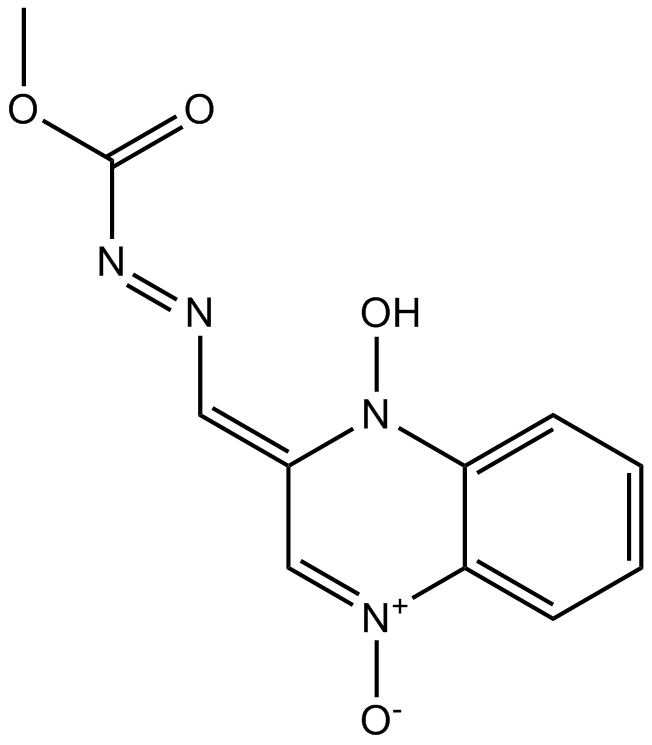
Carbadox |
Catalog No.GC16295
 One-Click Copy Product Info
|

antibiotic
Products are for research use only. Not for human use. We do not sell to patients.
Cas No.: 6804-07-5
Sample solution is provided at 25 µL, 10mM.
_1-3.$$$39978408@51.jpg');)
_1-9.$$$38538795@65.jpg');)
_1-9.$$$39112701@51.jpg');)
_1-7.$$$37316672@70.jpg');)
_366-372.$$$36198801@70.jpg');)
.$$$38565142@65.jpg');)
_1867-1883.$$$33248023@67.jpg');)
_eads6055.$$$39977546@45.jpg');)
_eadm9805.$$$40080571@45.jpg');)
_eadj3020.$$$39666821@45.jpg');)
_1-20.$$$39757301@28.jpg');)
_1-24.$$$38898113@28.jpg');)
_273-287.$$$36806353@46.jpg');)
_1-16.$$$37156877@44.jpg');)
_1-19.$$$37460805@44.jpg');)
_1291-1307.$$$34518654@46.jpg');)
Carbadox is a quinoxaline-di-N-oxide antibiotic compound which is widely fed to nursery-age pigs to control enteric diseases and improve feed efficiency.
The results of MTT assay demonstrate a dose-dependent decrease in mitochondrial activity in Vero cells at all concentrations of Carbadox. Treatment with Carbadox at the highest concentration of 160 μg/mL results in cell viability down to only 12%. Cells following Carbadox treatment show a dose-dependent increase of the DNA migration (p
Alpha diversities (Shannon diversity, Heips evenness, and inverse Simpson indices) of samples from medicated piglets compare to non-medicated piglets are significantly different at 2, 3, and 4 days after continuous Carbadox, but not different in either late Carbadox or at any time during the withdrawal period. Analysis of the community structure of bacteria in animals shows significant differences at days 3 and 4 of early Carbadox treatment ([R=0.32, p=0.015] and [R=0.54, p=0.003], respectively), but not before starting antibiotic treatment (p=0.82). No significant differences in E. coli colony forming units (CFUs) are observed during the Carbadox-treatment period of the study or late in the withdrawal period. E. coli CFUs are significantly different between the medicated and non-medicated groups on day 2 after the withdrawal of Carbadox[2].
References:
[1]. Chen Q, et al. Investigation of the genotoxicity of quinocetone, carbadox and olaquindox in vitro using Vero cells. Food Chem Toxicol. 2009 Feb;47(2):328-34.
[2]. Looft T, et al. Carbadox has both temporary and lasting effects on the swine gut microbiota. Front Microbiol. 2014 Jun 10;5:276.
Cell experiment: | Exponentially growing Vero cells are seeded at 104 cells/well density in 96 microplates and exposed to various concentrations of Carbadox (5, 10, 20, 40, 80, 160, 210, 260, 310 and 360 μg/mL). Cells incubated with the same concentration DMSO are used as a control. After 4 h or 24 h, each well is added 100 μL MTT solution (200 μg/mL) followed incubation for 4 h at 37 °C, and the medium containing MTT is removed. The formazan crystals in the viable cells are solubilized with 100 μL DMSO and the absorbance at 570 nm of each well is read using a microplate reader. All experiments are performed at least 3 times, with 6 wells for each concentration of Carbadox (n=6 per experiment). Final results are the average of three independent experiments. The cell viability is calculated as follows: OD of experimental group/(OD of control group-OD of blank group)×100%. The data are presented as means±SE[1]. |
Animal experiment: | At 3 weeks of age, 12 piglets from 2 litters are divided into two rooms of six pigs each, with equal representation of littermates and gender. All pigs are fed a standard starter diet ad libitum for 3 weeks, after which six control pigs continue to receive non-medicated feed while the other group receives feed containing Carbadox (50 g/ton). After 21 days of continuous feed with or without Carbadox, all pigs (60 days old) are switched to a non-medicated maintenance diet. Feces are collected from each pig at multiple times before, during, and after antibiotic withdrawal[2]. |
References: [1]. Chen Q, et al. Investigation of the genotoxicity of quinocetone, carbadox and olaquindox in vitro using Vero cells. Food Chem Toxicol. 2009 Feb;47(2):328-34. | |
| Cas No. | 6804-07-5 | SDF | |
| Chemical Name | methyl N-[(E)-(1-hydroxy-4-oxidoquinoxalin-4-ium-2-ylidene)methyl]iminocarbamate | ||
| Canonical SMILES | COC(=O)N=NC=C1C=[N+](C2=CC=CC=C2N1O)[O-] | ||
| Formula | C11H10N4O4 | M.Wt | 262.22 |
| Solubility | 1 M NaOH: 50 mg/ml,Water: slightly | Storage | Store at -20°C |
| General tips | Please select the appropriate solvent to prepare the stock solution according to the
solubility of the product in different solvents; once the solution is prepared, please store it in
separate packages to avoid product failure caused by repeated freezing and thawing.Storage method
and period of the stock solution: When stored at -80°C, please use it within 6 months; when stored
at -20°C, please use it within 1 month. To increase solubility, heat the tube to 37°C and then oscillate in an ultrasonic bath for some time. |
||
| Shipping Condition | Evaluation sample solution: shipped with blue ice. All other sizes available: with RT, or with Blue Ice upon request. | ||
| Prepare stock solution | |||

|
1 mg | 5 mg | 10 mg |
| 1 mM | 3.8136 mL | 19.068 mL | 38.1359 mL |
| 5 mM | 762.7 μL | 3.8136 mL | 7.6272 mL |
| 10 mM | 381.4 μL | 1.9068 mL | 3.8136 mL |
Step 1: Enter information below (Recommended: An additional animal making an allowance for loss during the experiment)
 g
μL
g
μL
Step 2: Enter the in vivo formulation (This is only the calculator, not formulation. Please contact us first if there is no in vivo formulation at the solubility Section.)
Calculation results:
Working concentration: mg/ml;
Method for preparing DMSO master liquid: mg drug pre-dissolved in μL DMSO ( Master liquid concentration mg/mL, Please contact us first if the concentration exceeds the DMSO solubility of the batch of drug. )
Method for preparing in vivo formulation: Take μL DMSO master liquid, next addμL PEG300, mix and clarify, next addμL Tween 80, mix and clarify, next add μL saline, mix and clarify.
Method for preparing in vivo formulation: Take μL DMSO master liquid, next add μL Corn oil, mix and clarify.
Note: 1. Please make sure the liquid is clear before adding the next solvent.
2. Be sure to add the solvent(s) in order. You must ensure that the solution obtained, in the previous addition, is a clear solution before proceeding to add the next solvent. Physical methods such as vortex, ultrasound or hot water bath can be used to aid dissolving.
3. All of the above co-solvents are available for purchase on the GlpBio website.
Quality Control & SDS
- View current batch:
- Purity: >98.00% Appearance: A solid
- COA (Certificate of Analysis)
- SDS (Safety Data Sheet)
- Datasheet
Average Rating: 5 (Based on Reviews and 6 reference(s) in Google Scholar.)