

SU5416 (Synonyms: NSC 696819, Semaxinib, Sugen 5416, VEGFR 2 Kinase Inhibitor) |
Catalog No.GC15307
 One-Click Copy Product Info
|

SU5416 is a small-molecule Flk-1/KDR inhibitor that inhibits autophosphorylation of the Flk-1 receptor, with an IC50 value of 1.23μM.
Products are for research use only. Not for human use. We do not sell to patients.
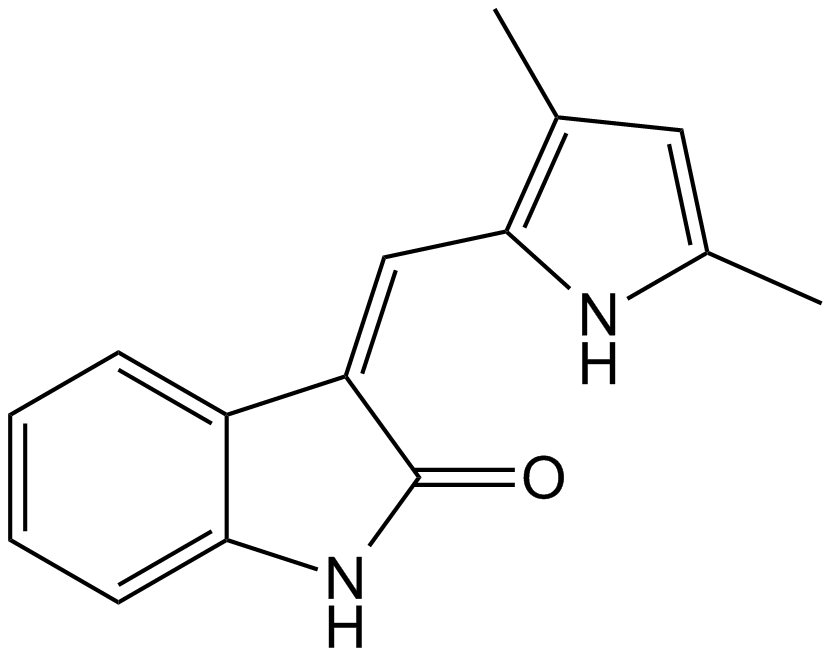
Cas No.: 204005-46-9,194413-58-6
Sample solution is provided at 25 µL, 10mM.
SU5416 is a small-molecule Flk-1/KDR inhibitor that inhibits autophosphorylation of the Flk-1 receptor, with an IC50 value of 1.23μM[1]. SU5416 acts selectively as a competitive inhibitor, binding to the ATP catalytic site, within the kinase domain of the receptor, which induces a blockade of VEGFR2 signaling, inhibiting the VEGF-dependent proliferation of endothelial cells[2]. SU5416 has been widely used to induce apoptosis of pulmonary artery endothelial cells (PAECs) and to induce vascular occlusive pulmonary hypertension in rats[3].
In vitro, SU5416 treatment for 48 hours significantly inhibited the viability of B16-F10 cells and MCF-7 cells, with IC50 values of 3.6nM and 3.1nM, respectively[4]. 5μM SU5416 treatment for 24 hours significantly increased the expression of endoglin in human umbilical vein endothelial cells (HUVECs)[5]. Treatment with 2μM SU5416 for 24 hours significantly inhibited the invasion of HepG2 cells stimulated by 20ng/ml hepatocyte growth factor (HGF) and reduced Met tyrosine phosphorylation[6].
In vivo, SU5416 treatment via intraperitoneal injection at a dose of 50mg/kg, twice a week for 2 weeks, significantly alleviated bleomycin-induced pulmonary fibrosis in mice and inhibited the activation of the TGF-β1/Smad3 signaling pathway[7]. Intraperitoneal injection of SU5416 at a dose of 15mg/kg/day for 7 weeks significantly inhibited the tumor volume growth and liver metastasis in the SGC-7901 xenograft mouse model[8].
References:
[1] Fong T A T, Shawver L K, Sun L, et al. SU5416 is a potent and selective inhibitor of the vascular endothelial growth factor receptor (Flk-1/KDR) that inhibits tyrosine kinase catalysis, tumor vascularization, and growth of multiple tumor types[J]. Cancer research, 1999, 59(1): 99-106.
[2] López R G, Del Castillo D A C C, Magana G V, et al. Expression and localization of vascular endothelial growth factor and its receptors in the pig uterus during peri-implantation and determination of the in vitro effect of the angiogenesis inhibitor SU5416 on VEGF system expression[J]. Theriogenology, 2023, 207: 49-60.
[3] Strielkov I, Weissmann N. Role of the aryl hydrocarbon receptor in Su5416/hypoxia-induced pulmonary hypertension: a new mechanism for an “Old” model[J]. American Journal of Respiratory Cell and Molecular Biology, 2018, 58(3): 279-281.
[4] Wang Z C, Qin Y J, Wang P F, et al. Sulfonamides containing coumarin moieties selectively and potently inhibit carbonic anhydrases II and IX: design, synthesis, inhibitory activity and 3D-QSAR analysis[J]. European journal of medicinal chemistry, 2013, 66: 1-11.
[5] Chen C Y, Lin Y J, Wang C C N, et al. Epigallocatechin-3-gallate inhibits tumor angiogenesis: involvement of endoglin/Smad1 signaling in human umbilical vein endothelium cells[J]. Biomedicine & Pharmacotherapy, 2019, 120: 109491.
[6] Wang S Y, Chen B, Zhan Y Q, et al. SU5416 is a potent inhibitor of hepatocyte growth factor receptor (c-Met) and blocks HGF-induced invasiveness of human HepG2 hepatoma cells[J]. Journal of hepatology, 2004, 41(2): 267-273.
[7] Ou X M, Li W C, Liu D S, et al. VEGFR-2 antagonist SU5416 attenuates bleomycin-induced pulmonary fibrosis in mice[J]. International immunopharmacology, 2009, 9(1): 70-79.
[8] ZHANG G F, WANG Y H, Wang Q, et al. Effect of SU5416 on the inhibition of growth and metastasis of human gastric cancer implanted in nude mice[J]. Chinese Journal of Digestive Diseases, 2003, 4(2): 60-63.
| Cell experiment [1]: | |
|
Cell lines |
B16-F10 cells |
|
Preparation Method |
B16-F10 cells were cultured in DMEM medium supplemented with 10% fetal bovine serum (FBS), and 1% penicillin-streptomycin at 37°C in 5% CO2/atmosphere. B16-F10 cells cultured were seeded onto 96-well microplates (5×10³ cells/well) and cultured for 24h. Cells were treated with SU5416 at increasing concentrations (0, 0.01, 0.1, 1, 10, 100, and 1000nM) in the presence of 10% FBS for 48h, cell viability was assessed. |
|
Reaction Conditions |
0, 0.01, 0.1, 1, 10, 100, and 1000nM; 48h |
|
Applications |
SU5416 treatment reduced the cell viability of B16-F10 cells in a dose-dependent manner. |
| Animal experiment [2]: | |
|
Animal models |
Male BALB/c nu/nu nude mice |
|
Preparation Method |
Male BALB/c nu/nu nude mice (4 weeks old; 18-22g) were housed under controlled temperature (21-23°C), humidity (30-35%) and light cycle (7:00 AM to 7:00 PM) and maintained on a standard rodent diet. The mice received a subcutaneous injection of 2×10⁶ SGC-7901 cells in 0.1ml of saline. One week after implantation, the four groups were given four different solutions intraperitoneally: saline solution (control group), and SU5416 (15mg/kg/day). Treatment was continued for 7 weeks. The mice were killed at 8 weeks after tumor implantation and the tumors were removed for analysis. |
|
Dosage form |
15mg/kg/day; 7 weeks; i.p. |
|
Applications |
SU5416 treatment significantly inhibited tumor growth in mice with SGC-7901 xenografts. |
References: [1] Wang Z C, Qin Y J, Wang P F, et al. Sulfonamides containing coumarin moieties selectively and potently inhibit carbonic anhydrases II and IX: design, synthesis, inhibitory activity and 3D-QSAR analysis[J]. European journal of medicinal chemistry, 2013, 66: 1-11. [2] ZHANG G F, WANG Y H, Wang Q, et al. Effect of SU5416 on the inhibition of growth and metastasis of human gastric cancer implanted in nude mice[J]. Chinese Journal of Digestive Diseases, 2003, 4(2): 60-63. | |
| Cas No. | 204005-46-9,194413-58-6 | SDF | |
| Synonyms | NSC 696819, Semaxinib, Sugen 5416, VEGFR 2 Kinase Inhibitor | ||
| Chemical Name | (3Z)-3-[(3,5-dimethyl-1H-pyrrol-2-yl)methylidene]-1H-indol-2-one | ||
| Canonical SMILES | CC1=CC(=C(N1)C=C2C3=CC=CC=C3NC2=O)C | ||
| Formula | C15H14N2O | M.Wt | 238.28 |
| Solubility | ≥ 11.9 mg/mL in DMSO | Storage | Desiccate at -20°C |
| General tips | Please select the appropriate solvent to prepare the stock solution according to the
solubility of the product in different solvents; once the solution is prepared, please store it in
separate packages to avoid product failure caused by repeated freezing and thawing.Storage method
and period of the stock solution: When stored at -80°C, please use it within 6 months; when stored
at -20°C, please use it within 1 month. To increase solubility, heat the tube to 37°C and then oscillate in an ultrasonic bath for some time. |
||
| Shipping Condition | Evaluation sample solution: shipped with blue ice. All other sizes available: with RT, or with Blue Ice upon request. | ||
| Prepare stock solution | |||

|
1 mg | 5 mg | 10 mg |
| 1 mM | 4.1967 mL | 20.9837 mL | 41.9674 mL |
| 5 mM | 839.3 μL | 4.1967 mL | 8.3935 mL |
| 10 mM | 419.7 μL | 2.0984 mL | 4.1967 mL |
Step 1: Enter information below (Recommended: An additional animal making an allowance for loss during the experiment)
 g
μL
g
μL
Step 2: Enter the in vivo formulation (This is only the calculator, not formulation. Please contact us first if there is no in vivo formulation at the solubility Section.)
Calculation results:
Working concentration: mg/ml;
Method for preparing DMSO master liquid: mg drug pre-dissolved in μL DMSO ( Master liquid concentration mg/mL, Please contact us first if the concentration exceeds the DMSO solubility of the batch of drug. )
Method for preparing in vivo formulation: Take μL DMSO master liquid, next addμL PEG300, mix and clarify, next addμL Tween 80, mix and clarify, next add μL saline, mix and clarify.
Method for preparing in vivo formulation: Take μL DMSO master liquid, next add μL Corn oil, mix and clarify.
Note: 1. Please make sure the liquid is clear before adding the next solvent.
2. Be sure to add the solvent(s) in order. You must ensure that the solution obtained, in the previous addition, is a clear solution before proceeding to add the next solvent. Physical methods such as vortex, ultrasound or hot water bath can be used to aid dissolving.
3. All of the above co-solvents are available for purchase on the GlpBio website.
Quality Control & SDS
- View current batch:
- Purity: >98.00% Appearance: A solid
- COA (Certificate of Analysis)
- SDS (Safety Data Sheet)
- Datasheet
-
Related Biological Data

Catalpol protected NSCs against OGD through the VEGF-A/KDR pathway. b The results of MAP-2 and BrdU co-labeling showed the proliferation and diferentiation of NSCs in each group, scar bar=200μm. The statistical results of MAP2-positive cells.
Rats in the group of catalpol+SU5416 were injected with SU5416 (10mg/kg) (GlpBio, USA) from day 3 after dMCAO.
Molecular Neurobiology, 2023: 1-21. PMID: 37439957 IF: 5.1 -
Related Biological Data

Microvascular proliferation and, thereby, NVU remodeling after DFO intervention. (A–D, A1-D1) Semiquantitative analysis of LEA staining and CD31 (indicated by an arrow) revealed that SU5416 intervention inhibited endothelial cell proliferation, while DFO intervention promoted it (indicated by an arrow).
Each rat (AS group) was injected with (i.p.) the drug (15mg/kg, SU5416(GlpBio, USA) was dissolved in dimethylsulphoxide, DMSO) once a day.
Frontiers in Neuroscience 18 (2024): 1254600. PMID: 38510463 IF: 4.2997 -
Related Biological Data

Expression levels of STING in rats with Su/Hy-induced PAH. (H) Representative immunohistochemistry of STING expression in lung tissue after C-176 intervention.
Rats were given a solitary subcutaneous injection of Su5416 (20mg/kg; GLPBIO, Montclair, CA, USA) and then placed in a hypoxic chamber.
Immunobiology (2023): 152345. PMID: 36780836 IF: 3.152
Average Rating: 5 (Based on Reviews and 30 reference(s) in Google Scholar.)