

Carbidopa |
Catalog No.GC12225
 One-Click Copy Product Info
|

Carbidopa is an aryl hydrocarbon receptor (AhR) agonist that inhibits pancreatic cancer cell and tumor growth.
Products are for research use only. Not for human use. We do not sell to patients.
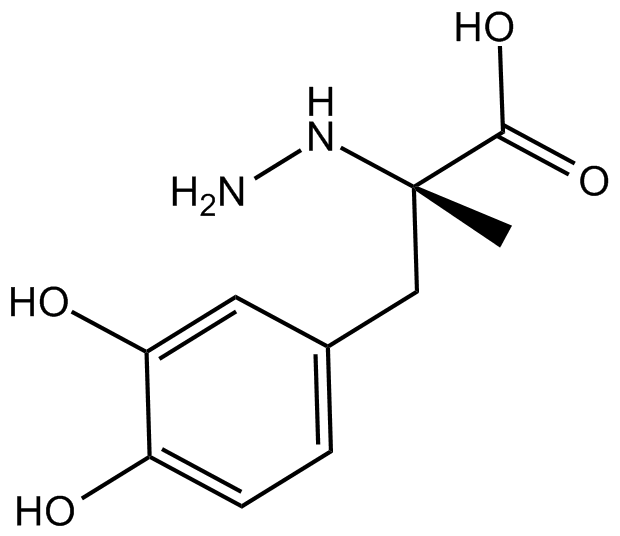
Cas No.: 28860-95-9
Sample solution is provided at 25 µL, 10mM.
_1-3.$$$39978408@51.jpg');)
_1-9.$$$38538795@65.jpg');)
_1-9.$$$39112701@51.jpg');)
_1-7.$$$37316672@70.jpg');)
_366-372.$$$36198801@70.jpg');)
.$$$38565142@65.jpg');)
_1867-1883.$$$33248023@67.jpg');)
_eads6055.$$$39977546@45.jpg');)
_eadm9805.$$$40080571@45.jpg');)
_eadj3020.$$$39666821@45.jpg');)
_1-20.$$$39757301@28.jpg');)
_1-24.$$$38898113@28.jpg');)
_273-287.$$$36806353@46.jpg');)
_1-16.$$$37156877@44.jpg');)
_1-19.$$$37460805@44.jpg');)
_1291-1307.$$$34518654@46.jpg');)
Carbidopa is an aryl hydrocarbon receptor (AhR) agonist that inhibits pancreatic cancer cell and tumor growth [1]. Carbidopa can block the conversion of levodopa to dopamine in the periphery, enabling greater availability of dopamine to the central nervous system as well as minimizing the peripheral side effects of dopamine [2]. Carbidopa has been widely used to improve neurodegenerative diseases and promote the proteasomal degradation of androgen receptor (AR) protein[3].
In vitro, Carbidopa treatment for 72 hours significantly reduced the viability of NCI-H146, NCI-H209 and NCI-H727 cells, with IC50 values of 12, 22 and 29μM, respectively[4]. Treatment with 1mM Carbidopa for 24 hours significantly reduced the expression of IDO1 mRNA and IDO1 protein in BxPC-3 cells[5]. Treatment with 300μM Carbidopa for 24 hours significantly reduced the mitochondrial membrane potential of MDA-MB-231 cells, leading to mitochondrial dysfunction and cell damage[6].
In vivo, Carbidopa treatment via intraperitoneal injection at a dose of 7.5mg/kg), twice a day for 14 days, significantly inhibited tumor growth in a MCF7 cell-xenograft mouse model, and led to an increase in CYP1A1 protein and a decrease in ERα protein in the tumor tissue[7]. Daily intraperitoneal injection of Carbidopa (25mg/kg) was administered for 11 weeks, which significantly inhibited tumor growth in a xenograft mouse model of LNCaP cells and suppressed the production of serum prostate-specific antigen (PSA)[8].
References:
[1] Safe S. Carbidopa: a selective Ah receptor modulator (SAhRM)[J]. Biochemical Journal, 2017, 474(22): 3763-3765.
[2] Lenka A, Vernino S. Carbidopa: beyond Parkinson’s disease[J]. Clinical Autonomic Research, 2025, 35(3): 347-352.
[3] Chen Z, Cai A, Zheng H, et al. Carbidopa suppresses prostate cancer via aryl hydrocarbon receptor-mediated ubiquitination and degradation of androgen receptor[J]. Oncogenesis, 2020, 9(5): 49.
[4] Gilbert J A, Frederick L M, Pobst L J, et al. Hydrogen peroxide degradation and selective carbidopa-induced cytotoxicity against human tumor lines[J]. Biochemical pharmacology, 2005, 69(8): 1159-1166.
[5] Korac K, Rajasekaran D, Sniegowski T, et al. Carbidopa, an activator of aryl hydrocarbon receptor, suppresses IDO1 expression in pancreatic cancer and decreases tumor growth[J]. Biochemical Journal, 2022, 479(17): 1807-1824.
[6] Actis Dato A B, Naso L G, Martínez V R, et al. Carbidopa and ZnCarbidopa Induce Reductive Stress in MDA‐MB‐231 Cells[J]. ChemPlusChem, 2025, 90(3): e202400596.
[7] Chen Z, Xia X, Chen H, et al. Carbidopa suppresses estrogen receptor-positive breast cancer via AhR-mediated proteasomal degradation of ERα[J]. Investigational New Drugs, 2022, 40(6): 1216-1230.
[8] Wafa L A, Cheng H, Plaa N, et al. Carbidopa abrogates L‐dopa decarboxylase coactivation of the androgen receptor and delays prostate tumor progression[J]. International journal of cancer, 2012, 130(12): 2835-2844.
| Cell experiment [1]: | |
Cell lines | NCI-H146 cells |
Preparation Method | NCI-H146 cells (50,000) were seeded in 60mm plates in 3ml growth medium supplemented with 10% qualified, heat-inactivated FBS and 50units/ml of penicillin and streptomycin. Following incubation overnight, different concentrations of Carbidopa (0, 0.1, 1, 10, and 100μM) were added to the plate of a suspension cell line or to 3ml of fresh media for a monolayer cell for 72h and cell viability was measured. |
Reaction Conditions | 0, 0.1, 1, 10, and 100μM; 72h |
Applications | Carbidopa treatment significantly inhibited the cell viability of NCI-H146 cells in a concentration-dependent manner. |
| Animal experiment [2]: | |
Animal models | BALB/c nude mice |
Preparation Method | BALB/c nude mice were housed in temperature (23±2°C) and light-controlled (12:12-hour light-dark cycle) animal care facility with food and tap water ad libitum. The rats were provided with standard rat chow and water. MCF7 cells were subcutaneously injected into the right flank of each mouse (0.1ml; 1×10⁶ cells per mouse). When tumors reached a volume of 100mm3, mice were randomized into control and treatment groups (6 mice per group); no specific criteria or method was used for randomization. The treatment group received intraperitoneal (i.p.) injection of Carbidopa (7.5mg/kg) and the control group the same amount of vehicle twice a day, every 12h. The treatment continued for 14 days continuously. The body weight and tumor volume were recorded every two days throughout the procedure. |
Dosage form | 7.5mg/kg; twice a day for 14 days; i.p. |
Applications | Carbidopa treatment inhibited tumor growth in a MCF7 cell-xenograft mouse model without affecting body weight. |
References: | |
| Cas No. | 28860-95-9 | SDF | |
| Chemical Name | (2S)-3-(3,4-dihydroxyphenyl)-2-hydrazinyl-2-methylpropanoic acid | ||
| Canonical SMILES | CC(CC1=CC(=C(C=C1)O)O)(C(=O)O)NN | ||
| Formula | C10H14N2O4 | M.Wt | 226.23 |
| Solubility | ≥ 6.9mg/mL in DMSO with gentle warming | Storage | Store at -20°C |
| General tips | Please select the appropriate solvent to prepare the stock solution according to the
solubility of the product in different solvents; once the solution is prepared, please store it in
separate packages to avoid product failure caused by repeated freezing and thawing.Storage method
and period of the stock solution: When stored at -80°C, please use it within 6 months; when stored
at -20°C, please use it within 1 month. To increase solubility, heat the tube to 37°C and then oscillate in an ultrasonic bath for some time. |
||
| Shipping Condition | Evaluation sample solution: shipped with blue ice. All other sizes available: with RT, or with Blue Ice upon request. | ||
| Prepare stock solution | |||

|
1 mg | 5 mg | 10 mg |
| 1 mM | 4.4203 mL | 22.1014 mL | 44.2028 mL |
| 5 mM | 884.1 μL | 4.4203 mL | 8.8406 mL |
| 10 mM | 442 μL | 2.2101 mL | 4.4203 mL |
Step 1: Enter information below (Recommended: An additional animal making an allowance for loss during the experiment)
 g
μL
g
μL
Step 2: Enter the in vivo formulation (This is only the calculator, not formulation. Please contact us first if there is no in vivo formulation at the solubility Section.)
Calculation results:
Working concentration: mg/ml;
Method for preparing DMSO master liquid: mg drug pre-dissolved in μL DMSO ( Master liquid concentration mg/mL, Please contact us first if the concentration exceeds the DMSO solubility of the batch of drug. )
Method for preparing in vivo formulation: Take μL DMSO master liquid, next addμL PEG300, mix and clarify, next addμL Tween 80, mix and clarify, next add μL saline, mix and clarify.
Method for preparing in vivo formulation: Take μL DMSO master liquid, next add μL Corn oil, mix and clarify.
Note: 1. Please make sure the liquid is clear before adding the next solvent.
2. Be sure to add the solvent(s) in order. You must ensure that the solution obtained, in the previous addition, is a clear solution before proceeding to add the next solvent. Physical methods such as vortex, ultrasound or hot water bath can be used to aid dissolving.
3. All of the above co-solvents are available for purchase on the GlpBio website.
Quality Control & SDS
- View current batch:
- Purity: >99.00% Appearance: A solid
- COA (Certificate of Analysis)
- SDS (Safety Data Sheet)
- Datasheet
Average Rating: 5 (Based on Reviews and 7 reference(s) in Google Scholar.)