

Cholestenone (Synonyms: 4-Cholesten-3-one, Δ4-Cholestenone, NSC 63000, NSC 134926) |
Catalog No.GC31590
 One-Click Copy Product Info
|

Cholestenone is an orally active intermediate oxidation product of cholesterol that is mainly metabolized in the liver.
Products are for research use only. Not for human use. We do not sell to patients.
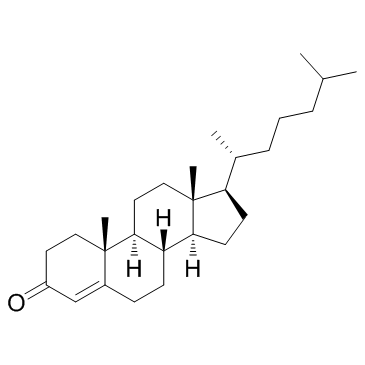
Cas No.: 601-57-0
Sample solution is provided at 25 µL, 10mM.
_1-3.$$$39978408@51.jpg');)
_1-9.$$$38538795@65.jpg');)
_1-9.$$$39112701@51.jpg');)
_1-7.$$$37316672@70.jpg');)
_366-372.$$$36198801@70.jpg');)
.$$$38565142@65.jpg');)
_1867-1883.$$$33248023@67.jpg');)
_eads6055.$$$39977546@45.jpg');)
_eadm9805.$$$40080571@45.jpg');)
_eadj3020.$$$39666821@45.jpg');)
_1-20.$$$39757301@28.jpg');)
_1-24.$$$38898113@28.jpg');)
_273-287.$$$36806353@46.jpg');)
_1-16.$$$37156877@44.jpg');)
_1-19.$$$37460805@44.jpg');)
_1291-1307.$$$34518654@46.jpg');)
Cholestenone is an orally active intermediate oxidation product of cholesterol that is mainly metabolized in the liver[1]. Cholestenone exhibits high mobility in cell membranes, can affect cholesterol turnover and efflux processes, and can participate in cholesterol metabolism, bile acid synthesis, and lipid signaling regulation[2]. Cholestenone is commonly used in research related to lipid metabolism, steroidal signaling pathways, and cell membrane dynamics[3,4].
In vitro, treatment of Helicobacter pylori ATCC 43504 with Cholestenone (150μM) for 2 days significantly inhibited the biosynthesis of the cell wall glycolipid CGL and its derivatives CAG and CPG[5]. Treatment of A549 and SPC-A-1 cells with Cholestenone (25-400μM) for 24h dose-dependently reduced cell viability[6].
In vivo, db/db mice fed a diet containing 0.25% Cholestenone for 4 weeks showed significantly reduced plasma triglyceride levels and significantly increased fecal free fatty acid content[7]. Male CDF1 mice fed diets containing 0.1%, 0.3%, and 0.5% Cholestenone for 5 months showed dose-dependent increases in the degree of body weight suppression[8].
References:[1] Neuvonen M, Manna M, Mokkila S, et al. Enzymatic oxidation of cholesterol: properties and functional effects of cholestenone in cell membranes[J]. PLoS One, 2014, 9(8): e103743.
[2] Xu F, Rychnovsky S D, Belani J D, et al. Dual roles for cholesterol in mammalian cells[J]. Proceedings of the National Academy of Sciences, 2005, 102(41): 14551-14556.
[3] Tomkins G M, Nichols Jr C W, Chapman D D, et al. Use of Δ4-cholestenone to reduce the level of serum cholesterol in man[J]. Science, 1957, 125(3254): 936-937.
[4] Roth A T, Philips J A, Chandra P. The role of cholesterol and its oxidation products in tuberculosis pathogenesis[J]. Immunometabolism (Cobham, Surrey), 2024, 6(2): e00042.
[5] Kobayashi J, Kawakubo M, Fujii C, et al. Cholestenone functions as an antibiotic against Helicobacter pylori by inhibiting biosynthesis of the cell wall component CGL[J]. Proceedings of the National Academy of Sciences, 2021, 118(16): e2016469118.
[6] Ma J, Fu G, Wu J, et al. 4-cholesten-3-one suppresses lung adenocarcinoma metastasis by regulating translocation of HMGB1, HIF1α and Caveolin-1[J]. Cell death & disease, 2016, 7(9): e2372-e2372.
[7] Higuchi M, Okumura M, Mitsuta S, et al. Dietary Cholest-4-en-3-one, a cholesterol metabolite of gut microbiota, alleviates hyperlipidemia, hepatic cholesterol accumulation, and hyperinsulinemia in obese, diabetic db/db mice[J]. Metabolites, 2024, 14(6): 321.
[8] SUZUKI K. Anti-obesity effect of cholest-4-en-3-one, an intestinal catabolite of cholesterol, on mice[J]. Journal of nutritional science and vitaminology, 1993, 39(5): 537-543.
| Cell experiment [1]: | |
|
Cell lines |
A549 and SPC-A-1 cells |
|
Preparation Method |
A549 and SPC-A-1 cells were serum-starved for 4h and treated with 10-400μM Cholestenone for 24h, then cell viability was assessed using the CCK-8 assay. |
|
Reaction Conditions |
10, 25, 50, 100, 200, and 400μM; 24h |
|
Applications |
Cholestenone treatment for 24h reduced cell viabilities in a dose-dependent manner. Cholestenone did not depress viabilities of A549 and SPC-A-1 cells at the concentration of 10μM but strikingly inhibited cell growth at the concentration of 25μM up to 400μM. |
| Animal experiment [2]: | |
|
Animal models |
db/db mice |
|
Preparation Method |
db/db mice were fed a 0.25% Cholestenone-supplemented diet for 4 weeks, then plasma triglyceride levels were measured using the Triglyceride E-test kit, and fecal free fatty acid contents were measured using the NEFA C-test kit. |
|
Dosage form |
0.25% Cholestenone-supplemented diet (2.5g/kg diet); p.o. (free access to diet) |
|
Applications |
Dietary Cholestenone significantly decreased plasma triglyceride levels, and fecal free fatty acid contents were markedly increased in Cholestenone-fed mice. |
| References: [1] Ma J, Fu G, Wu J, et al. 4-cholesten-3-one suppresses lung adenocarcinoma metastasis by regulating translocation of HMGB1, HIF1α and Caveolin-1[J]. Cell death & disease, 2016, 7(9): e2372-e2372. [2] Higuchi M, Okumura M, Mitsuta S, et al. Dietary Cholest-4-en-3-one, a cholesterol metabolite of gut microbiota, alleviates hyperlipidemia, hepatic cholesterol accumulation, and hyperinsulinemia in obese, diabetic db/db mice[J]. Metabolites, 2024, 14(6): 321. | |
| Cas No. | 601-57-0 | SDF | |
| Synonyms | 4-Cholesten-3-one, Δ4-Cholestenone, NSC 63000, NSC 134926 | ||
| Canonical SMILES | CC(C)CCC[C@@H](C)[C@H]1CC[C@@]2([H])[C@]3([H])CCC4=CC(CC[C@]4(C)[C@@]3([H])CC[C@]12C)=O | ||
| Formula | C27H44O | M.Wt | 384.64 |
| Solubility | DMF: 0.1 mg/ml,Ethanol: 2 mg/ml | Storage | Store at -20°C |
| Shipping Condition | Evaluation sample solution: shipped with blue ice. All other sizes available: with RT, or with Blue Ice upon request. | ||
| Prepare stock solution | |||

|
1 mg | 5 mg | 10 mg |
| 1 mM | 2.5998 mL | 12.9992 mL | 25.9983 mL |
| 5 mM | 520 μL | 2.5998 mL | 5.1997 mL |
| 10 mM | 260 μL | 1.2999 mL | 2.5998 mL |
Step 1: Enter information below (Recommended: An additional animal making an allowance for loss during the experiment)
 g
μL
g
μL
Step 2: Enter the in vivo formulation (This is only the calculator, not formulation. Please contact us first if there is no in vivo formulation at the solubility Section.)
Calculation results:
Working concentration: mg/ml;
Method for preparing DMSO master liquid: mg drug pre-dissolved in μL DMSO ( Master liquid concentration mg/mL, Please contact us first if the concentration exceeds the DMSO solubility of the batch of drug. )
Method for preparing in vivo formulation: Take μL DMSO master liquid, next addμL PEG300, mix and clarify, next addμL Tween 80, mix and clarify, next add μL saline, mix and clarify.
Method for preparing in vivo formulation: Take μL DMSO master liquid, next add μL Corn oil, mix and clarify.
Note: 1. Please make sure the liquid is clear before adding the next solvent.
2. Be sure to add the solvent(s) in order. You must ensure that the solution obtained, in the previous addition, is a clear solution before proceeding to add the next solvent. Physical methods such as vortex, ultrasound or hot water bath can be used to aid dissolving.
3. All of the above co-solvents are available for purchase on the GlpBio website.
Quality Control & SDS
- View current batch:
- Purity: >98.00% Appearance: A solid
- COA (Certificate of Analysis)
- SDS (Safety Data Sheet)
- Datasheet
Average Rating: 5 (Based on Reviews and 36 reference(s) in Google Scholar.)