

BH3I-1 (Synonyms: BHI1; BH 3I1) |
Catalog No.GC18136
 One-Click Copy Product Info
|

Bcl-2 or Bcl-XL inhibitor
Products are for research use only. Not for human use. We do not sell to patients.
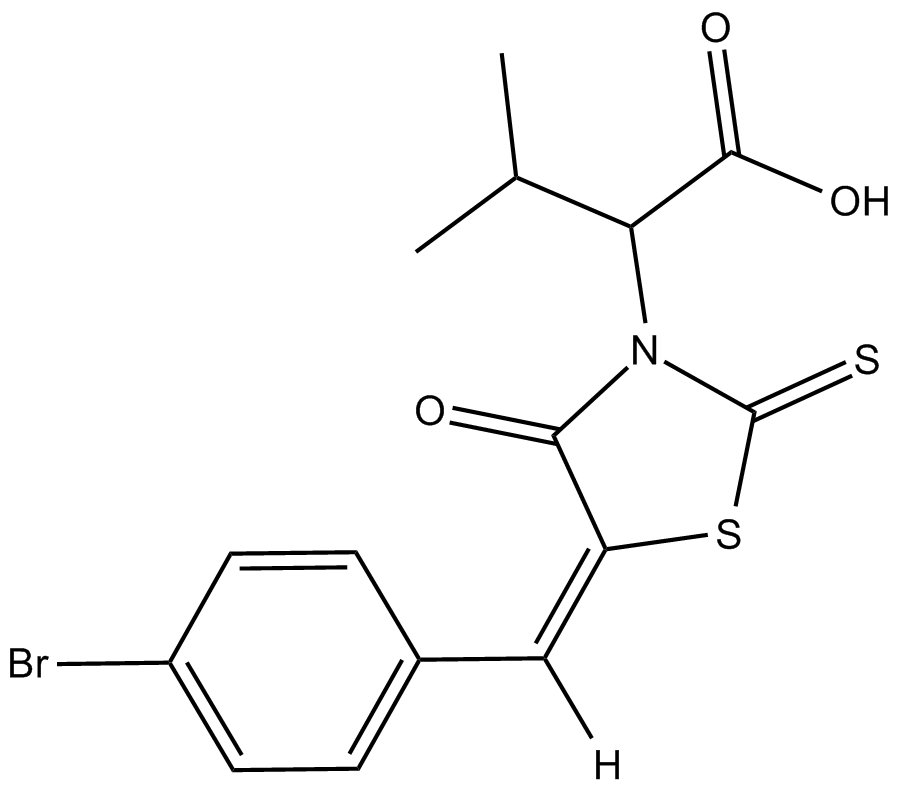
Cas No.: 300817-68-9
Sample solution is provided at 25 µL, 10mM.
_1-3.$$$39978408@51.jpg');)
_1-9.$$$38538795@65.jpg');)
_1-9.$$$39112701@51.jpg');)
_1-7.$$$37316672@70.jpg');)
_366-372.$$$36198801@70.jpg');)
.$$$38565142@65.jpg');)
_1867-1883.$$$33248023@67.jpg');)
_eads6055.$$$39977546@45.jpg');)
_eadm9805.$$$40080571@45.jpg');)
_eadj3020.$$$39666821@45.jpg');)
_1-20.$$$39757301@28.jpg');)
_1-24.$$$38898113@28.jpg');)
_273-287.$$$36806353@46.jpg');)
_1-16.$$$37156877@44.jpg');)
_1-19.$$$37460805@44.jpg');)
_1291-1307.$$$34518654@46.jpg');)
IC50: 293.95 μM
BH3I-1 is an inhibitor of Bcl-2 or Bcl-XL.
It has been reported that a disregulation of the Bcl-2/ Bcl-XL family proteins may result in the development of cancer, since the failure of the inactivation of pro-apoptotic pathways, or the activation of anti-apoptotic pathways, may occur in the regulation processes.
In vitro: The Bcl-2 inhibitors BH3I-1 and it analog BH3I-2 had been applied as lead compounds to find possible Bcl-2 or Bcl-X(L) inhibitors by using computer-assisted screening of in-house database. The identified compounds were further studied regarding their possible application as a drug. It was found that the induction of apoptosis, which was shown as number of hypodiploid cells, was increased by adding BH3I-1 and it analog BH3I-2 to Bjab Bcl-XL and Bjab neo/mock cells. In addition, the effects of the pro-apoptotic proteins Bax and Bak on the induction of apoptosis via BH3I-1 and it analog BH3I-2 were investigated with a variety of knockout cell lines, and resulted showed that the presence or absence of Bak or Bax has no significant influence on the amount of apoptotic events induced by BH3I-1 and it analog BH3I-2 [1].
In vivo: Currently, there is no animial in vivo data reported.
Clinical trial: Up to now, BH3I-1 is still in the preclinical development stage.
Reference:
[1] Füllbeck M,Gebhardt N,Hossbach J,Daniel PT,Preissner R. Computer-assisted identification of small-molecule Bcl-2 modulators. Comput Biol Chem.2009 Dec;33(6):451-6.
Cell experiment: | Jurkat cells overexpressing Bcl-xL, FL 5.12 and FL 5.12/Bcl-xL cells (5×10⁴ cells per well) are seeded into white 96-well plates and treated with various concentrations of the compounds (e.g., BH3I-1; 30 μM and 90 μM)for 48 h. For zVAD-FMK protection experiments, cells are preincubated with 100 μM zVAD-FMK for 1 h before the addition of chemicals. Cell viability is determined with an MTS assay with a Victor plate reader. For PI staining experiments, cells are grown in 24-well plates and then incubated with 2 μg/mL PI. Cell death is determined by FACS analysis in a FACSCalibur machine[3]. |
References: [1]. Wang L, et al. Development of dimeric modulators for anti-apoptotic Bcl-2 proteins. Bioorg Med Chem Lett. 2008 Jan 1;18(1):236-40. | |
| Cas No. | 300817-68-9 | SDF | |
| Synonyms | BHI1; BH 3I1 | ||
| Chemical Name | (E)-2-(5-(4-bromobenzylidene)-4-oxo-2-thioxothiazolidin-3-yl)-3-methylbutanoic acid | ||
| Canonical SMILES | CC(C(N(C1=S)C(/C(S1)=C([H])\C2=CC=C(Br)C=C2)=O)C(O)=O)C | ||
| Formula | C15H14BrNO3S2 | M.Wt | 400.31 |
| Solubility | ≥ 40mg/mL in DMSO | Storage | Store at -20°C |
| General tips | Please select the appropriate solvent to prepare the stock solution according to the
solubility of the product in different solvents; once the solution is prepared, please store it in
separate packages to avoid product failure caused by repeated freezing and thawing.Storage method
and period of the stock solution: When stored at -80°C, please use it within 6 months; when stored
at -20°C, please use it within 1 month. To increase solubility, heat the tube to 37°C and then oscillate in an ultrasonic bath for some time. |
||
| Shipping Condition | Evaluation sample solution: shipped with blue ice. All other sizes available: with RT, or with Blue Ice upon request. | ||
| Prepare stock solution | |||

|
1 mg | 5 mg | 10 mg |
| 1 mM | 2.4981 mL | 12.4903 mL | 24.9806 mL |
| 5 mM | 499.6 μL | 2.4981 mL | 4.9961 mL |
| 10 mM | 249.8 μL | 1.249 mL | 2.4981 mL |
Step 1: Enter information below (Recommended: An additional animal making an allowance for loss during the experiment)
 g
μL
g
μL
Step 2: Enter the in vivo formulation (This is only the calculator, not formulation. Please contact us first if there is no in vivo formulation at the solubility Section.)
Calculation results:
Working concentration: mg/ml;
Method for preparing DMSO master liquid: mg drug pre-dissolved in μL DMSO ( Master liquid concentration mg/mL, Please contact us first if the concentration exceeds the DMSO solubility of the batch of drug. )
Method for preparing in vivo formulation: Take μL DMSO master liquid, next addμL PEG300, mix and clarify, next addμL Tween 80, mix and clarify, next add μL saline, mix and clarify.
Method for preparing in vivo formulation: Take μL DMSO master liquid, next add μL Corn oil, mix and clarify.
Note: 1. Please make sure the liquid is clear before adding the next solvent.
2. Be sure to add the solvent(s) in order. You must ensure that the solution obtained, in the previous addition, is a clear solution before proceeding to add the next solvent. Physical methods such as vortex, ultrasound or hot water bath can be used to aid dissolving.
3. All of the above co-solvents are available for purchase on the GlpBio website.
Quality Control & SDS
- View current batch:
- Purity: >98.00% Appearance: A solid
- COA (Certificate of Analysis)
- SDS (Safety Data Sheet)
- Datasheet
Average Rating: 5 (Based on Reviews and 40 reference(s) in Google Scholar.)