
CMI-392 |
| Catalog No.GC33905 |
CMI-392 is a dual 5-lipoxygenese inhibitor and platelet-activating factor (PAF) receptor antagonist with IC50s of 100 and 10 nM, respectively.
Products are for research use only. Not for human use. We do not sell to patients.
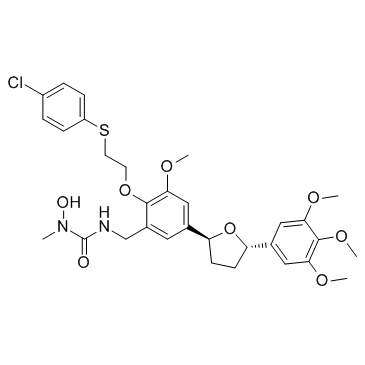
Cas No.: 205654-37-1
Sample solution is provided at 25 µL, 10mM.
CMI-392 is a dual 5-lipoxygenese inhibitor and platelet-activating factor (PAF) receptor antagonist with IC50s of 100 and 10 nM, respectively.
Topical treatment of CMI-392 in the acute and chronic TPA models result in a significant decrease of ear weight, inflammatory cell infiltration, and histological examination. The ED50 for PAF-induced mouse hemoconcentration and arachidonic acid-induced mouse ear edema are 2.2 and 1.8 mg/kg, respectively[1].
[1]. Cai X, et al. (+/-)-trans-2-[3-methoxy-4-(4-chlorophenylthioethoxy)-5-(N-methyl-N- hydroxyureidyl)methylphenyl]-5-(3,4, 5-trimethoxyphenyl)tetrahydrofuran (CMI-392), a potent dual 5-lipoxygenase inhibitor and platelet-activating factor receptor antagonist. J Med Chem. 1998 May 21;41(11):1970-9.

Kinase experiment: | 5-lipoxygenese activity in cell lysate is determined as follows: 0.1 mL reactions consisting of buffer, test compound (CMI-392 in DMSO), and an amount of cell lysate that will convert 15% of [14C]AA substrate mix to oxygenated products are incubated (20 min, room temperature). A substrate mix containing [14C]AA is added and incubated further (5 min, 37°C). The reaction is terminated by adding 0.2 mL of an organic extraction solution containing triphenylphosphine, followed by microcentrifugation. The organic phase (50 μL) is spotted onto silica gel TLC plates. The plates are developed in ethyl ether/acetic acid (100:0.1) (25 min, room temperature). Plates are exposed to film for 36 h. The film is developed and scanned using a densitometer, and the peak areas of AA and its products are calculated[1]. |
Animal experiment: | Mice: Acute TPA-induced ear edema in mice is determined by topically applying TPA to the ears of mice. Mice are sacrificed after 6 h and the ear punch biopsies are weighed. Chronic TPA-induced ear edema in mice is determined by topically applying TPA once a day every 2 days for a total of 10 days. CMI-392 is topically administered twice daily on the last 3 days of the experiment. Mice are then sacrificed and the ear punch biopsies are weighed. Biopsies are homogenized and MPO content is determined via spectrophotometric assay[1]. |
References: [1]. Cai X, et al. (+/-)-trans-2-[3-methoxy-4-(4-chlorophenylthioethoxy)-5-(N-methyl-N- hydroxyureidyl)methylphenyl]-5-(3,4, 5-trimethoxyphenyl)tetrahydrofuran (CMI-392), a potent dual 5-lipoxygenase inhibitor and platelet-activating factor receptor antagonist. J Med Chem. 1998 May 21;41(11):1970-9. | |
| Cas No. | 205654-37-1 | SDF | |
| Canonical SMILES | O=C(NCC1=CC([C@H]2O[C@H](C3=CC(OC)=C(OC)C(OC)=C3)CC2)=CC(OC)=C1OCCSC4=CC=C(Cl)C=C4)N(O)C | ||
| Formula | C31H37ClN2O8S | M.Wt | 633.15 |
| Solubility | Soluble in DMSO | Storage | Store at -20°C |
| General tips | Please select the appropriate solvent to prepare the stock solution according to the
solubility of the product in different solvents; once the solution is prepared, please store it in
separate packages to avoid product failure caused by repeated freezing and thawing.Storage method
and period of the stock solution: When stored at -80°C, please use it within 6 months; when stored
at -20°C, please use it within 1 month. To increase solubility, heat the tube to 37°C and then oscillate in an ultrasonic bath for some time. |
||
| Shipping Condition | Evaluation sample solution: shipped with blue ice. All other sizes available: with RT, or with Blue Ice upon request. | ||
| Prepare stock solution | |||
|
1 mg | 5 mg | 10 mg |
| 1 mM | 1.5794 mL | 7.897 mL | 15.794 mL |
| 5 mM | 315.9 μL | 1.5794 mL | 3.1588 mL |
| 10 mM | 157.9 μL | 789.7 μL | 1.5794 mL |
Step 1: Enter information below (Recommended: An additional animal making an allowance for loss during the experiment)
Step 2: Enter the in vivo formulation (This is only the calculator, not formulation. Please contact us first if there is no in vivo formulation at the solubility Section.)
Calculation results:
Working concentration: mg/ml;
Method for preparing DMSO master liquid: mg drug pre-dissolved in μL DMSO ( Master liquid concentration mg/mL, Please contact us first if the concentration exceeds the DMSO solubility of the batch of drug. )
Method for preparing in vivo formulation: Take μL DMSO master liquid, next addμL PEG300, mix and clarify, next addμL Tween 80, mix and clarify, next add μL ddH2O, mix and clarify.
Method for preparing in vivo formulation: Take μL DMSO master liquid, next add μL Corn oil, mix and clarify.
Note: 1. Please make sure the liquid is clear before adding the next solvent.
2. Be sure to add the solvent(s) in order. You must ensure that the solution obtained, in the previous addition, is a clear solution before proceeding to add the next solvent. Physical methods such as vortex, ultrasound or hot water bath can be used to aid dissolving.
3. All of the above co-solvents are available for purchase on the GlpBio website.
Quality Control & SDS
- View current batch:
- Purity: >98.00%
- COA (Certificate Of Analysis)
- SDS (Safety Data Sheet)
- Datasheet
Average Rating: 5 (Based on Reviews and 29 reference(s) in Google Scholar.)
GLPBIO products are for RESEARCH USE ONLY. Please make sure your review or question is research based.
Required fields are marked with *


