

D-+-Galactosamine (Synonyms: D-(+)-Galactosamine) |
Catalog No.GC11746
 One-Click Copy Product Info
|

D-+-Galactosamine is a highly selective hepatotoxin that causes liver damage primarily through the production of free radicals and the consumption of uracil nucleotides.
Products are for research use only. Not for human use. We do not sell to patients.
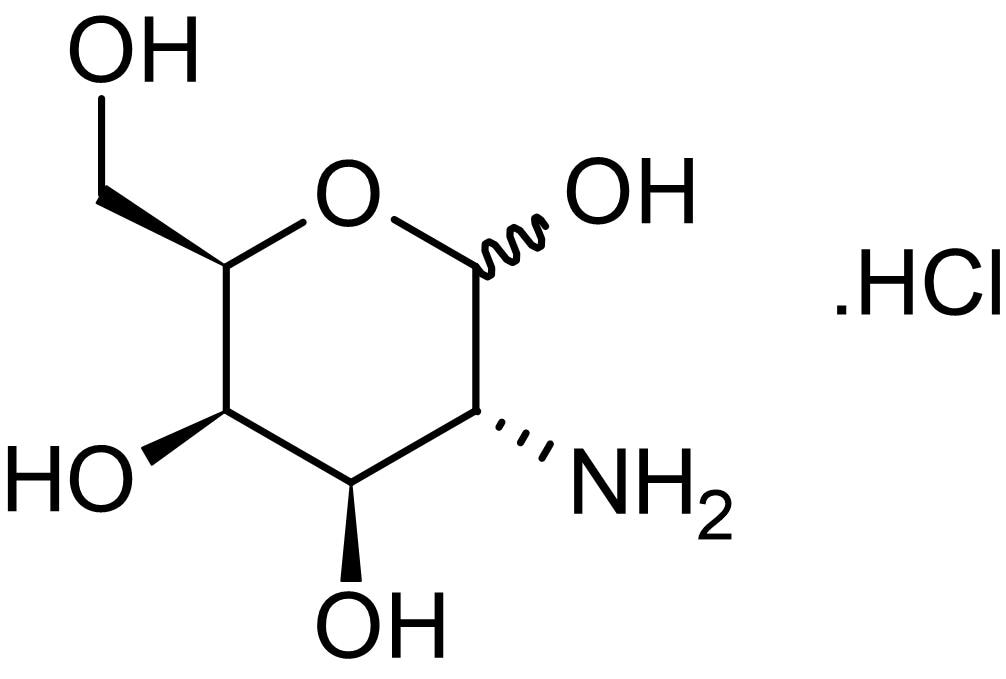
Cas No.: 1772-03-8
Sample solution is provided at 25 µL, 10mM.
_1-3.$$$39978408@51.jpg');)
_1-9.$$$38538795@65.jpg');)
_1-9.$$$39112701@51.jpg');)
_1-7.$$$37316672@70.jpg');)
_366-372.$$$36198801@70.jpg');)
.$$$38565142@65.jpg');)
_1867-1883.$$$33248023@67.jpg');)
_eads6055.$$$39977546@45.jpg');)
_eadm9805.$$$40080571@45.jpg');)
_eadj3020.$$$39666821@45.jpg');)
_1-20.$$$39757301@28.jpg');)
_1-24.$$$38898113@28.jpg');)
_273-287.$$$36806353@46.jpg');)
_1-16.$$$37156877@44.jpg');)
_1-19.$$$37460805@44.jpg');)
_1291-1307.$$$34518654@46.jpg');)
D-+-Galactosamine is a highly selective hepatotoxin that causes liver damage primarily through the production of free radicals and the consumption of uracil nucleotides[1]. D-+-Galactosamine is a 6-carbon amino sugar derived from galactose that is used to induce hepatitis in the liver of rodents[2]. D-+-Galactosamine poisoning can also lead to renal insufficiency, so renal failure is often associated with end-stage liver damage[3].
In vitro, D-+-Galactosamine (5mM) treatment of mouse primary hepatocytes for 24h significantly induced apoptosis 2h after hepatotoxin administration, significantly increased cell necrosis 24h after administration, induced caspase-3 activation and DNA fragmentation in hepatocytes, but did not change the activity of caspase-6, -8, -9, SMases or cytochrome c release [4]. Treatment of rat primary hepatocytes with D-+-Galactosamine (1-40 mM) for 24 h reduced mitochondrial dehydrogenase activity and glutathione content in a dose-dependent manner, and increased the concentration of lipid peroxide MDA[5].
In vivo, a single intraperitoneal injection of D-+-Galactosamine (500 mg/kg) in Sprague-Dawley rats caused significant damage to liver tissue, increased serum aspartate and alanine aminotransferase, γ-glutamyl transpeptidase, alkaline phosphatase, lactate dehydrogenase, sialic acid and uric acid levels, increased serum superoxide dismutase, glutathione peroxidase, glutathione-S-transferase, catalase activities and lipid peroxidation values, and reduced serum and liver glutathione levels[6]. A single intraperitoneal injection of D-+-Galactosamine (1400 mg/kg) in Wistar rats induced acute liver failure with severe parenchymal necrosis and severe lobular and periportal inflammatory infiltration in the liver[7].
References:
[1] Endo Y, Shibazaki M, Yamaguchi K, et al. Enhancement by galactosamine of lipopolysaccharide (LPS)‐induced tumour necrosis factor production and lethality: its suppression by LPS pretreatment[J]. British journal of pharmacology, 1999, 128(1): 5-12.
[2] Saracyn M, Zdanowski R, Brytan M, et al. D-Galactosamine intoxication in experimental animals: is it only an experimental model of acute liver failure?[J]. Medical Science Monitor: International Medical Journal of Experimental and Clinical Research, 2015, 21: 1469.
[3] Sinha M, Manna P, Sil P C. Amelioration of galactosamine-induced nephrotoxicity by a protein isolated from the leaves of the herb, Cajanus indicus L[J]. BMC complementary and alternative medicine, 2007, 7: 1-18.
[4] Siendones E, JIMÉNEZ‐GÓMEZ Y, Montero J L, et al. PGE1 abolishes the mitochondrial‐independent cell death pathway induced by D‐galactosamine in primary culture of rat hepatocytes[J]. Journal of gastroenterology and hepatology, 2005, 20(1): 108-116.
[5] Kučera O, Lotková H, Kanďár R, et al. The model of D-galactosamine-induced injury of rat hepatocytes in primary culture[J]. Mesenchymal stem cells isolated from the human bone marrow: Cultivation, phenotypic and changes, 2006, 49(1): 59-65.
[6] Catal T, Tunali S, Bolkent S, et al. An antioxidant combination improves histopathological alterations and biochemical parameters in D-galactosamine-induced hepatotoxicity in rats[J]. European Journal of Biology, 2017, 76(1): 14-19.
[7] Éboli L P C B, Netto A A S, Azevedo R A, et al. Evaluating the best time to intervene acute liver failure in rat models induced by d-galactosamine[J]. Acta Cirurgica Brasileira, 2016, 31(12): 783-792.
| Cell experiment [1]: | |
Cell lines | Hepatocytes |
Preparation Method | Cells were treated with PGE1 (1mM) 2 h before D-+-Galactosamine (5mM) and then cultured for 24 h. Apoptosis was determined by DNA fragmentation and caspase-3, -6, -8, and -9 activation in hepatocytes. Necrosis was determined by measuring lactate dehydrogenase (LDH) activity in the culture medium. |
Reaction Conditions | 5mM; 0-24h |
Applications | D-+-Galactosamine significantly induced cell apoptosis 2 hours after hepatotoxin administration and significantly increased cell necrosis 24 hours after administration. |
| Animal experiment [2]: | |
Animal models | Sprague-Dawley rats |
Preparation Method | The rats were separated into four groups of 10 rats each: (1) control animals (0.9% NaCl i.p.); (2) control animals given antioxidants (100 mg/kg/day ascorbic acid,100 mg/kg/day alpha tocopherol, 15 mg/kg/day beta carotene, and 0.2 mg/kg/day sodium selenate, p.o.); (3)animals given only a single dose of D-+-Galactosamine (500mg/kg, i.p.) (dissolved in 0.9% NaCl); (4)animals given D-+-Galactosamine and antioxidants. D-+-Galactosamine was administered on day 3, and rats were sacrificed 7 hours after the last antioxidant administration. Blood samples were collected and liver tissue samples were obtained for biochemical and histological analyses. |
Dosage form | 500mg/kg; i.p. |
Applications | D-+-Galactosamine administration caused significant damage to liver tissue. Serum aspartate and alanine aminotransferase, γ-glutamyl transpeptidase, alkaline phosphatase, lactate dehydrogenase, sialic acid, and uric acid levels were increased. Serum and liver glutathione levels were decreased, and serum superoxide dismutase, glutathione peroxidase, glutathione-S-transferase, catalase activities, and lipid peroxidation values were increased in the D-+-Galactosamine group. |
References: [1]Siendones E, JIMÉNEZ‐GÓMEZ Y, Montero J L, et al. PGE1 abolishes the mitochondrial‐independent cell death pathway induced by D‐galactosamine in primary culture of rat hepatocytes[J]. Journal of gastroenterology and hepatology, 2005, 20(1): 108-116. [2]Catal T, Tunali S, Bolkent S, et al. An antioxidant combination improves histopathological alterations and biochemical parameters in D-galactosamine-induced hepatotoxicity in rats[J]. European Journal of Biology, 2017, 76(1): 14-19. | |
| Cas No. | 1772-03-8 | SDF | |
| Synonyms | D-(+)-Galactosamine | ||
| Chemical Name | (2R,3R,4R,5R)-2-amino-3,4,5,6-tetrahydroxyhexanal hydrochloride | ||
| Canonical SMILES | N[C@@]([C@](O)([H])[C@](O)([H])[C@@](O)([H])CO)([H])C=O.Cl | ||
| Formula | C6H13NO5.HCl | M.Wt | 215.63 |
| Solubility | ≥ 21.6mg/mL in Water | Storage | Store at RT |
| General tips | Please select the appropriate solvent to prepare the stock solution according to the
solubility of the product in different solvents; once the solution is prepared, please store it in
separate packages to avoid product failure caused by repeated freezing and thawing.Storage method
and period of the stock solution: When stored at -80°C, please use it within 6 months; when stored
at -20°C, please use it within 1 month. To increase solubility, heat the tube to 37°C and then oscillate in an ultrasonic bath for some time. |
||
| Shipping Condition | Evaluation sample solution: shipped with blue ice. All other sizes available: with RT, or with Blue Ice upon request. | ||
| Prepare stock solution | |||

|
1 mg | 5 mg | 10 mg |
| 1 mM | 4.6376 mL | 23.1879 mL | 46.3757 mL |
| 5 mM | 927.5 μL | 4.6376 mL | 9.2751 mL |
| 10 mM | 463.8 μL | 2.3188 mL | 4.6376 mL |
Step 1: Enter information below (Recommended: An additional animal making an allowance for loss during the experiment)
 g
μL
g
μL
Step 2: Enter the in vivo formulation (This is only the calculator, not formulation. Please contact us first if there is no in vivo formulation at the solubility Section.)
Calculation results:
Working concentration: mg/ml;
Method for preparing DMSO master liquid: mg drug pre-dissolved in μL DMSO ( Master liquid concentration mg/mL, Please contact us first if the concentration exceeds the DMSO solubility of the batch of drug. )
Method for preparing in vivo formulation: Take μL DMSO master liquid, next addμL PEG300, mix and clarify, next addμL Tween 80, mix and clarify, next add μL saline, mix and clarify.
Method for preparing in vivo formulation: Take μL DMSO master liquid, next add μL Corn oil, mix and clarify.
Note: 1. Please make sure the liquid is clear before adding the next solvent.
2. Be sure to add the solvent(s) in order. You must ensure that the solution obtained, in the previous addition, is a clear solution before proceeding to add the next solvent. Physical methods such as vortex, ultrasound or hot water bath can be used to aid dissolving.
3. All of the above co-solvents are available for purchase on the GlpBio website.
Quality Control & SDS
- View current batch:
- Purity: >98.00% Appearance: A solid
- COA (Certificate of Analysis)
- SDS (Safety Data Sheet)
- Datasheet
Average Rating: 5 (Based on Reviews and 13 reference(s) in Google Scholar.)