

Daidzein |
Catalog No.GN10293
 One-Click Copy Product Info
|

Daidzein is a natural phytoestrogen isoflavone. Daidzein serves as a PPAR activator.
Products are for research use only. Not for human use. We do not sell to patients.
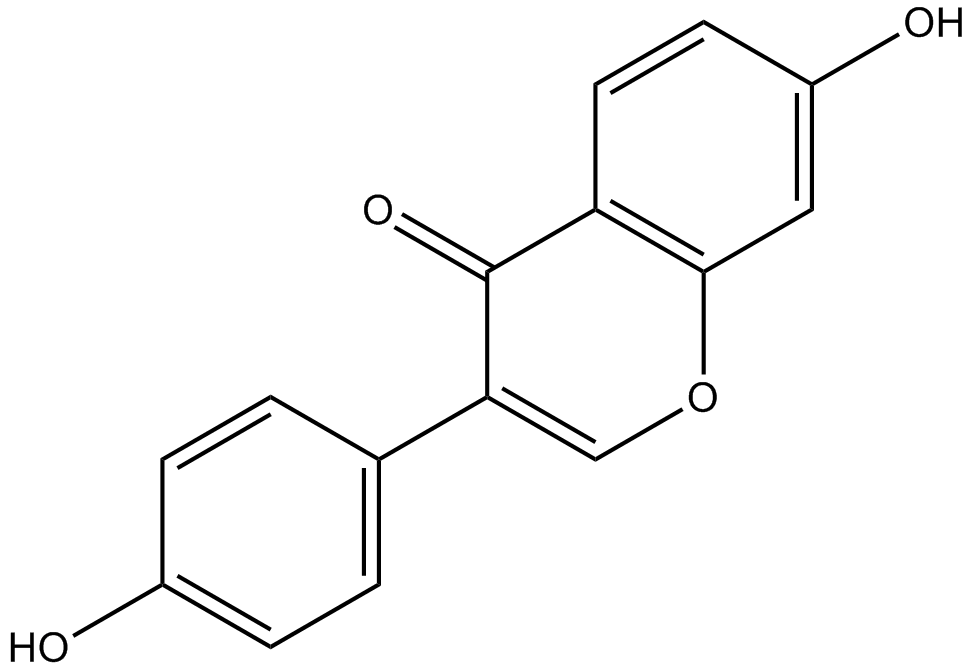
Cas No.: 486-66-8
Sample solution is provided at 25 µL, 10mM.
_1-3.$$$39978408@51.jpg');)
_1-9.$$$38538795@65.jpg');)
_1-9.$$$39112701@51.jpg');)
_1-7.$$$37316672@70.jpg');)
_366-372.$$$36198801@70.jpg');)
.$$$38565142@65.jpg');)
_1867-1883.$$$33248023@67.jpg');)
_eads6055.$$$39977546@45.jpg');)
_eadm9805.$$$40080571@45.jpg');)
_eadj3020.$$$39666821@45.jpg');)
_1-20.$$$39757301@28.jpg');)
_1-24.$$$38898113@28.jpg');)
_273-287.$$$36806353@46.jpg');)
_1-16.$$$37156877@44.jpg');)
_1-19.$$$37460805@44.jpg');)
_1291-1307.$$$34518654@46.jpg');)
Daidzein is a natural phytoestrogen isoflavone. Daidzein serves as a PPAR activator. Daidzein exerts biological functions through estrogen receptor modulation, antioxidant and anti-inflammatory mechanisms. Daidzein can be used in research related to breast cancer, diabetes, osteoporosis and cardiovascular diseases[1-4].
In vitro, treatment with 1-100μM Daidzein for 24-72 hours reduced cell viability and inhibited proliferation in MCF-7 and MDA-MB-453 cells. Daidzein caused cell cycle arrest at G1 and G2/M phases[5]. Treatment with 25-100μM Daidzein for 24-72 hours reduced cell viability and inhibited proliferation in MCF-7 cells. Daidzein induced apoptosis, decreased mitochondrial transmembrane potential, and increased intracellular ROS generation[6]. Treatment with 6.25-100μM Daidzein for 48 hours reduced cell viability in BEL-7402, HeLa, A549, HepG-2 and MG-63 cells. Daidzein induced apoptosis, caused DNA fragmentation, and elevated intracellular ROS levels[7].
In vivo, intraperitoneal injection of 200mg/kg Daidzein daily for 3 consecutive days improved liver congestion, swelling and scattered hemorrhagic spots in C57BL/6J mice with Concanavalin A‑induced liver injury. Daidzein alleviated sinusoidal congestion, edema, necrotic foci and lymphocyte infiltration and reduced Suzuki score[8]. Starting from day 3 after bilateral ovariectomy, oral gavage of 25mg/kg Daidzein 5 days per week for 8 weeks increased femoral bone volume fraction, bone mineral density and trabecular number and decreased trabecular separation in C57BL/6 mice. Daidzein increased osteocalcin-positive osteoblast number and osteogenic activity on trabecular surface, reduced TRAP-positive osteoclast number, downregulated Cav-1 expression in cancellous bone, increased CD31/EMCN double-positive H-type vessel number, and elevated p-EGFR level in femoral cancellous bone endothelial cells[9]. Daily oral gavage of 5-10mg/kg Daidzein for 6 weeks increased bcl-2 mRNA positive cell numbers and decreased bax mRNA positive cell numbers in hippocampus and cortex of Kunming mouse aging model. Daidzein reduced caspase-3 positive cell numbers in hippocampus and cortex[10].
References:
[1] Singh L. Daidzein's potential in halting neurodegeneration: unveiling mechanistic insights. Naunyn Schmiedebergs Arch Pharmacol. 2025 Jan;398(1):243-259.
[2] Ahmed T, Javed S, Tariq A, et al. Daidzein and its Effects on Brain. Curr Med Chem. 2017;24(4):365-375.
[3] Praisthy Lj C, Kushwah R, Dubey S, et al. Pharmacotherapeutic potential of daidzein: insights into mechanisms and clinical relevance. Inflammopharmacology. 2025 Sep;33(9):5145-5171.
[4] Laddha AP, Kulkarni YA. Daidzein ameliorates peripheral neuropathy in Sprague Dawley rats. Front Pharmacol. 2024 Aug 6;15:1385419.
[5] Choi EJ, Kim GH. Daidzein causes cell cycle arrest at the G1 and G2/M phases in human breast cancer MCF-7 and MDA-MB-453 cells. Phytomedicine. 2008;15(8):683-690.
[6] Jin S, Zhang QY, Kang XM, et al. Daidzein induces MCF-7 breast cancer cell apoptosis via the mitochondrial pathway. Ann Oncol. 2010 Feb;21(2):263-268.
[7] Han BJ, Li W, Jiang GB, et al. Effects of daidzein in regards to cytotoxicity in vitro, apoptosis, reactive oxygen species level, cell cycle arrest and the expression of caspase and Bcl-2 family proteins. Oncol Rep. 2015;34(3):1115-1120.
[8] Li SL, Cao R, Hu XF, et al. Daidzein ameliorated concanavalin A-induced liver injury through the Akt/GSK-3β/Nrf2 pathway in mice. Ann Transl Med. 2021 Aug;9(15):1228.
[9] Jia J, He R, Yao Z, et al. Daidzein alleviates osteoporosis by promoting osteogenesis and angiogenesis coupling. PeerJ. 2023;11:e16121.
[10] Mao Z, Zheng YL, Zhang YQ, et al. The anti-apoptosis effects of daidzein in the brain of D-galactose treated mice. Molecules. 2007;12(7):1455-1470.
| Cell experiment [1]: | |
|
Cell lines |
MCF-7 cells (human breast cancer cell line) |
|
Preparation Method |
MCF-7 cells were maintained in phenol red-free RPMI-1640 medium with 10% charcoal-stripped FBS at 37°C, 5% CO2. MCF-7 cells were treated with Daidzein at 25, 50 or 100μM for 24, 48 or 72 hours. After treatment, MTT assay, Hoechst-PI staining, flow cytometry (Annexin V-FITC/PI), DiOC6(3) mitochondrial transmembrane potential assay, DCFH-DA ROS assay, and Western blot of bcl-2, bax, cytochrome C, cleaved caspase-9 and cleaved caspase-7 were performed. |
|
Reaction Conditions |
25-100μM; 24, 48 or 72h |
|
Applications |
Daidzein reduced MCF-7 cell viability in a concentration- and time-dependent manner. Daidzein induced nuclear condensation and increased Annexin V-positive apoptotic cells. Daidzein decreased mitochondrial transmembrane potential. Daidzein increased intracellular ROS. Daidzein downregulated bcl-2 and upregulated bax protein. Daidzein promoted cytochrome C release from mitochondria to cytosol. Daidzein increased cleaved caspase-9 and cleaved caspase-7. |
| Animal experiment [2]: | |
|
Animal models |
8-week-old female Kunming mice (D-galactose-induced aging model) |
|
Preparation Method |
Mice received daily subcutaneous injection of 50mg/kg D-galactose for 8 weeks, then oral gavage of Daidzein (5mg/kg/day or 10mg/kg/day, dissolved in 0.1% Tween-80 distilled water) for 6 weeks. Mice were sacrificed 24h after the last treatment; brain tissues were collected for in situ hybridization of bcl-2 mRNA and bax mRNA, and immunohistochemistry of caspase-3 in hippocampus and cortex. |
|
Dosage form |
5-10mg/kg/day; oral gavage; 6 weeks |
|
Applications |
Daidzein increased bcl-2 mRNA positive cell numbers in hippocampus and cortex of D-galactose-treated mice. Daidzein decreased bax mRNA positive cell numbers in hippocampus and cortex. Daidzein reduced caspase-3 positive cell numbers in hippocampus and cortex. |
References: [1] Jin S, Zhang QY, Kang XM, et al. Daidzein induces MCF-7 breast cancer cell apoptosis via the mitochondrial pathway. Ann Oncol. 2010 Feb;21(2):263-268. [2] Mao Z, Zheng YL, Zhang YQ, et al. The anti-apoptosis effects of daidzein in the brain of D-galactose treated mice. Molecules. 2007;12(7):1455-1470. | |
| Cas No. | 486-66-8 | SDF | |
| Chemical Name | 7-hydroxy-3-(4-hydroxyphenyl)chromen-4-one | ||
| Canonical SMILES | C1=CC(=CC=C1C2=COC3=C(C2=O)C=CC(=C3)O)O | ||
| Formula | C15H10O4 | M.Wt | 254.24 |
| Solubility | ≥ 11.6mg/mL in DMSO | Storage | Store at 2-8°C |
| Shipping Condition | Evaluation sample solution: shipped with blue ice. All other sizes available: with RT, or with Blue Ice upon request. | ||
| Prepare stock solution | |||

|
1 mg | 5 mg | 10 mg |
| 1 mM | 3.9333 mL | 19.6665 mL | 39.3329 mL |
| 5 mM | 786.7 μL | 3.9333 mL | 7.8666 mL |
| 10 mM | 393.3 μL | 1.9666 mL | 3.9333 mL |
Step 1: Enter information below (Recommended: An additional animal making an allowance for loss during the experiment)
 g
μL
g
μL
Step 2: Enter the in vivo formulation (This is only the calculator, not formulation. Please contact us first if there is no in vivo formulation at the solubility Section.)
Calculation results:
Working concentration: mg/ml;
Method for preparing DMSO master liquid: mg drug pre-dissolved in μL DMSO ( Master liquid concentration mg/mL, Please contact us first if the concentration exceeds the DMSO solubility of the batch of drug. )
Method for preparing in vivo formulation: Take μL DMSO master liquid, next addμL PEG300, mix and clarify, next addμL Tween 80, mix and clarify, next add μL saline, mix and clarify.
Method for preparing in vivo formulation: Take μL DMSO master liquid, next add μL Corn oil, mix and clarify.
Note: 1. Please make sure the liquid is clear before adding the next solvent.
2. Be sure to add the solvent(s) in order. You must ensure that the solution obtained, in the previous addition, is a clear solution before proceeding to add the next solvent. Physical methods such as vortex, ultrasound or hot water bath can be used to aid dissolving.
3. All of the above co-solvents are available for purchase on the GlpBio website.
Quality Control & SDS
- View current batch:
- Purity: >99.50% Appearance: A solid
- COA (Certificate of Analysis)
- SDS (Safety Data Sheet)
- Datasheet
Average Rating: 5 (Based on Reviews and 30 reference(s) in Google Scholar.)