

BPTES |
Katalog-Nr.GC13958
 One-Click Copy Product Info
|

Ein GLS-Inhibitor
Products are for research use only. Not for human use. We do not sell to patients.
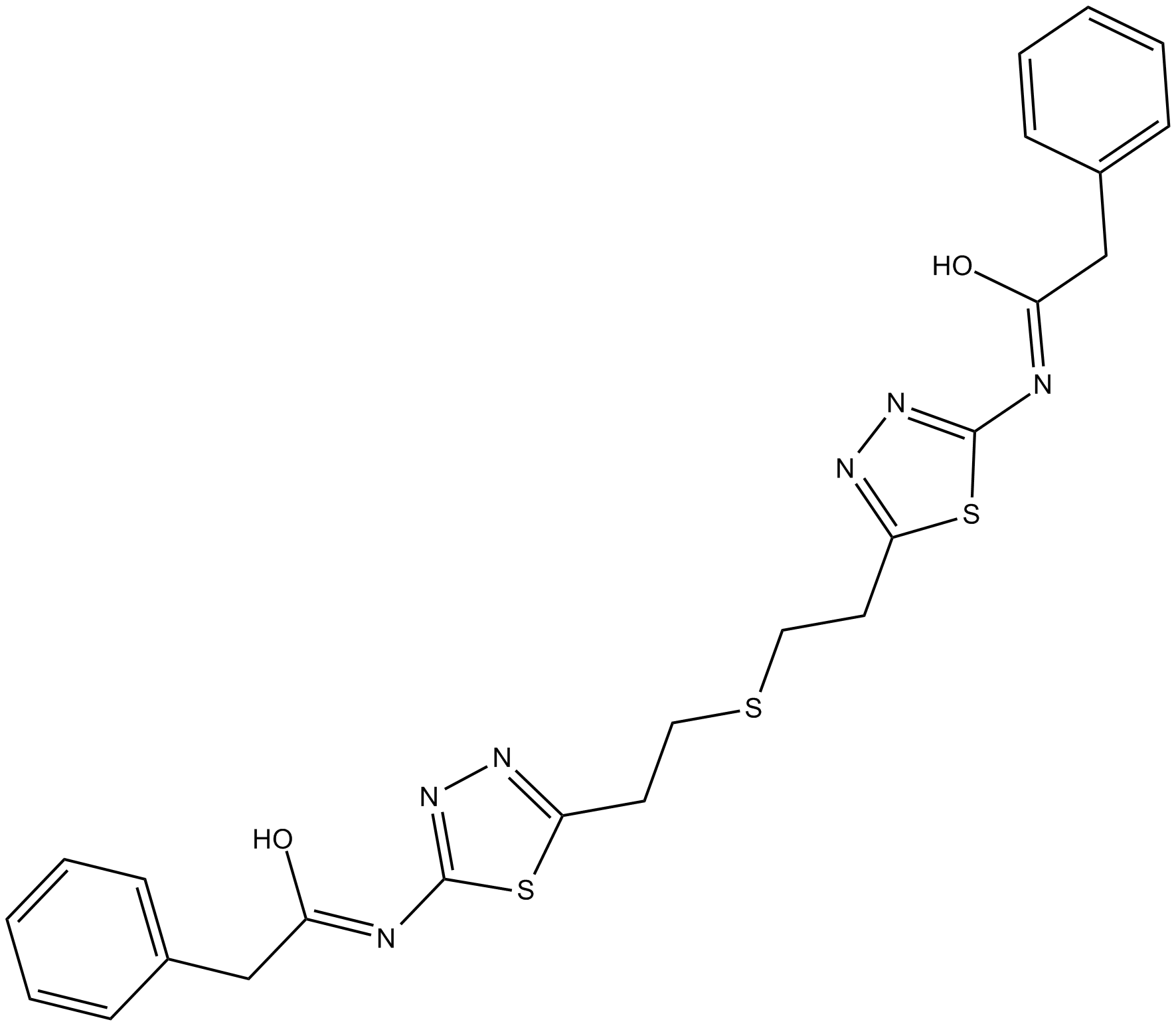
Cas No.: 314045-39-1
Sample solution is provided at 25 µL, 10mM.
_1-3.$$$39978408@51.jpg');)
_1-9.$$$38538795@65.jpg');)
_1-9.$$$39112701@51.jpg');)
_1-7.$$$37316672@70.jpg');)
_366-372.$$$36198801@70.jpg');)
.$$$38565142@65.jpg');)
_1867-1883.$$$33248023@67.jpg');)
_eads6055.$$$39977546@45.jpg');)
_eadm9805.$$$40080571@45.jpg');)
_eadj3020.$$$39666821@45.jpg');)
_1-20.$$$39757301@28.jpg');)
_1-24.$$$38898113@28.jpg');)
_273-287.$$$36806353@46.jpg');)
_1-16.$$$37156877@44.jpg');)
_1-19.$$$37460805@44.jpg');)
_1291-1307.$$$34518654@46.jpg');)
BPTES is a potent and selective allosteric inhibitor of kidney-type glutaminase (GLS) that has served as a molecular probe to determine the therapeutic potential of GLS inhibition[1].
In vitro, BPTES (2, 5 and 10μM) could effectively and specifically suppress NLRP1b inflammasome activation in macrophages[2]. BPTES (10μM; 6h) pretreatments increased the toxic effects of cisplatin and etoposide on HCC1937 and BT-549 cells[3]. BPTES (0, 0.05, 0.5, 1, 2.5 and 5μM; 72h) selectively eliminates human skin senescent fibroblasts[4]. BPTES (10μM; 24h) reduces Extracellular vesicle (EV) release in HIV-1-infected macrophages and immune-activated microglia[5].
In vivo, BPTES (1mg/kg; 1h; i.p.) can block the anthrax lethal toxin-induced mortality and tissue injury in mice by preventing injury to lungs, adrenal glands and intestine[2]. BPTES (0.25mg/20g/200μL; 2-3 times a week for 1 month; i.p.) can eliminate SA-β-Gal-positive cells in a human skin graft chimera model in mice[4].
References:
[1] Shukla K, Ferraris DV, Thomas AG, et al. Design, synthesis, and pharmacological evaluation of bis-2-(5-phenylacetamido-1,2,4-thiadiazol-2-yl)ethyl sulfide 3 (BPTES) analogs as glutaminase inhibitors. J Med Chem. 2012 Dec 13;55(23):10551-63.
[2] Wang J, Yang D, Shen X, et al. BPTES inhibits anthrax lethal toxin-induced inflammatory response. Int Immunopharmacol. 2020 Aug;85:106664.
[3] Chen L, Cui H, Fang J, et al. Glutamine deprivation plus BPTES alters etoposide- and cisplatin-induced apoptosis in triple negative breast cancer cells. Oncotarget. 2016 Aug 23;7(34):54691-54701.
[4] Takaya K, Ishii T, Asou T, et al. Glutaminase inhibitors rejuvenate human skin via clearance of senescent cells: a study using a mouse/human chimeric model. Aging (Albany NY). 2022 Nov 21;14(22):8914-8926.
[5] Wu B, Liu J, Zhao R, et al. Glutaminase 1 regulates the release of extracellular vesicles during neuroinflammation through key metabolic intermediate alpha-ketoglutarate. J Neuroinflammation. 2018 Mar 14;15(1):79.
| Cell experiment [1]: | |
Cell lines | HCC1937 and BT-549 cells |
Preparation Method | HCC1937 and BT-549 cells were pretreated with 10μM BPTES for 6h and then treated with 5μM etoposide or cisplatin for 48h. The expressions of cleaved-PARP, cleaved-caspase 3, cleaved-caspase 9, Bcl-2, and BAX in HCC1937 and BT-549 cells were measured by immunoblotting. Cell apoptosis was measured by flow cytometry in BT-549 and HCC1937 cells. |
Reaction Conditions | 10μM; 6h |
Applications | BPTES pretreatments increased the toxic effects of cisplatin and etoposide on HCC1937 and BT-549 cells. |
| Animal experiment [2]: | |
Animal models | 4-week-old female Balb/c mice |
Preparation Method | Four-week-old female Balb/c mice were pretreated with vehicle or 1mg/kg BPTES via intraperitoneal injection for 1h, and then subjected to intravenous injection of 500mg/kg lethal factor (LF) and protective antigen (PA). Mouse survival was measured up to 150h. |
Dosage form | 1mg/kg; 1h; i.p. |
Applications | BPTES can block the anthrax lethal toxin-induced mortality and tissue injury in mice by preventing injury to lungs, adrenal glands and intestine. |
References: | |
| Cas No. | 314045-39-1 | SDF | |
| Chemical Name | (1Z,1'Z)-N',N''-(5,5'-(thiobis(ethane-2,1-diyl))bis(1,3,4-thiadiazole-5,2-diyl))bis(2-phenylacetimidic acid) | ||
| Canonical SMILES | O/C(CC1=CC=CC=C1)=N\C2=NN=C(S2)CCSCCC(S3)=NN=C3/N=C(O)/CC4=CC=CC=C4 | ||
| Formula | C24H24N6O2S3 | M.Wt | 524.68 |
| Löslichkeit | ≥ 18 mg/mL in DMSO | Storage | Store at -20°C |
| General tips | Please select the appropriate solvent to prepare the stock solution according to the
solubility of the product in different solvents; once the solution is prepared, please store it in
separate packages to avoid product failure caused by repeated freezing and thawing.Storage method
and period of the stock solution: When stored at -80°C, please use it within 6 months; when stored
at -20°C, please use it within 1 month. To increase solubility, heat the tube to 37°C and then oscillate in an ultrasonic bath for some time. |
||
| Shipping Condition | Evaluation sample solution: shipped with blue ice. All other sizes available: with RT, or with Blue Ice upon request. | ||
| Prepare stock solution | |||

|
1 mg | 5 mg | 10 mg |
| 1 mM | 1.9059 mL | 9.5296 mL | 19.0592 mL |
| 5 mM | 381.2 μL | 1.9059 mL | 3.8118 mL |
| 10 mM | 190.6 μL | 953 μL | 1.9059 mL |
Step 1: Enter information below (Recommended: An additional animal making an allowance for loss during the experiment)
 g
μL
g
μL
Step 2: Enter the in vivo formulation (This is only the calculator, not formulation. Please contact us first if there is no in vivo formulation at the solubility Section.)
Calculation results:
Working concentration: mg/ml;
Method for preparing DMSO master liquid: mg drug pre-dissolved in μL DMSO ( Master liquid concentration mg/mL, Please contact us first if the concentration exceeds the DMSO solubility of the batch of drug. )
Method for preparing in vivo formulation: Take μL DMSO master liquid, next addμL PEG300, mix and clarify, next addμL Tween 80, mix and clarify, next add μL saline, mix and clarify.
Method for preparing in vivo formulation: Take μL DMSO master liquid, next add μL Corn oil, mix and clarify.
Note: 1. Please make sure the liquid is clear before adding the next solvent.
2. Be sure to add the solvent(s) in order. You must ensure that the solution obtained, in the previous addition, is a clear solution before proceeding to add the next solvent. Physical methods such as vortex, ultrasound or hot water bath can be used to aid dissolving.
3. All of the above co-solvents are available for purchase on the GlpBio website.
Quality Control & SDS
- View current batch:
- Purity: >98.00% Appearance: A solid
- COA (Certificate of Analysis)
- SDS (Safety Data Sheet)
- Datasheet
Average Rating: 5 (Based on Reviews and 20 reference(s) in Google Scholar.)