

PTUPB |
Katalog-Nr.GC60311
 One-Click Copy Product Info
|

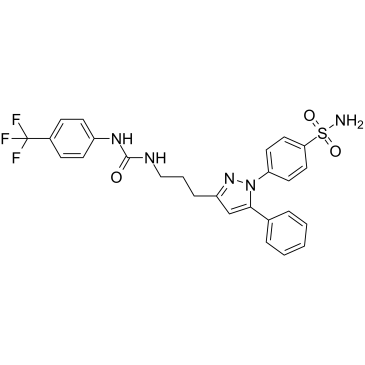
PTUPB ist ein potenter und dualer sEH- und COX-2-Enzyminhibitor mit IC50 von 0,9 nM bzw. 1,26 μM.
Products are for research use only. Not for human use. We do not sell to patients.
Cas No.: 1287761-01-6
Sample solution is provided at 25 µL, 10mM.
_1-3.$$$39978408@51.jpg');)
_1-9.$$$38538795@65.jpg');)
_1-9.$$$39112701@51.jpg');)
_1-7.$$$37316672@70.jpg');)
_366-372.$$$36198801@70.jpg');)
.$$$38565142@65.jpg');)
_1867-1883.$$$33248023@67.jpg');)
_eads6055.$$$39977546@45.jpg');)
_eadm9805.$$$40080571@45.jpg');)
_eadj3020.$$$39666821@45.jpg');)
_1-20.$$$39757301@28.jpg');)
_1-24.$$$38898113@28.jpg');)
_273-287.$$$36806353@46.jpg');)
_1-16.$$$37156877@44.jpg');)
_1-19.$$$37460805@44.jpg');)
_1291-1307.$$$34518654@46.jpg');)
PTUPB is a novel dual COX-2 and sEH inhibitor with IC50 values of 1.26 nM and 0.9 μM, respectively[1]. It has certain anti-tumor and anti-inflammatory effects[2].
PTUPB(10, 100, 1000, and 10000 nM;1h) inhibits the activation of NLRP3 inflammasome in primary murine macrophages by reduced the protein expression of caspase-1 p10 and IL-1β p17 in macrophages [3]. PTUPB (10, 20, 25 or 30 μM; 72 h) inhibits glioblastoma cell proliferation and G1 phase cell cycle arrest in vitro, and suppresses the tumor growth and angiogenesis in vivo[4].
PTUPB(5 mg/kg; 1 h before the LPS administration; s.c) decreased the pro-inflammatory factors, oxidative stress, and activation of NACHT, LRR, and PYD domains-containing protein 3 (NLRP3) inflammasome in LPS-induced ALI mice [3]. PTUPB(10 mg/kg/d; 8 weeks) attenuates renal inflammation and oxidative stress in Zucker diabetic fatty(ZDF) rats[5]. PTUPB(5 mg/kg; s.c) treatment suppressed the activation of NLRP3 inflammasome in the liver and lung of septic mice[6]. PTUPB (5 mg/kg; s.c; once a day for 14days) alleviated the pathological changes in lung tissue and collagen deposition, as well as reduced senescence marker molecules (p16Ink4a and p53-p21Waf1/Cip1) in the lungs of mice treated by bleomycin (BLM) [7].
References:
[1]. Hwang SH, Wagner KM, et,al. Synthesis and structure-activity relationship studies of urea-containing pyrazoles as dual inhibitors of cyclooxygenase-2 and soluble epoxide hydrolase. J Med Chem. 2011 Apr 28;54(8):3037-50. doi: 10.1021/jm2001376. Epub 2011 Apr 5. PMID: 21434686; PMCID: PMC3281519.
[2]. Wang F, Zhang H, et,al. COX-2/sEH Dual Inhibitor PTUPB Potentiates the Antitumor Efficacy of Cisplatin. Mol Cancer Ther. 2018 Feb;17(2):474-483. doi: 10.1158/1535-7163.MCT-16-0818. Epub 2017 Dec 28. PMID: 29284644; PMCID: PMC5824635.
[3]. Yang HH, Duan JX, et,al. A COX-2/sEH dual inhibitor PTUPB alleviates lipopolysaccharide-induced acute lung injury in mice by inhibiting NLRP3 inflammasome activation. Theranostics. 2020 Mar 26;10(11):4749-4761. doi: 10.7150/thno.43108. PMID: 32308747; PMCID: PMC7163435.
[4]. Li J, Zhou Y, et,al. COX-2/sEH dual inhibitor PTUPB suppresses glioblastoma growth by targeting epidermal growth factor receptor and hyaluronan mediated motility receptor. Oncotarget. 2017 Sep 15;8(50):87353-87363. doi: 10.18632/oncotarget.20928. PMID: 29152086; PMCID: PMC5675638.
[5]. Hye Khan MA, Hwang SH, et,al. A dual COX-2/sEH inhibitor improves the metabolic profile and reduces kidney injury in Zucker diabetic fatty rat. Prostaglandins Other Lipid Mediat. 2016 Sep;125:40-7. doi: 10.1016/j.prostaglandins.2016.07.003. Epub 2016 Jul 16. PMID: 27432695; PMCID: PMC5035206.
[6]. Zhang YF, Sun CC, et,al. A COX-2/sEH dual inhibitor PTUPB ameliorates cecal ligation and puncture-induced sepsis in mice via anti-inflammation and anti-oxidative stress. Biomed Pharmacother. 2020 Jun;126:109907. doi: 10.1016/j.biopha.2020.109907. Epub 2020 Feb 27. PMID: 32114358; PMCID: PMC8868492.
[7]. Zhang CY, Duan JX, et,al. COX-2/sEH dual inhibitor PTUPB alleviates bleomycin-induced pulmonary fibrosis in mice via inhibiting senescence. FEBS J. 2020 Apr;287(8):1666-1680. doi: 10.1111/febs.15105. Epub 2019 Nov 8. PMID: 31646730; PMCID: PMC7174142.
| Cell experiment [1]: | |
|
Cell lines |
Primary murine peritoneal macrophages |
|
Preparation Method |
Macrophages were treated with LPS (100 ng/mL) for 6 h with or without PTUPB pre-treatment (10, 100, and 1000 nM) for 1 h and activity of LDH in the supernatant was detected. |
|
Reaction Conditions |
10, 100, 1000, and 10000 nM;1h |
|
Applications |
PTUPB pretreatment at concentrations of 10, 100, and 1000 nM significantly decreased the LDH activity triggered by LPS. |
| Animal experiment [1]: | |
|
Animal models |
Acute lung injury (ALI) C57BL/6 mice |
|
Preparation Method |
Mice were subcutaneously injected with PTUPB (5 mg/kg) dissolved in PEG400 1 h prior to ALI. Specifically, The mice were randomly assigned to four groups: control, PTUPB, ALI, and ALI + PTUPB. ALI was induced by administering an intratracheal injection of LPS (5 mg/kg) dissolved in 50 μL of sterile saline. Mice in the PTUPB and PTUPB + ALI groups received a subcutaneous injection of PTUPB (5 mg/kg) dissolved in PEG400, one hour before the intratracheal injection. For the control and ALI groups, PEG400 was administered subcutaneously. |
|
Dosage form |
5 mg/kg; 1 h before the LPS administration (ALI); s.c |
|
Applications |
PTUPB mitigates the pathological lung damage and restores the respiratory function in mice exposed to LPS. |
| Kinase experiment [1]: | |
|
Preparation Method |
For the recombinant affinity purified sEHs (human, mouse, and rat), we used a fluorescent-based assay to determine IC50s. |
|
Applications |
PTUPB is sEH inhibitor with IC50 values of 0.9 μM. |
|
References: |
|
| Cas No. | 1287761-01-6 | SDF | |
| Canonical SMILES | O=S(C1=CC=C(N2N=C(CCCNC(NC3=CC=C(C(F)(F)F)C=C3)=O)C=C2C4=CC=CC=C4)C=C1)(N)=O | ||
| Formula | C26H24F3N5O3S | M.Wt | 543.56 |
| Löslichkeit | DMSO: 100 mg/mL (183.97 mM) | Storage | Store at -20°C |
| General tips | Please select the appropriate solvent to prepare the stock solution according to the
solubility of the product in different solvents; once the solution is prepared, please store it in
separate packages to avoid product failure caused by repeated freezing and thawing.Storage method
and period of the stock solution: When stored at -80°C, please use it within 6 months; when stored
at -20°C, please use it within 1 month. To increase solubility, heat the tube to 37°C and then oscillate in an ultrasonic bath for some time. |
||
| Shipping Condition | Evaluation sample solution: shipped with blue ice. All other sizes available: with RT, or with Blue Ice upon request. | ||
| Prepare stock solution | |||

|
1 mg | 5 mg | 10 mg |
| 1 mM | 1.8397 mL | 9.1986 mL | 18.3972 mL |
| 5 mM | 367.9 μL | 1.8397 mL | 3.6794 mL |
| 10 mM | 184 μL | 919.9 μL | 1.8397 mL |
Step 1: Enter information below (Recommended: An additional animal making an allowance for loss during the experiment)
 g
μL
g
μL
Step 2: Enter the in vivo formulation (This is only the calculator, not formulation. Please contact us first if there is no in vivo formulation at the solubility Section.)
Calculation results:
Working concentration: mg/ml;
Method for preparing DMSO master liquid: mg drug pre-dissolved in μL DMSO ( Master liquid concentration mg/mL, Please contact us first if the concentration exceeds the DMSO solubility of the batch of drug. )
Method for preparing in vivo formulation: Take μL DMSO master liquid, next addμL PEG300, mix and clarify, next addμL Tween 80, mix and clarify, next add μL saline, mix and clarify.
Method for preparing in vivo formulation: Take μL DMSO master liquid, next add μL Corn oil, mix and clarify.
Note: 1. Please make sure the liquid is clear before adding the next solvent.
2. Be sure to add the solvent(s) in order. You must ensure that the solution obtained, in the previous addition, is a clear solution before proceeding to add the next solvent. Physical methods such as vortex, ultrasound or hot water bath can be used to aid dissolving.
3. All of the above co-solvents are available for purchase on the GlpBio website.
Quality Control & SDS
- View current batch:
- Purity: >98.00% Appearance: A solid
- COA (Certificate of Analysis)
- SDS (Safety Data Sheet)
- Datasheet
Average Rating: 5 (Based on Reviews and 16 reference(s) in Google Scholar.)