

Regadenoson (Synonyms: CVT-3146, Lexiscan) |
Katalog-Nr.GC13082
 One-Click Copy Product Info
|

Regadenoson (CVT-3146) ist ein selektiver A2A-Adenosinrezeptor-Agonist und Vasodilatator, der den koronaren Blutfluss erhÖht und zur Untersuchung der myokardialen Perfusionsbildgebung verwendet werden kann.
Products are for research use only. Not for human use. We do not sell to patients.
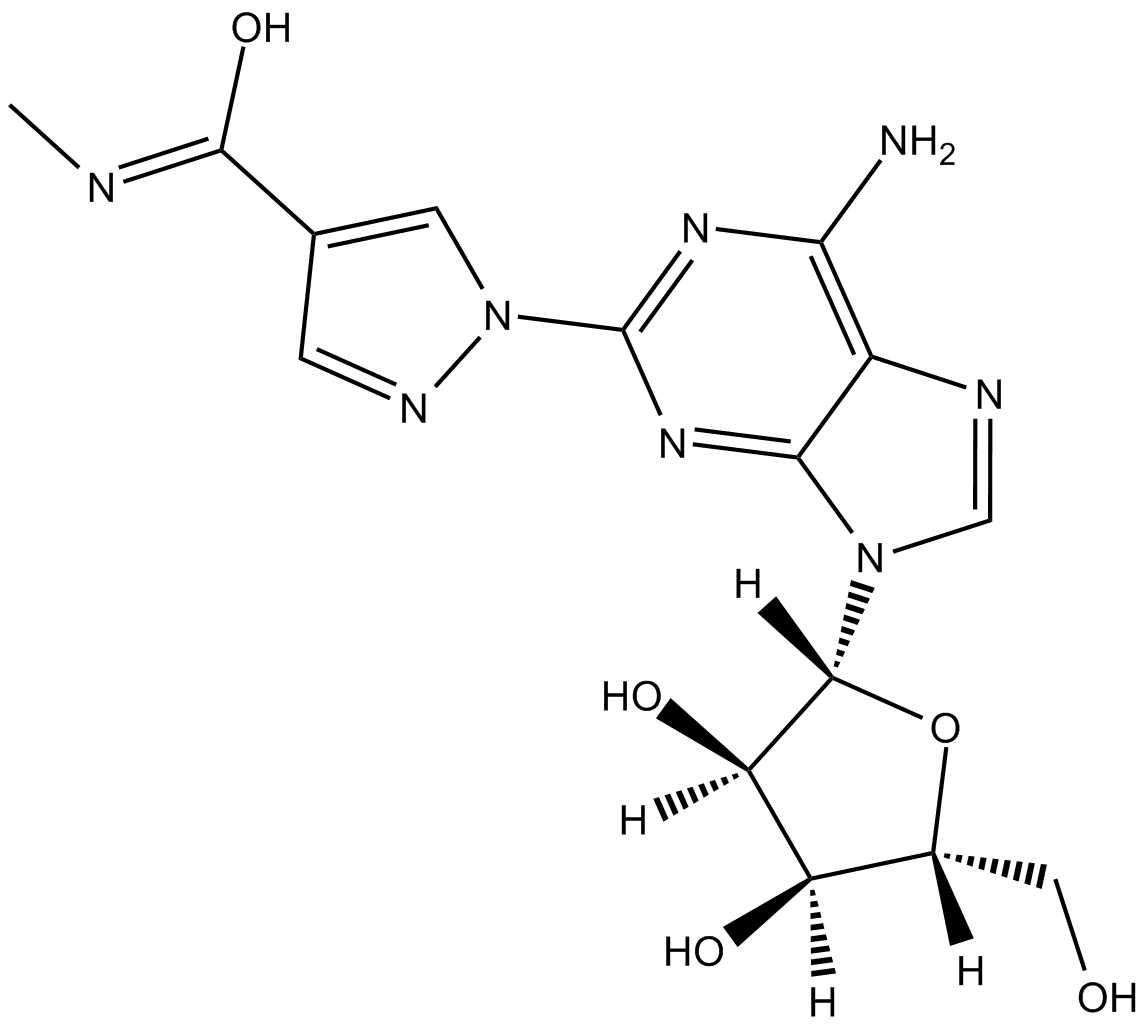
Cas No.: 313348-27-5
Sample solution is provided at 25 µL, 10mM.
_1-3.$$$39978408@51.jpg');)
_1-9.$$$38538795@65.jpg');)
_1-9.$$$39112701@51.jpg');)
_1-7.$$$37316672@70.jpg');)
_366-372.$$$36198801@70.jpg');)
.$$$38565142@65.jpg');)
_1867-1883.$$$33248023@67.jpg');)
_eads6055.$$$39977546@45.jpg');)
_eadm9805.$$$40080571@45.jpg');)
_eadj3020.$$$39666821@45.jpg');)
_1-20.$$$39757301@28.jpg');)
_1-24.$$$38898113@28.jpg');)
_273-287.$$$36806353@46.jpg');)
_1-16.$$$37156877@44.jpg');)
_1-19.$$$37460805@44.jpg');)
_1291-1307.$$$34518654@46.jpg');)
Regadenoson is a selective A2A adenosine receptor agonist with coronary vasodilatory activity[1-2]. Regadenoson functions by selectively activating A2A adenosine receptors, which are predominantly distributed on coronary artery smooth muscle cells. This activation increases adenylate cyclase activity, elevates intracellular cyclic adenosine monophosphate (cAMP) levels, thereby relaxing coronary vessels and significantly augmenting coronary blood flow[3-4].
In vitro, Regadenoson (10µM) was administered to mouse brain endothelial cells (bEnd.3) and rat brain microvascular endothelial cells (RBMEC) for durations ranging from 30 minutes to 4 hours. Treatment with Regadenoson induced cytoskeletal actin filament depolymerization via A2AR activation and downregulated the expression of tight junction proteins (claudin-5, occludin) and adherens junction proteins (VE-cadherin), resulting in a transient disruption of endothelial barrier function[5]. Non-small cell lung cancer cells (A549, H1299) were treated with Regadenoson (5–10µM) for 6 hours. Regadenoson upregulated the expression of the transcription factor Snail via the cAMP/PKA/CREB and PI3K/AKT signaling pathways, thereby inducing epithelial-mesenchymal transition (EMT) [6].
In vivo, K18-hACE2 transgenic mice infected with SARS-CoV-2 received a continuous subcutaneous infusion of Regadenoson (0.5µL/h; 80µg/mL) via an implanted Alzet micro-osmotic pump, initiated prior to infection and sustained for 7 days. Regadenoson significantly improved survival rates and delayed the time to death in the mice[7]. Normal F344 rats received a single intravenous tail vein injection of Regadenoson (0.5µg/kg) administered 60 or 90 minutes after oral temozolomide. Regadenoson significantly increased the concentration of temozolomide in the brain tissue and the brain-to-plasma concentration ratio at the 120-minute time point[8].
References:
[1] Bengalorkar GM, Bhuvana K, Sarala N, et al. Regadenoson. J Postgrad Med. 2012 Apr-Jun;58(2):140-6.
[2] Garnock-Jones KP, Curran MP. Regadenoson. Am J Cardiovasc Drugs. 2010;10(1):65-71.
[3] Ye Z, Sheu WC, Qu H, et al. Autocatalytic, Brain Tumor-Targeting Delivery of Bardoxolone Methyl Self-Assembled Nanoparticles for Glioblastoma Treatment. Small Sci. 2024 May 22;4(8):2400081.
[4] Han L, Cai Q, Tian D, et al. Targeted drug delivery to ischemic stroke via chlorotoxin-anchored, lexiscan-loaded nanoparticles. Nanomedicine. 2016 Oct;12(7):1833-1842.
[5] Vézina A, Manglani M, Morris D, et al. Adenosine A2A Receptor Activation Enhances Blood-Tumor Barrier Permeability in a Rodent Glioma Model. Mol Cancer Res. 2021 Dec;19(12):2081-2095.
[6] Lu Y, Yang Y, Chang T, et al. Lactate drives CD38 signaling to promote Epithelial-Mesenchymal Transition through Snail induction in non-small cell lung cancer cells. J Cell Commun Signal. 2024 Feb 14;18(1):e12018.
[7] Rabin J, Zhao Y, Mostafa E, et al. Regadenoson for the treatment of COVID-19: A five case clinical series and mouse studies. PLoS One. 2023 Aug 11;18(8):e0288920.
[8] Jackson S, Anders NM, Mangraviti A, et al. The effect of regadenoson-induced transient disruption of the blood-brain barrier on temozolomide delivery to normal rat brain. J Neurooncol. 2016 Feb;126(3):433-9.
| Cell experiment [1]: | |
Cell lines | A549 and H1299 cells (human non-small cell lung cancer cell lines) |
Preparation Method | A549 and H1299 cells were maintained in Dulbecco's minimal essential medium (DMEM) supplemented with 10% fetal bovine serum (FBS) at 37°C, 5% CO₂. Cells were treated with Regadenoson at concentrations of 5–10µM for 6 hours. |
Reaction Conditions | 5–10µM; 6h. |
Applications | Regadenoson significantly induced epithelial-mesenchymal transition (EMT), characterized by downregulation of E-cadherin and upregulation of N-cadherin, fibronectin, and Snail. Regadenoson also activated the A2AR-mediated cAMP/PKA/CREB and PI3K/AKT signaling pathways, increasing phosphorylated AKT and CREB levels. The pro-migratory effects of Regadenoson were abrogated by Snail knockdown, confirming Snail's essential role in Regadenoson-induced EMT. |
| Animal experiment [2]: | |
Animal models | K18-hACE2 transgenic mice (B6.Cg-Tg(K18-ACE2)2Prlmn/J) |
Preparation Method | Mice were subcutaneously implanted with 7-day Alzet osmotic pumps delivering Regadenoson (0.5μL/h;80μg/mL) or saline, starting just prior to intranasal infection with SARS-CoV-2 (1250PFU). Mice were monitored for survival and euthanized based on clinical endpoints (e.g., >20% weight loss). |
Dosage form | 0.5μL/h;80μg/mL; s.c.; Continuous infusion via osmotic pump for 7 days. |
Applications | Regadenoson significantly increased 10-day survival from 10% (saline control) to 40% in SARS-CoV-2-infected mice, delaying mortality with most deaths occurring on day 7 (coinciding with pump exhaustion) versus day 4–5 in controls. |
References: | |
| Cas No. | 313348-27-5 | SDF | |
| Überlieferungen | CVT-3146, Lexiscan | ||
| Chemical Name | (Z)-1-(6-amino-9-((2R,3R,4S,5R)-3,4-dihydroxy-5-(hydroxymethyl)tetrahydrofuran-2-yl)-9H-purin-2-yl)-N-methyl-1H-pyrazole-4-carbimidic acid | ||
| Canonical SMILES | C/N=C(O)/C(C=N1)=CN1C2=NC(N)=C(N=CN3[C@@]4([H])[C@@](O)([H])[C@@](O)([H])[C@@](O4)([H])CO)C3=N2 | ||
| Formula | C15H18N8O5 | M.Wt | 390.35 |
| Löslichkeit | ≥ 18.05mg/mL in DMSO | Storage | Store at -20°C |
| General tips | Please select the appropriate solvent to prepare the stock solution according to the
solubility of the product in different solvents; once the solution is prepared, please store it in
separate packages to avoid product failure caused by repeated freezing and thawing.Storage method
and period of the stock solution: When stored at -80°C, please use it within 6 months; when stored
at -20°C, please use it within 1 month. To increase solubility, heat the tube to 37°C and then oscillate in an ultrasonic bath for some time. |
||
| Shipping Condition | Evaluation sample solution: shipped with blue ice. All other sizes available: with RT, or with Blue Ice upon request. | ||
| Prepare stock solution | |||

|
1 mg | 5 mg | 10 mg |
| 1 mM | 2.5618 mL | 12.809 mL | 25.618 mL |
| 5 mM | 512.4 μL | 2.5618 mL | 5.1236 mL |
| 10 mM | 256.2 μL | 1.2809 mL | 2.5618 mL |
Step 1: Enter information below (Recommended: An additional animal making an allowance for loss during the experiment)
 g
μL
g
μL
Step 2: Enter the in vivo formulation (This is only the calculator, not formulation. Please contact us first if there is no in vivo formulation at the solubility Section.)
Calculation results:
Working concentration: mg/ml;
Method for preparing DMSO master liquid: mg drug pre-dissolved in μL DMSO ( Master liquid concentration mg/mL, Please contact us first if the concentration exceeds the DMSO solubility of the batch of drug. )
Method for preparing in vivo formulation: Take μL DMSO master liquid, next addμL PEG300, mix and clarify, next addμL Tween 80, mix and clarify, next add μL saline, mix and clarify.
Method for preparing in vivo formulation: Take μL DMSO master liquid, next add μL Corn oil, mix and clarify.
Note: 1. Please make sure the liquid is clear before adding the next solvent.
2. Be sure to add the solvent(s) in order. You must ensure that the solution obtained, in the previous addition, is a clear solution before proceeding to add the next solvent. Physical methods such as vortex, ultrasound or hot water bath can be used to aid dissolving.
3. All of the above co-solvents are available for purchase on the GlpBio website.
Quality Control & SDS
- View current batch:
- Purity: >99.50% Appearance: A solid
- COA (Certificate of Analysis)
- SDS (Safety Data Sheet)
- Datasheet
Average Rating: 5 (Based on Reviews and 5 reference(s) in Google Scholar.)