

Didox (Synonyms: NSC 324360) |
Catalog No.GC12266
 One-Click Copy Product Info
|

synthetic antioxidant
Products are for research use only. Not for human use. We do not sell to patients.
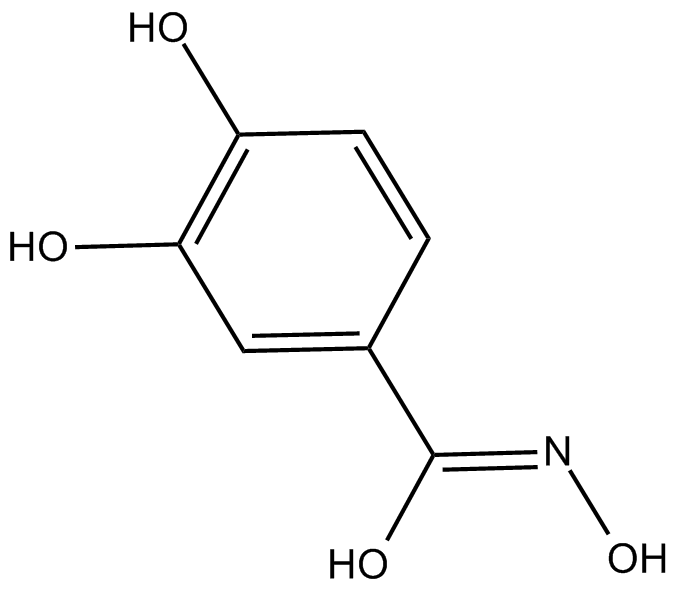
Cas No.: 69839-83-4
Sample solution is provided at 25 µL, 10mM.
_1-3.$$$39978408@51.jpg');)
_1-9.$$$38538795@65.jpg');)
_1-9.$$$39112701@51.jpg');)
_1-7.$$$37316672@70.jpg');)
_366-372.$$$36198801@70.jpg');)
.$$$38565142@65.jpg');)
_1867-1883.$$$33248023@67.jpg');)
_eads6055.$$$39977546@45.jpg');)
_eadm9805.$$$40080571@45.jpg');)
_eadj3020.$$$39666821@45.jpg');)
_1-20.$$$39757301@28.jpg');)
_1-24.$$$38898113@28.jpg');)
_273-287.$$$36806353@46.jpg');)
_1-16.$$$37156877@44.jpg');)
_1-19.$$$37460805@44.jpg');)
_1291-1307.$$$34518654@46.jpg');)
Didox is a synthetic antioxidant.
Polyhydroxylated aromatic compounds, both natural and synthetic, are important biological antioxidants.
In vitro: In a previous study, the brain tissue from patients with HIV encephalitis was immunostained for lipid peroxidation. The presence of oxidized proteins in the CSF and CSF-induced progressive decrease in mitochondrial activity correlated with the severity of cognitive impairment. Didox together with L-deprenyl, imidate, diosgenin, and ebselen could block the CSF-induced toxicity. No effect of trimidox, ruthenium red, or Quercetin was seen [1]. Another study found that the exposure of didox prior or post to radiation in both PC-3/vector and PC-3/Bcl-2 transfectants led to an increase in radiation enhancement ratios. A significant reduction in G(2)M phase was observed in cells exposed to didox post IR when compared to cells exposed to IR alone. In addition, the exposure to didox after radiation in PC-3/vector significantly abrogated radiation-induced Bcl-2 upregulation [2].
In vivo: In syngeneic, therapy-resistant AML models, single agent didox treatment led to a significant reduction in leukemia burden and a survival benefit. Didox was well tolerated and didox exposure at levels that impaired leukemia growth did not inhibit normal HSC engraftment [3].
Clinical trial: So far, no clinical study has been conducted.
References:
[1] Turchan, J. ,Pocernich, C.B.,Gairola, C., et al. Oxidative stress in HIV demented patients and protection ex vivo with novel antioxidants. Neurology 60, 307-314 (2003).
[2] Inayat, M. S.,Chendil, D.,Mohiuddin, M., et al. Didox (A novel ribonucleotide reductase inhibitor) Overcomes bcl-2 mediated radiation resistance in prostate cancer cell line PC-3. Cancer Biology and Therapy 1(5), 539-545 (2002).
[3] Cook GJ, Caudell DL, Elford HL, Pardee TS. The efficacy of the ribonucleotide reductase inhibitor Didox in preclinical models of AML. PLoS One. 2014 Nov 17;9(11):e112619.
Cell experiment: | RAW264.7 macrophages are treated with Didox alone, with 0.1 μg/mL LPS, or the two in combination. Cellular respiration, as an indication of cytotoxicity, is measured by the MTT assay, which quantifies mitochondrial dehydrogenase activity. Macrophages are plated into 96 well Costar plates at 105 cells per well in 100 μL of DMEM media. After 4 h of incubation at 37°C for adherence, compounds and DMSO carrier control (0.01% final) are added in triplicate over serial dilutions beginning with 200 μM per well in a total volume of 200 μL, and the plates incubated for 24 h. Four h before termination of the assay, each well receives 20 μL of a 5 mg/mL MTT solution in un-supplemented DMEM. After centrifugation, the supernatant for each well is discarded and cells containing reduced MTT are solubilized with 100 μL of acidified isopropanol (4 mM HCl, 0.1% NP-40 in isopropanol). Following a brief period of shaking, the optical density (O.D.) for each well is recorded at 550 nm. Each experiment is repeated three times and the data averaged from each triplicate, then expressed as percentage of the control O.D. values for each experiment[1]. |
Animal experiment: | Mice[2]Luciferase-tagged leukemia cells are transplanted into 8- week old, sublethally irradiated (4.5 Gy) C57Bl/6 mice by tail vein injection of 1.0×10⁶ cells per mouse. Mice are injected with 150 mg/kg D-Luciferin, anesthetised with Isoflurane, and imaged using the IVIS 100 imaging system. Mice begin treatment with Didox upon detection of clear signal. The animals are treated with daily administrations of Didox (NSC-324360) at 425 mg/kg Didox by intraperitoneal injection (IP) for 5 days. Control animals receive 5% dextrose water by IP injection. Repeat imaging is performed on the day following the final treatment[2]. |
References: [1]. Matsebatlela TM, et al. 3,4-Dihydroxy-benzohydroxamic acid (Didox) suppresses pro-inflammatory profiles and oxidative stress in TLR4-activated RAW264.7 murine macrophages. Chem Biol Interact. 2015 May 25;233:95-105. | |
| Cas No. | 69839-83-4 | SDF | |
| Synonyms | NSC 324360 | ||
| Chemical Name | N-3,4-tridhydroxy-benzamide | ||
| Canonical SMILES | ONC(=O)c1ccc(O)c(O)c1 | ||
| Formula | C7H7NO4 | M.Wt | 169.1 |
| Solubility | ≤20mg/ml in ethanol;20mg/ml in DMSO;20mg/ml in dimethyl formamide | Storage | Store at -20°C |
| General tips | Please select the appropriate solvent to prepare the stock solution according to the
solubility of the product in different solvents; once the solution is prepared, please store it in
separate packages to avoid product failure caused by repeated freezing and thawing.Storage method
and period of the stock solution: When stored at -80°C, please use it within 6 months; when stored
at -20°C, please use it within 1 month. To increase solubility, heat the tube to 37°C and then oscillate in an ultrasonic bath for some time. |
||
| Shipping Condition | Evaluation sample solution: shipped with blue ice. All other sizes available: with RT, or with Blue Ice upon request. | ||
| Prepare stock solution | |||

|
1 mg | 5 mg | 10 mg |
| 1 mM | 5.9137 mL | 29.5683 mL | 59.1366 mL |
| 5 mM | 1.1827 mL | 5.9137 mL | 11.8273 mL |
| 10 mM | 591.4 μL | 2.9568 mL | 5.9137 mL |
Step 1: Enter information below (Recommended: An additional animal making an allowance for loss during the experiment)
 g
μL
g
μL
Step 2: Enter the in vivo formulation (This is only the calculator, not formulation. Please contact us first if there is no in vivo formulation at the solubility Section.)
Calculation results:
Working concentration: mg/ml;
Method for preparing DMSO master liquid: mg drug pre-dissolved in μL DMSO ( Master liquid concentration mg/mL, Please contact us first if the concentration exceeds the DMSO solubility of the batch of drug. )
Method for preparing in vivo formulation: Take μL DMSO master liquid, next addμL PEG300, mix and clarify, next addμL Tween 80, mix and clarify, next add μL saline, mix and clarify.
Method for preparing in vivo formulation: Take μL DMSO master liquid, next add μL Corn oil, mix and clarify.
Note: 1. Please make sure the liquid is clear before adding the next solvent.
2. Be sure to add the solvent(s) in order. You must ensure that the solution obtained, in the previous addition, is a clear solution before proceeding to add the next solvent. Physical methods such as vortex, ultrasound or hot water bath can be used to aid dissolving.
3. All of the above co-solvents are available for purchase on the GlpBio website.
Quality Control & SDS
- View current batch:
- Purity: >98.00% Appearance: A solid
- COA (Certificate of Analysis)
- SDS (Safety Data Sheet)
- Datasheet
Average Rating: 5 (Based on Reviews and 25 reference(s) in Google Scholar.)