

Diosgenin (Synonyms: Nitogenin, NSC 33396, 3β-hydroxy-5-Spirostene) |
Catalog No.GN10115
 One-Click Copy Product Info
|

Diosgenin is a naturally occurring steroidal sapogenin that can inhibit the STAT3 signaling pathway and acts as an activator of Pdia3/ERp57, possessing a variety of important pharmacological activities.
Products are for research use only. Not for human use. We do not sell to patients.
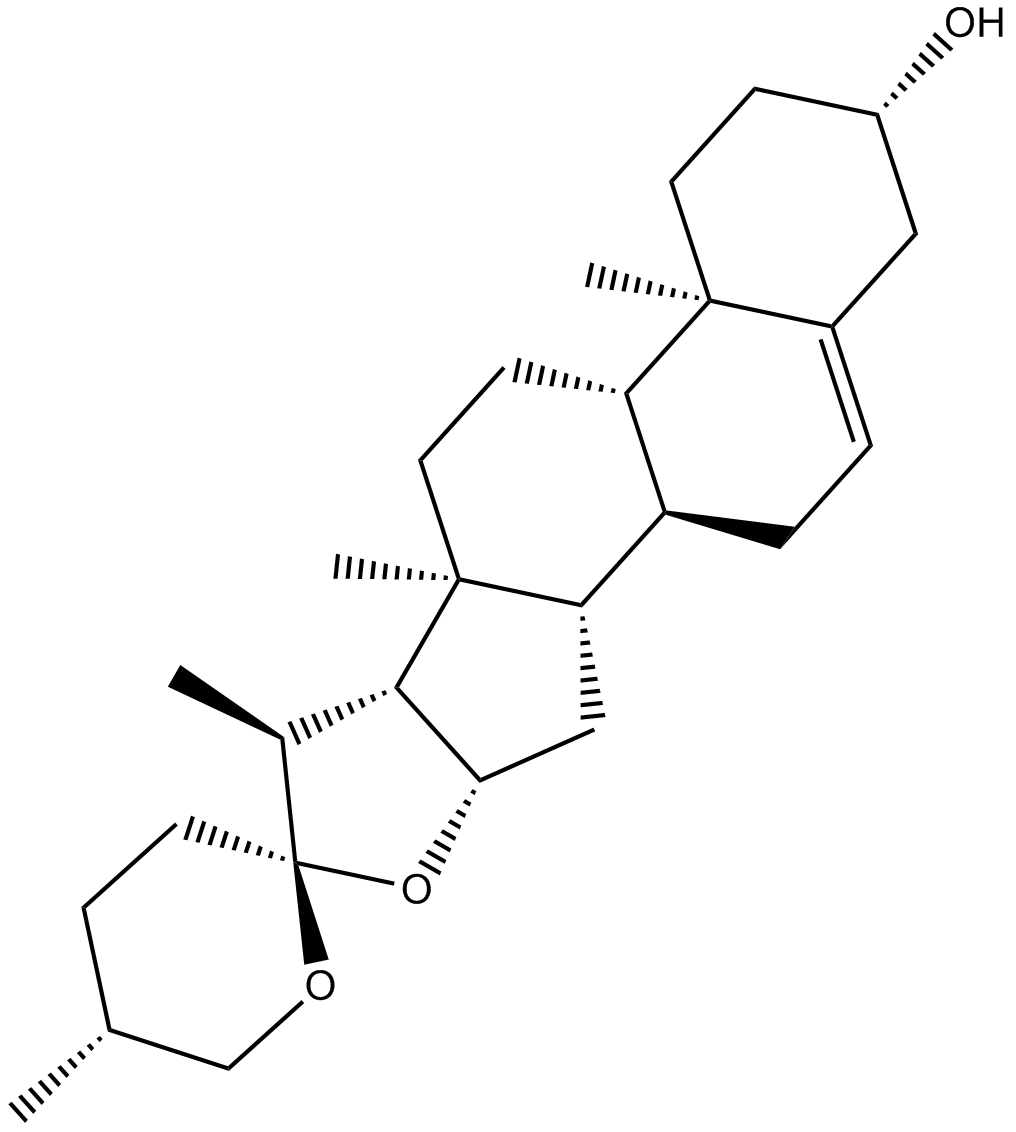
Cas No.: 512-04-9
Sample solution is provided at 25 µL, 10mM.
_1-3.$$$39978408@51.jpg');)
_1-9.$$$38538795@65.jpg');)
_1-9.$$$39112701@51.jpg');)
_1-7.$$$37316672@70.jpg');)
_366-372.$$$36198801@70.jpg');)
.$$$38565142@65.jpg');)
_1867-1883.$$$33248023@67.jpg');)
_eads6055.$$$39977546@45.jpg');)
_eadm9805.$$$40080571@45.jpg');)
_eadj3020.$$$39666821@45.jpg');)
_1-20.$$$39757301@28.jpg');)
_1-24.$$$38898113@28.jpg');)
_273-287.$$$36806353@46.jpg');)
_1-16.$$$37156877@44.jpg');)
_1-19.$$$37460805@44.jpg');)
_1291-1307.$$$34518654@46.jpg');)
Diosgenin is a naturally occurring steroidal sapogenin that can inhibit the STAT3 signaling pathway and acts as an activator of Pdia3/ERp57, possessing a variety of important pharmacological activities[1-2]. Diosgenin has been shown in studies to have lipid-lowering, hypoglycemic, antioxidant, anti-inflammatory, and anti-proliferative effects, among others[3-4].
In vitro, Diosgenin (50μM) treatment of MCF-7 and MDA-MB-231 breast cancer cells for 72 hours, Diosgenin significantly inhibits cell viability, induces apoptosis, and reduces cell invasive ability. Treatment of MCF-7 and MDA-MB-231 cells with Diosgenin (50μM) for 72 hours significantly downregulates the mRNA and protein expression levels of Skp2 and upregulates the protein expression of its downstream targets p57 and FOXO1[5]. Pretreatment of human periodontal ligament stem cells (hPDLSCs) with Diosgenin (2μM) for 1 hour, followed by culture under lipopolysaccharide (LPS; 1μg/ml) stimulation, Diosgenin significantly inhibits the LPS-induced expression of inflammatory factors TNF-α, IL-1β, and IL-6, and suppresses the activation of the NF-κB pathway (reducing p-IκBα levels and p65 nuclear translocation)[6].
In vivo, oral administration of Diosgenin (20-80mg/kg/day) to epileptic model rats (starting 7 days before epileptogenesis induction and continuing until the end of the experiment), Diosgenin significantly promotes the differentiation of oligodendrocyte precursor cells (OPCs) into mature myelinating oligodendrocytes in the corpus callosum region and alleviates seizure severity and weight loss[7]. Intraperitoneal injection of Diosgenin (1, 10, 20mg/kg/day) in Crystalline Silica (50mg/kg) and 500×10⁷CFU Mycobacterium smegmatis-induced pulmonary tuberculosis Sprague-Dawley rats (starting from the first day of crystalline silica induction and continuing for 50 days), Diosgenin significantly inhibits Mycobacterium smegmatis growth (IC₅₀=0.006043μg/mL), reduces lung tissue malondialdehyde (MDA) levels, increases superoxide dismutase (SOD) and catalase (CAT) activity, and improves pathological lung fibrosis damage[8].
References:
[1] Singh S, Varshney M, Sharma H. Amarogentin, Natural Bitter Terpenoids: Research Update with Pharmacological Potential, Patent and Toxicity Aspects. Curr Top Med Chem. 2025 Aug 21.
[2] Patel K, Kumar V, Verma A, et al. Amarogentin as Topical Anticancer and Anti-Infective Potential: Scope of Lipid Based Vesicular in its Effective Delivery. Recent Pat Antiinfect Drug Discov. 2019;14(1):7-15.
[3] Wölfle U, Haarhaus B, Schempp CM. Amarogentin Displays Immunomodulatory Effects in Human Mast Cells and Keratinocytes. Mediators Inflamm. 2015;2015:630128.
[4] Sur S, Pal D, Banerjee K, et al. Amarogentin regulates self renewal pathways to restrict liver carcinogenesis in experimental mouse model. Mol Carcinog. 2016 Jul;55(7):1138-49.
[5] Disasa D, Cheng L, Manzoor M, et al. Amarogentin from Gentiana rigescens Franch Exhibits Antiaging and Neuroprotective Effects through Antioxidative Stress. Oxid Med Cell Longev. 2020 Aug 1;2020:3184019.
[6] Zhang Y, Zhang Y, Wang J, et al. Amarogentin Inhibits Liver Cancer Cell Angiogenesis after Insufficient Radiofrequency Ablation via Affecting Stemness and the p53-Dependent VEGFA/Dll4/Notch1 Pathway. Biomed Res Int. 2020 Oct 20;2020:5391058.
[7] Li S, Li X, He F, et al. Amarogentin promotes osteoblast differentiation in oestrogen-deficiency-induced osteoporosis rats by modulating the Nrf-2/MAPK/ERK signalling pathway. Arch Med Sci. 2019 Nov 11;19(2):452-457.
[8] Niu HS, Chao PC, Ku PM, et al. Amarogentin ameliorates diabetic disorders in animal models. Naunyn Schmiedebergs Arch Pharmacol. 2016 Nov;389(11):1215-1223.
| Cell experiment [1]: | |
Cell lines | MCF-7 and MDA-MB-231 cells |
Preparation Method | MCF-7 and MDA-MB-231 cells were maintained in Dulbecco's minimal essential medium (DMEM) supplemented with 10% fetal bovine serum (FBS) and 1% penicillin/streptomycin at 37°C, 5% CO₂. Cells were treated with Diosgenin at concentrations of 50μM for 72 hours. |
Reaction Conditions | 50μM; 72hours. |
Applications | Diosgenin significantly inhibited cell viability and induced apoptosis in MCF-7 and MDA-MB-231 cells. Diosgenin also reduced cell invasion and downregulated the expression of Skp2 at both mRNA and protein levels, while upregulating Diosgenin downstream targets p57 and FOXO1. |
| Animal experiment [2]: | |
Animal models | Sprague Dawley rats |
Preparation Method | Rats were administered Lithium Chloride (125mg/kg) followed by Pilocarpine (30mg/kg) to induce status epilepticus. Diosgenin was administered orally at doses of 20, 40, 60, and 80mg/kg for 7 days prior to epileptogenesis induction. |
Dosage form | 20-80mg/kg; oral gavage; once daily for 7 days. |
Applications | Diosgenin (80mg/kg) significantly attenuated seizure severity, reduced body weight loss, and promoted oligodendrocyte precursor cells (OPCs) differentiation into mature myelinating oligodendrocytes in the corpus callosum. Diosgenin disrupted GLUR2/GAPDH protein complex formation and inhibited GAPDH nuclear translocation, thereby enhancing myelin repair in epileptic rats. |
References: | |
| Cas No. | 512-04-9 | SDF | |
| Synonyms | Nitogenin, NSC 33396, 3β-hydroxy-5-Spirostene | ||
| Chemical Name | (2'R,4S,5'R,6aR,6bS,8aS,8bR,9S,11aS,12aS,12bS)-5',6a,8a,9-tetramethyl-1,3,3',4,4',5,5',6,6a,6b,6',7,8,8a,8b,9,11a,12,12a,12b-icosahydrospiro[naphtho[2',1':4,5]indeno[2,1-b]furan-10,2'-pyran]-4-ol | ||
| Formula | C27H42O3 | M.Wt | 414.61 |
| Solubility | Ethanol: 4.1mg/ml; DMSO:≤1mg/ml | Storage | Store at -20°C |
| General tips | Please select the appropriate solvent to prepare the stock solution according to the
solubility of the product in different solvents; once the solution is prepared, please store it in
separate packages to avoid product failure caused by repeated freezing and thawing.Storage method
and period of the stock solution: When stored at -80°C, please use it within 6 months; when stored
at -20°C, please use it within 1 month. To increase solubility, heat the tube to 37°C and then oscillate in an ultrasonic bath for some time. |
||
| Shipping Condition | Evaluation sample solution: shipped with blue ice. All other sizes available: with RT, or with Blue Ice upon request. | ||
| Prepare stock solution | |||

|
1 mg | 5 mg | 10 mg |
| 1 mM | 2.4119 mL | 12.0595 mL | 24.1191 mL |
| 5 mM | 482.4 μL | 2.4119 mL | 4.8238 mL |
| 10 mM | 241.2 μL | 1.206 mL | 2.4119 mL |
Step 1: Enter information below (Recommended: An additional animal making an allowance for loss during the experiment)
 g
μL
g
μL
Step 2: Enter the in vivo formulation (This is only the calculator, not formulation. Please contact us first if there is no in vivo formulation at the solubility Section.)
Calculation results:
Working concentration: mg/ml;
Method for preparing DMSO master liquid: mg drug pre-dissolved in μL DMSO ( Master liquid concentration mg/mL, Please contact us first if the concentration exceeds the DMSO solubility of the batch of drug. )
Method for preparing in vivo formulation: Take μL DMSO master liquid, next addμL PEG300, mix and clarify, next addμL Tween 80, mix and clarify, next add μL saline, mix and clarify.
Method for preparing in vivo formulation: Take μL DMSO master liquid, next add μL Corn oil, mix and clarify.
Note: 1. Please make sure the liquid is clear before adding the next solvent.
2. Be sure to add the solvent(s) in order. You must ensure that the solution obtained, in the previous addition, is a clear solution before proceeding to add the next solvent. Physical methods such as vortex, ultrasound or hot water bath can be used to aid dissolving.
3. All of the above co-solvents are available for purchase on the GlpBio website.
Quality Control & SDS
- View current batch:
- Purity: >98.00% Appearance: A solid
- COA (Certificate of Analysis)
- SDS (Safety Data Sheet)
- Datasheet
Average Rating: 5 (Based on Reviews and 30 reference(s) in Google Scholar.)