

DL-AP5 (Synonyms: DL-2-Amino-5-Phosphonovaleric acid,2-APV) |
Catalog No.GC17206
 One-Click Copy Product Info
|

DL-AP5 is an racemic form of a selective NMDA (N-methyl-D-aspartate) receptor antagonist. D-AP5 is the active (-) stereoisomer, which can competitively inhibit the glutamate binding site of the NMDA receptor (Kd = 1.4μM), while the (+) isomer (L-AP5) shows relatively low NMDA receptor antagonist activity.
Products are for research use only. Not for human use. We do not sell to patients.
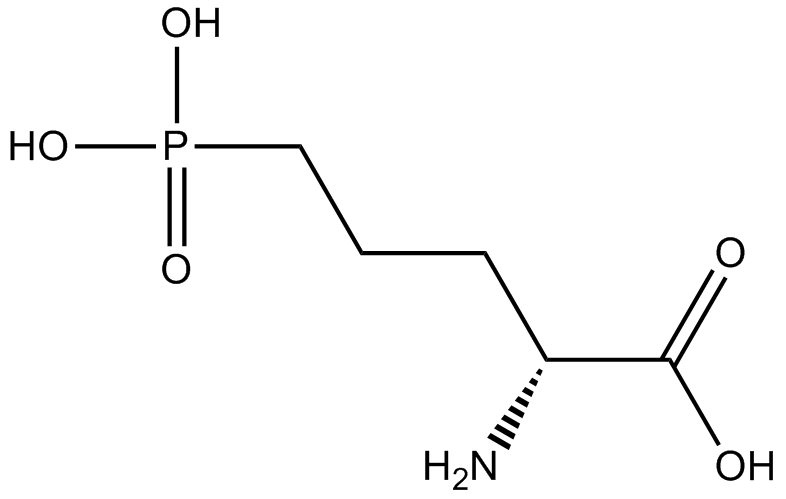
Cas No.: 76326-31-3
Sample solution is provided at 25 µL, 10mM.
DL-AP5 is an racemic form of a selective NMDA (N-methyl-D-aspartate) receptor antagonist. D-AP5 is the active (-) stereoisomer, which can competitively inhibit the glutamate binding site of the NMDA receptor (Kd = 1.4μM), while the (+) isomer (L-AP5) shows relatively low NMDA receptor antagonist activity [1]. NMDA is a glutamate-gated ion channel widely present in the central nervous system and plays a crucial role in excitatory synaptic transmission [2]. DL-AP5 has significant analgesic activity and can block the channels in rabbit retina [3-4].
In vitro, DL-AP5 (100μM; 6h) can inhibit the level of Arc/Arg3.1 protein in cortical neurons induced by glutamate [5]. Pre-incubation with DL-AP5 (100μM; 20min) reduces the phosphorylation level of intermediate filament (IF) protein in rat brain cortex slices treated with α-ketoisocaproic acid (KIC) [6].
In vivo, DL-AP5 (20, 40mM; 14 days; intracerebroventricular injection) significantly reduces the vaginal opening age of immature female rats and inhibits the effect of intravenous injection of NMDA on the response to luteinizing hormone [7]. DL-AP5 (0, 2.5, 5 and 10nM; 10μl, single-dose intracerebroventricular injection) increases the food intake of broiler chickens in the 3-hour food deprivation (FD3) model in a dose-dependent manner and weakens the reduction in food consumption caused by the injection of ghrelin [8].
References:
[1] Evans, R.H., Francis, A.A., Jones, A.W., et al. The effects of a series of ω-phosphonic α-carboxylic amino acids on electrically evoked and excitant amino acid-induced responses in isolated spinal cord preparations. Br. J. Pharmacol. 75(1), 65-75 (1982).
[2] Paoletti P, Neyton J. NMDA receptor subunits: function and pharmacology. Curr Opin Pharmacol. 2007;7(1):39-47.
[3] Jafari-Sabet M. NMDA receptor blockers prevents the facilitatory effects of post-training intra-dorsal hippocampal NMDA and physostigmine on memory retention of passive avoidance learning in rats. Behav Brain Res. 2006;169(1):120-127.
[4] Massey SC, Miller RF. N-methyl-D-aspartate receptors of ganglion cells in rabbit retina. J Neurophysiol. 1990;63(1):16-30.
[5] Chen T, Zhu J, Yang LK, Feng Y, Lin W, Wang YH. Glutamate-induced rapid induction of Arc/Arg3.1 requires NMDA receptor-mediated phosphorylation of ERK and CREB. Neurosci Lett. 2017;661:23-28.
[6] Funchal C, Zamoner A, dos Santos AQ, Loureiro SO, Wajner M, Pessoa-Pureur R. Alpha-ketoisocaproic acid increases phosphorylation of intermediate filament proteins from rat cerebral cortex by mechanisms involving Ca2+ and cAMP. Neurochem Res. 2005;30(9):1139-1146.
[7] Wu F C W, Howe D C, Naylor A M. N‐Methyl‐DL‐Aspartate Receptor Antagonism by D‐2‐Amino‐5‐Phosphonovaleric Acid Delays Onset of Puberty in the Female Rat[J]. Journal of Neuroendocrinology, 1990, 2(5): 627-631.
[8] Taati M, Nayebzadeh H, Zendehdel M. The effects of DL-AP5 and glutamate on ghrelin-induced feeding behavior in 3-h food-deprived broiler cockerels. J Physiol Biochem. 2011;67(2):217-223.
| Cell experiment [1]: | |
Cell lines | Cortical neurons cells |
Preparation Method | Neurons were resuspended in neurobasal medium containing 2% B27 supplement and 0.5mM l-Glutamine, and then the neurons were seeded at a density of 3 × 10⁵ cells/cm2. Before seeding, culture vessels were coated with poly-l-lysine (PLL, 50μg/ml) at room temperature overnight. Cortical neurons were treated with 0.5mM glutamate (Glu) with or without the NMDAR antagonist DL-AP5 (100μM) or the AMPAR antagonist NBQX (100μM), and the expression of Arc/Arg3.1 was detected by western blot. |
Reaction Conditions | 100μM; 6h |
Applications | DL-AP5 significantly inhibited the increase in Arc/Arg3.1 protein levels in cortical neurons induced by glutamate to a certain extent. |
| Animal experiment [2]: | |
Animal models | chicken |
Preparation Method | Testing the effects of centrally administered of DL-AP5 and glutamate on the feeding response induced by ghrelin in chickens. The birds received 0, 2.5, 5, and 10nM of DL-AP5 in a volume of 10μl. Control group was injected with 10μl of 0.9% NaCl solution. Three hours before the beginning of the experiments, animals were deprived of food but with water ad lib. Immediately after injections, the birds were returned to their cages. Fresh food was supplied at the time of injection, and cumulative feed intake (grams) was recorded at 15, 30, 60, 120, and 180min after injection. |
Dosage form | 0, 2.5, 5, and 10nM; 10μl; single-dose; intraventricular injection |
Applications | DL-AP5 increased the food intake of broilers subjected to 3-hour food deprivation (FD3) in a dose-dependent manner. |
References: | |
| Cas No. | 76326-31-3 | SDF | |
| Synonyms | DL-2-Amino-5-Phosphonovaleric acid,2-APV | ||
| Chemical Name | (R)-2-amino-5-phosphonopentanoic acid | ||
| Canonical SMILES | OP(O)(CCC[C@H](C(O)=O)N)=O | ||
| Formula | C5H12NO5P | M.Wt | 197.13 |
| Solubility | 10mg/mL in PBS, pH 7.2 | Storage | Store at -20°C |
| General tips | Please select the appropriate solvent to prepare the stock solution according to the
solubility of the product in different solvents; once the solution is prepared, please store it in
separate packages to avoid product failure caused by repeated freezing and thawing.Storage method
and period of the stock solution: When stored at -80°C, please use it within 6 months; when stored
at -20°C, please use it within 1 month. To increase solubility, heat the tube to 37°C and then oscillate in an ultrasonic bath for some time. |
||
| Shipping Condition | Evaluation sample solution: shipped with blue ice. All other sizes available: with RT, or with Blue Ice upon request. | ||
| Prepare stock solution | |||

|
1 mg | 5 mg | 10 mg |
| 1 mM | 5.0728 mL | 25.364 mL | 50.7279 mL |
| 5 mM | 1.0146 mL | 5.0728 mL | 10.1456 mL |
| 10 mM | 507.3 μL | 2.5364 mL | 5.0728 mL |
Step 1: Enter information below (Recommended: An additional animal making an allowance for loss during the experiment)
 g
μL
g
μL
Step 2: Enter the in vivo formulation (This is only the calculator, not formulation. Please contact us first if there is no in vivo formulation at the solubility Section.)
Calculation results:
Working concentration: mg/ml;
Method for preparing DMSO master liquid: mg drug pre-dissolved in μL DMSO ( Master liquid concentration mg/mL, Please contact us first if the concentration exceeds the DMSO solubility of the batch of drug. )
Method for preparing in vivo formulation: Take μL DMSO master liquid, next addμL PEG300, mix and clarify, next addμL Tween 80, mix and clarify, next add μL saline, mix and clarify.
Method for preparing in vivo formulation: Take μL DMSO master liquid, next add μL Corn oil, mix and clarify.
Note: 1. Please make sure the liquid is clear before adding the next solvent.
2. Be sure to add the solvent(s) in order. You must ensure that the solution obtained, in the previous addition, is a clear solution before proceeding to add the next solvent. Physical methods such as vortex, ultrasound or hot water bath can be used to aid dissolving.
3. All of the above co-solvents are available for purchase on the GlpBio website.
Quality Control & SDS
- View current batch:
- Purity: >98.00% Appearance: A solid
- COA (Certificate of Analysis)
- SDS (Safety Data Sheet)
- Datasheet
Average Rating: 5 (Based on Reviews and 18 reference(s) in Google Scholar.)