

DT-061 |
Catalog No.GC34562
 One-Click Copy Product Info
|

DT-061 (SMAP) is an orally administered bioactive activator of protein phosphatase 2A (PP2A) that can be used to study tumors driven by KRAS (Kirsten rat sarcoma viral oncogene, a murine sarcoma virus oncogene) mutations and MYC (myelocytomatosis oncogene, myeloid cell tumor oncogene).
Products are for research use only. Not for human use. We do not sell to patients.
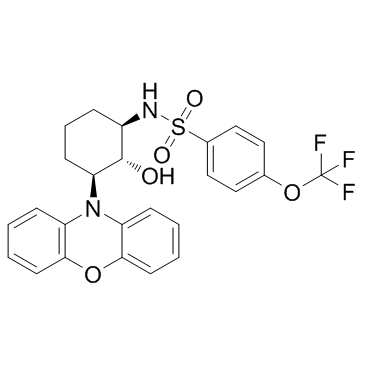
Cas No.: 1809427-19-7
Sample solution is provided at 25 µL, 10mM.
_1-3.$$$39978408@51.jpg');)
_1-9.$$$38538795@65.jpg');)
_1-9.$$$39112701@51.jpg');)
_1-7.$$$37316672@70.jpg');)
_366-372.$$$36198801@70.jpg');)
.$$$38565142@65.jpg');)
_1867-1883.$$$33248023@67.jpg');)
_eads6055.$$$39977546@45.jpg');)
_eadm9805.$$$40080571@45.jpg');)
_eadj3020.$$$39666821@45.jpg');)
_1-20.$$$39757301@28.jpg');)
_1-24.$$$38898113@28.jpg');)
_273-287.$$$36806353@46.jpg');)
_1-16.$$$37156877@44.jpg');)
_1-19.$$$37460805@44.jpg');)
_1291-1307.$$$34518654@46.jpg');)
DT-061 (SMAP) is an orally administered bioactive activator of protein phosphatase 2A (PP2A) that can be used to study tumors driven by KRAS (Kirsten rat sarcoma viral oncogene, a murine sarcoma virus oncogene) mutations and MYC (myelocytomatosis oncogene, myeloid cell tumor oncogene)[1, 2]. PP2A is an important intracellular regulatory protein, and its dysregulation is associated with the development and progression of various cancers[3]. DT-061 can disrupt the Golgi apparatus and endoplasmic reticulum, as well as lipid synthesis associated with these structures[4].
In vitro, treatment of KRAS mutant H441 and H358 cell lines with DT-061 (5, 10μM) for 3 weeks significantly inhibited cell colony formation and induced intracellular caspase-3/7 activation[5]. Treatment of MDA-MB-231 cells with DT-061 (5μM) for 24h, in combination with calmidazolium, significantly induced apoptosis and intracellular caspase-3/7 activation[6].
In vivo, oral administration of DT-061 (5mg/kg) to mice with H358 or H441 cell xenografts for 4 weeks significantly inhibited tumor growth, with better efficacy when combined with AZD6244. DT-061 also inhibited the expression of p-AKT (protein kinase B, PKB) and MYC in mice[5]. Oral administration of DT-061 (5mg/kg) to mice with heterotopic heart transplantation prolonged survival and suppressed the inflammatory immune response in the transplanted organs[7].
References:
[1] Brautigan D L, Farrington C, Narla G. Targeting protein phosphatase PP2A for cancer therapy: development of allosteric pharmaceutical agents[J]. Clinical Science, 2021, 135(13): 1545-1556.
[2] Farrington C C. Targeted Degradation of the MYC Oncogene Using PP2A-B56alpha Selective Small Molecule Modulators of Proteinphosphatase 2A as a Therapeutic Strategy for Treating Myc-Driven Cancers[M]. Case Western Reserve University, 2020.
[3] Seshacharyulu P, Pandey P, Datta K, et al. Phosphatase: PP2A structural importance, regulation and its aberrant expression in cancer[J]. Cancer letters, 2013, 335(1): 9-18.
[4] Vit G, Duro J, Rajendraprasad G, et al. Chemogenetic profiling reveals PP2A‐independent cytotoxicity of proposed PP2A activators iHAP1 and DT‐061[J]. The EMBO Journal, 2022, 41(14): e110611.
[5] Kauko O, O’Connor C M, Kulesskiy E, et al. PP2A inhibition is a druggable MEK inhibitor resistance mechanism in KRAS-mutant lung cancer cells[J]. Science translational medicine, 2018, 10(450): eaaq1093.
[6] Manoharan G B, Okutachi S, Abankwa D. Potential of phenothiazines to synergistically block calmodulin and reactivate PP2A in cancer cells[J]. PLoS One, 2022, 17(5): e0268635.
[7] Zhou X, Xu Q, Li W, et al. Protein phosphatase 2A activation promotes heart transplant acceptance in mice[J]. Transplantation, 2024, 108(3): e36-e48.
| Cell experiment [1]: | |
Cell lines | KRAS-mutant H441 and H358 cell lines |
Preparation Method | Clonogenic assay of H441 and H358 cells treated with increasing doses of DT-061 (5μM and 10μM), AZD6244 (200nM and 1μM), or the combination of DT-061 and AZD6244 for 3 weeks |
Reaction Conditions | 5, 10μM; 3 weeks |
Applications | Both DT-061 and AZD6244 showed dose-dependent inhibition of colony growth as single agents in both of the cell lines. In addition, doses of DT-061 and AZD6244 that alone did not affect colony growth resulted in a very apparent combinatorial activity. |
| Animal experiment [1]: | |
Animal models | Male BALB/c nu/nu mice |
Preparation Method | H358 or H441 cells were injected into the right flank of 6- to 8-week-old male BALB/c nu/nu mice. When tumor volumes reached an average of 100mm3, mice were randomized to treatment groups, and tumor volume was assessed by caliper measurement every other day throughout the study. Mice were treated by oral gavage with vehicle control, DT-061 (5mg/kg), AZD6244 (25mg/kg), or the combination of DT-061 (5mg/kg) and AZD6244 (25mg/kg) for 4 weeks. The body weights of mice were recorded weekly, and the percentage of body weights during treatment was calculated as weight at each time point/initial weight × 100. Animals were observed for signs of toxicity (mucous diarrhea, abdominal stiffness, or weight loss). Blood and tumor tissue were harvested 2 hours after the final dose of the treatment study. Tumors were both formalin-fixed for IHC and snap-frozen in liquid nitrogen for immunoblotting. |
Dosage form | 5mg/kg; 4 weeks; p.o. |
Applications | Assessed by inhibition of the tumor volume, both DT-061 and AZD6244 showed single-agent activity, but their combination was significantly more efficient than either of the compounds alone. Treatment with DT-061 resulted in suppression of both p-AKT (Protein Kinase B, PKB) and MYC (myelocytomatosis oncogene). |
References: | |
| Cas No. | 1809427-19-7 | SDF | |
| Canonical SMILES | O=S(C1=CC=C(OC(F)(F)F)C=C1)(N[C@H]2[C@H](O)[C@@H](N3C4=C(C=CC=C4)OC5=CC=CC=C35)CCC2)=O | ||
| Formula | C25H23F3N2O5S | M.Wt | 520.52 |
| Solubility | DMSO : 125 mg/mL (240.14 mM);Water : < 0.1 mg/mL (insoluble) | Storage | Store at -20°C |
| General tips | Please select the appropriate solvent to prepare the stock solution according to the
solubility of the product in different solvents; once the solution is prepared, please store it in
separate packages to avoid product failure caused by repeated freezing and thawing.Storage method
and period of the stock solution: When stored at -80°C, please use it within 6 months; when stored
at -20°C, please use it within 1 month. To increase solubility, heat the tube to 37°C and then oscillate in an ultrasonic bath for some time. |
||
| Shipping Condition | Evaluation sample solution: shipped with blue ice. All other sizes available: with RT, or with Blue Ice upon request. | ||
| Prepare stock solution | |||

|
1 mg | 5 mg | 10 mg |
| 1 mM | 1.9212 mL | 9.6058 mL | 19.2116 mL |
| 5 mM | 384.2 μL | 1.9212 mL | 3.8423 mL |
| 10 mM | 192.1 μL | 960.6 μL | 1.9212 mL |
Step 1: Enter information below (Recommended: An additional animal making an allowance for loss during the experiment)
 g
μL
g
μL
Step 2: Enter the in vivo formulation (This is only the calculator, not formulation. Please contact us first if there is no in vivo formulation at the solubility Section.)
Calculation results:
Working concentration: mg/ml;
Method for preparing DMSO master liquid: mg drug pre-dissolved in μL DMSO ( Master liquid concentration mg/mL, Please contact us first if the concentration exceeds the DMSO solubility of the batch of drug. )
Method for preparing in vivo formulation: Take μL DMSO master liquid, next addμL PEG300, mix and clarify, next addμL Tween 80, mix and clarify, next add μL saline, mix and clarify.
Method for preparing in vivo formulation: Take μL DMSO master liquid, next add μL Corn oil, mix and clarify.
Note: 1. Please make sure the liquid is clear before adding the next solvent.
2. Be sure to add the solvent(s) in order. You must ensure that the solution obtained, in the previous addition, is a clear solution before proceeding to add the next solvent. Physical methods such as vortex, ultrasound or hot water bath can be used to aid dissolving.
3. All of the above co-solvents are available for purchase on the GlpBio website.
Quality Control & SDS
- View current batch:
- Purity: >98.00% Appearance: A solid
- COA (Certificate of Analysis)
- SDS (Safety Data Sheet)
- Datasheet
Average Rating: 5 (Based on Reviews and 40 reference(s) in Google Scholar.)