

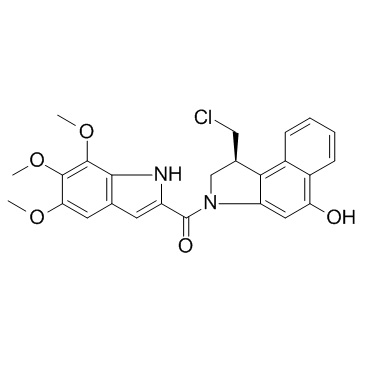
Duocarmycin TM (Synonyms: CBI-TMI) |
Catalog No.GC32187
 One-Click Copy Product Info
|

Duocarmycin TM is a highly potent synthetic DNA minor-groove-binding alkylating antitumor antibiotic that induces sequence-selective alkylation of double-stranded DNA.
Products are for research use only. Not for human use. We do not sell to patients.
Cas No.: 157922-77-5
Sample solution is provided at 25 µL, 10mM.
_1-3.$$$39978408@51.jpg');)
_1-9.$$$38538795@65.jpg');)
_1-9.$$$39112701@51.jpg');)
_1-7.$$$37316672@70.jpg');)
_366-372.$$$36198801@70.jpg');)
.$$$38565142@65.jpg');)
_1867-1883.$$$33248023@67.jpg');)
_eads6055.$$$39977546@45.jpg');)
_eadm9805.$$$40080571@45.jpg');)
_eadj3020.$$$39666821@45.jpg');)
_1-20.$$$39757301@28.jpg');)
_1-24.$$$38898113@28.jpg');)
_273-287.$$$36806353@46.jpg');)
_1-16.$$$37156877@44.jpg');)
_1-19.$$$37460805@44.jpg');)
_1291-1307.$$$34518654@46.jpg');)
Duocarmycin TM is a highly potent synthetic DNA minor-groove-binding alkylating antitumor antibiotic that induces sequence-selective alkylation of double-stranded DNA. Duocarmycin TM disrupts the integrity of the DNA double-helix structure, blocks replication and transcription, triggers S-phase arrest, and induces tumor cell apoptosis. Duocarmycin TM can be used in research related to malignant tumor models and ADC targeted delivery systems[1-4].
In vitro, SK-OV-3 human ovarian cancer cells were treated with Duocarmycin TM (0–10nM) for 72h. Duocarmycin TM concentration-dependently reduced cancer cell viability and inhibited cell proliferation, exhibiting extremely potent cytotoxic activity[5]. BJAB human Burkitt's lymphoma cells and WSU-DLCL2 diffuse large B-cell lymphoma cells were treated with Duocarmycin TM (0–100nM) for 4 days. Duocarmycin TM significantly decreased intracellular ATP production and cell viability and caused DNA damage[6].
References:
[1] Boger DL, Santillán A, Searcey M, et al. Synthesis and evaluation of duocarmycin and CC-1065 analogues containing modifications in the subunit linking amide. Journal of Organic Chemistry. 1999 Jul 9;64(14):5241-5244.
[2] Boger DL, Hughes TV, Hedrick MP. Synthesis, chemical properties, and biological evaluation of CC-1065 and duocarmycin analogues incorporating the 5-methoxycarbonyl-1,2,9,9a-tetrahydrocyclopropa. The Journal of Organic Chemistry. 2001 Apr;66(7):2207-2216.
[3] Jin W, Trzupek JD, Rayl TJ, et al. A unique class of duocarmycin and CC-1065 analogues subject to reductive activation. Journal of the American Chemical Society. 2007 Dec;129(49):15391-15397.
[4] Li LS, Sinha SC. Studies toward the duocarmycin prodrugs for the antibody prodrug therapy approach. Tetrahedron Letters. 2009 Jun;50(24):2933-2935.
[5] Mhetre AB, Lee H, Yang H, et al. Synthesis and anticancer activity of benzoselenophene and heteroaromatic derivatives of 1,2,9,9a-tetrahydrocyclopropa[c]benzo[e]indol-4-one (CBI). Organic & Biomolecular Chemistry. 2017 Feb;15(5):1198-1208.
[6] Zhang D, Le H, Cruz-Chuh JD, et al. Immolation of p-Aminobenzyl Ether Linker and Payload Potency and Stability Determine the Cell-Killing Activity of Antibody-Drug Conjugates with Phenol-Containing Payloads. Bioconjugate Chemistry. 2018 Feb;29(2):267-274.
| Cell experiment [1]: | |
Cell lines | SK-OV-3 cells (human ovarian cancer cell line) |
Preparation Method | SK-OV-3 cells were maintained in McCoy's 5A Medium supplemented with 10% fetal bovine serum (FBS) and 1% P/S (penicillin/streptomycin), inoculated into a 96-well plate at a concentration of 3 × 10⁴ cells/100μL per well, and cultured at 37°C for 4h, then treated with Duocarmycin TM at varying concentrations. |
Reaction Conditions | 0-10nM; 72h |
Applications | Duocarmycin TM exhibited potent cytotoxic activity against SK-OV-3 human ovarian cancer cells and concentration-dependently inhibited cancer cell growth, giving an IC₅₀ of 2.5nM, and served as the potency benchmark against which all synthesized CBI-benzoselenophene and heteroaromatic analogs in the study were compared. |
References: | |
| Cas No. | 157922-77-5 | SDF | |
| Synonyms | CBI-TMI | ||
| Canonical SMILES | ClC[C@H]1C2=C(C=CC=C3)C3=C(O)C=C2N(C(C4=CC(C=C(OC)C(OC)=C5OC)=C5N4)=O)C1 | ||
| Formula | C25H23ClN2O5 | M.Wt | 466.91 |
| Solubility | DMSO : ≥ 50 mg/mL (107.09 mM);Water : < 0.1 mg/mL (insoluble) | Storage | Store at -20°C |
| General tips | Please select the appropriate solvent to prepare the stock solution according to the
solubility of the product in different solvents; once the solution is prepared, please store it in
separate packages to avoid product failure caused by repeated freezing and thawing.Storage method
and period of the stock solution: When stored at -80°C, please use it within 6 months; when stored
at -20°C, please use it within 1 month. To increase solubility, heat the tube to 37°C and then oscillate in an ultrasonic bath for some time. |
||
| Shipping Condition | Evaluation sample solution: shipped with blue ice. All other sizes available: with RT, or with Blue Ice upon request. | ||
| Prepare stock solution | |||

|
1 mg | 5 mg | 10 mg |
| 1 mM | 2.1417 mL | 10.7087 mL | 21.4174 mL |
| 5 mM | 428.3 μL | 2.1417 mL | 4.2835 mL |
| 10 mM | 214.2 μL | 1.0709 mL | 2.1417 mL |
Step 1: Enter information below (Recommended: An additional animal making an allowance for loss during the experiment)
 g
μL
g
μL
Step 2: Enter the in vivo formulation (This is only the calculator, not formulation. Please contact us first if there is no in vivo formulation at the solubility Section.)
Calculation results:
Working concentration: mg/ml;
Method for preparing DMSO master liquid: mg drug pre-dissolved in μL DMSO ( Master liquid concentration mg/mL, Please contact us first if the concentration exceeds the DMSO solubility of the batch of drug. )
Method for preparing in vivo formulation: Take μL DMSO master liquid, next addμL PEG300, mix and clarify, next addμL Tween 80, mix and clarify, next add μL saline, mix and clarify.
Method for preparing in vivo formulation: Take μL DMSO master liquid, next add μL Corn oil, mix and clarify.
Note: 1. Please make sure the liquid is clear before adding the next solvent.
2. Be sure to add the solvent(s) in order. You must ensure that the solution obtained, in the previous addition, is a clear solution before proceeding to add the next solvent. Physical methods such as vortex, ultrasound or hot water bath can be used to aid dissolving.
3. All of the above co-solvents are available for purchase on the GlpBio website.
Quality Control & SDS
- View current batch:
- Purity: >98.50% Appearance: A solid
- COA (Certificate of Analysis)
- SDS (Safety Data Sheet)
- Datasheet
Average Rating: 5 (Based on Reviews and 36 reference(s) in Google Scholar.)