

Fenretinide (Synonyms: 4-HPR, 4-Hydroxy(phenyl)retinamide, MK-4016, Retinoic Acid p-hydroxyphenylamide, Ro 22-4667) |
Catalog No.GC17143
 One-Click Copy Product Info
|

A synthetic retinoic acid derivative
Products are for research use only. Not for human use. We do not sell to patients.
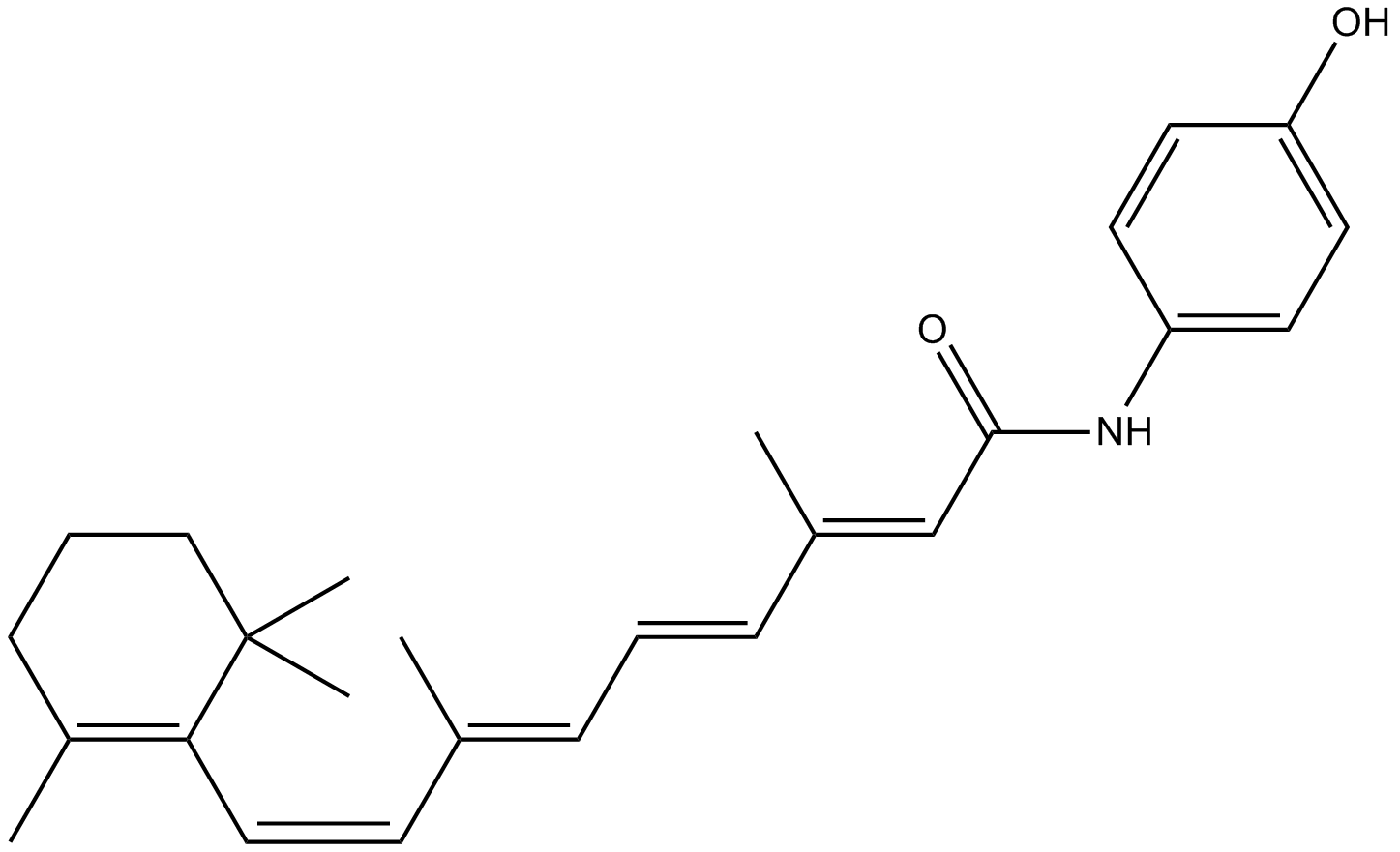
Cas No.: 65646-68-6
Sample solution is provided at 25 µL, 10mM.
_1-3.$$$39978408@51.jpg');)
_1-9.$$$38538795@65.jpg');)
_1-9.$$$39112701@51.jpg');)
_1-7.$$$37316672@70.jpg');)
_366-372.$$$36198801@70.jpg');)
.$$$38565142@65.jpg');)
_1867-1883.$$$33248023@67.jpg');)
_eads6055.$$$39977546@45.jpg');)
_eadm9805.$$$40080571@45.jpg');)
_eadj3020.$$$39666821@45.jpg');)
_1-20.$$$39757301@28.jpg');)
_1-24.$$$38898113@28.jpg');)
_273-287.$$$36806353@46.jpg');)
_1-16.$$$37156877@44.jpg');)
_1-19.$$$37460805@44.jpg');)
_1291-1307.$$$34518654@46.jpg');)
Fenretinide(4HPR) is an inhibitor of Focal adhesion kinase (FAK) [1].
Fenretinideis a vitamin A analogue, it has been shown toinhibit the growth of many tumor cells, including small-cell lung cancer, malignant hemopoietic cells, and breast cancer cells. Fenretinide may also protectwomen against the development of ovarian cancer. The effect of Fenretinide on several gynecologic cancer cell lines shows the IC50 values of Fenretinide are only 0.3 and 0.4μM in two ovarian cancer cell lines(222and UCI 101) and are from 1 to 10μM in other ovarian cancer cell lines and cervical, endometrial cancer cell lines [2].
Fenretinide has also been shown to induce apoptosis inhuman prostate carcinoma cells (HPC).The IC50s of Fenretinide in LNCaP, DU145, and PC-3 are 0.9±0.16μM, 4.4±0.45μM and 3.0±1.0μM,respectively.Fenretinide induces this apoptosis through increasingROS and increasing enzymatic labeling of DNA breaks and formation of a DNA ladder. It is also reported that Fenretinide can impair prostate cancer cell migration and invasion by interfering with FAK/AKT/GSK3β pathway and β-catenin stability [1, 3].
References:
[1] Roberto Benelli, Stefano Monteghirfo, Roberta Venè, Francesca Tosettiand Nicoletta Ferrari.The chemopreventive retinoid 4HPR impairs prostate cancer cell migration and invasion by interfering with FAK/AKT/GSK3β pathway andβ-catenin stability. Molecular Cancer.2010, 9:142-154.
[2] Anita L. Sabichi, Denver T. Hendricks, Mary A. Bober, Michael J. Birrer. Retinoic acid receptorβexpression and growthinhibition of gynecologic cancer cells by thesynthetic retinoidn-(4-hydroxyphenyl) retinamide. Journal of the National Cancer Institute. 1998, 90(8): 597-605.
[3] Shi-Yong Sun, Ping Yue, and Reuben Lotan. Induction of apoptosis by n-(4-hydroxyphenyl)retinamide andits association with reactive oxygen species, nuclearretinoic acid receptors, and apoptosis-related genes in human prostate carcinoma cells.Molecular Pharmacology. 1999, 55:403–410.
| Cell experiment [1-3]: | |
|
Cell lines |
T-ALL cell lines, CCRF-CEM leukemia cells, CCRF-CEM and Jurkat cell, OVCAR-5 cell |
|
Preparation method |
The solubility of this compound in DMSO is > 19.6 mg/mL. General tips for obtaining a higher concentration: Please warm the tube at 37 ℃ for 10 minutes and/or shake it in the ultrasonic bath for a while. Stock solution can be stored below -20℃ for several months. |
|
Reacting condition |
>1 μM, 3 days |
|
Applications |
Fenretinide inhibited the growth of many tumor cells, including small-cell lung cancer, malignant hemopoietic cells, and breast cancer cells. The IC50 values of Fenretinide were 0.3 and 0.4 μM in 222 and UCI 101 ovarian cancer cell lines. Fenretinide showed antitumor activity in selected T-ALL cell lines. Fenretinide inhibited DES activity in CCRF-CEM leukemia cells in a dose and time dependent manner, leading to a concomitant increase of the endogenous cellular dhCer content. Fenretinide (3 μM) induced dhCer accumulation in both CCRF-CEM and Jurkat cells. Fenretinide (> 1 μM) inhibited OVCAR-5 cell proliferation and viability, with 70-90% growth inhibition at 10 μM. Fenretinide (1 μM) significantly inhibited OVCAR-5 invasion after 3 days preincubation. |
| Animal experiment [4,5]: | |
|
Animal models |
HFD-fed male C57Bl/6 mice, NOD/SCID mice |
|
Dosage form |
Intraperitoneal injection, 10 mg/kg |
|
Application |
Fenretinide (10 mg/kg, i.p.) selectively inhibited ceramide accumulation HFD-fed male C57Bl/6 mice. Fenretinide treatment improved glucose tolerance and insulin sensitivity. Addition of 25 mg/kg ketoconazole to Fenretinide in NOD/SCID mice increased 4-HPR plasma levels. |
|
Other notes |
Please test the solubility of all compounds indoor, and the actual solubility may slightly differ with the theoretical value. This is caused by an experimental system error and it is normal. |
|
References: [1]. Apraiz, Aintzane., et al. Dihydroceramide accumulation and reactive oxygen species are distinct and nonessential events in 4-HPR-mediated leukemia cell death. Biochemistry and Cell Biology (2012), 90(2), 209-223. [2]. Golubkov V, et al. Action of fenretinide (4-HPR) on ovarian cancer and endothelial cells. Anticancer Res. 2005 Jan-Feb;25(1A):249-53. [3]. Anita L. Sabichi, Denver T. Hendricks, Mary A. Bober, Michael J. Birrer. Retinoic acid receptorβexpression and growthinhibition of gynecologic cancer cells by thesynthetic retinoidn-(4-hydroxyphenyl) retinamide. Journal of the National Cancer Institute. 1998, 90(8): 597-605. [4]. Bikman, Benjamin T., et al. Fenretinide Prevents Lipid-induced Insulin Resistance by Blocking Ceramide Biosynthesis. Journal of Biological Chemistry (2012), 287(21), 17426-17437. [5]. Cooper JP, et al. Fenretinide metabolism in humans and mice: utilizing pharmacological modulation of its metabolic pathway to increase systemic exposure. Br J Pharmacol. 2011 Jul;163(6):1263-75. |
|
| Cas No. | 65646-68-6 | SDF | |
| Synonyms | 4-HPR, 4-Hydroxy(phenyl)retinamide, MK-4016, Retinoic Acid p-hydroxyphenylamide, Ro 22-4667 | ||
| Chemical Name | (2E,4E,6E,8E)-N-(4-hydroxyphenyl)-3,7-dimethyl-9-(2,6,6-trimethylcyclohexen-1-yl)nona-2,4,6,8-tetraenamide | ||
| Canonical SMILES | CC1=C(C(CCC1)(C)C)C=CC(=CC=CC(=CC(=O)NC2=CC=C(C=C2)O)C)C | ||
| Formula | C26H33NO2 | M.Wt | 391.55 |
| Solubility | ≥ 19.6 mg/mL in DMSO, ≥ 47.8 mg/mL in EtOH with gentle warming | Storage | Store at -20°C, filled inert atmosphere |
| General tips | Please select the appropriate solvent to prepare the stock solution according to the
solubility of the product in different solvents; once the solution is prepared, please store it in
separate packages to avoid product failure caused by repeated freezing and thawing.Storage method
and period of the stock solution: When stored at -80°C, please use it within 6 months; when stored
at -20°C, please use it within 1 month. To increase solubility, heat the tube to 37°C and then oscillate in an ultrasonic bath for some time. |
||
| Shipping Condition | Evaluation sample solution: shipped with blue ice. All other sizes available: with RT, or with Blue Ice upon request. | ||
| Prepare stock solution | |||

|
1 mg | 5 mg | 10 mg |
| 1 mM | 2.554 mL | 12.7698 mL | 25.5395 mL |
| 5 mM | 510.8 μL | 2.554 mL | 5.1079 mL |
| 10 mM | 255.4 μL | 1.277 mL | 2.554 mL |
Step 1: Enter information below (Recommended: An additional animal making an allowance for loss during the experiment)
 g
μL
g
μL
Step 2: Enter the in vivo formulation (This is only the calculator, not formulation. Please contact us first if there is no in vivo formulation at the solubility Section.)
Calculation results:
Working concentration: mg/ml;
Method for preparing DMSO master liquid: mg drug pre-dissolved in μL DMSO ( Master liquid concentration mg/mL, Please contact us first if the concentration exceeds the DMSO solubility of the batch of drug. )
Method for preparing in vivo formulation: Take μL DMSO master liquid, next addμL PEG300, mix and clarify, next addμL Tween 80, mix and clarify, next add μL saline, mix and clarify.
Method for preparing in vivo formulation: Take μL DMSO master liquid, next add μL Corn oil, mix and clarify.
Note: 1. Please make sure the liquid is clear before adding the next solvent.
2. Be sure to add the solvent(s) in order. You must ensure that the solution obtained, in the previous addition, is a clear solution before proceeding to add the next solvent. Physical methods such as vortex, ultrasound or hot water bath can be used to aid dissolving.
3. All of the above co-solvents are available for purchase on the GlpBio website.
Quality Control & SDS
- View current batch:
- Purity: >99.00% Appearance: A solid
- COA (Certificate of Analysis)
- SDS (Safety Data Sheet)
- Datasheet
Average Rating: 5 (Based on Reviews and 30 reference(s) in Google Scholar.)