

Fluconazole (Synonyms: UK 49858) |
Catalog No.GC11512
 One-Click Copy Product Info
|

Fluconazole is a triazole broad-spectrum antifungal drug that inhibits Candida tropicalis (IC99=0.20μg/mL) and Candida kefyr (IC99=0.39μg/mL).
Products are for research use only. Not for human use. We do not sell to patients.
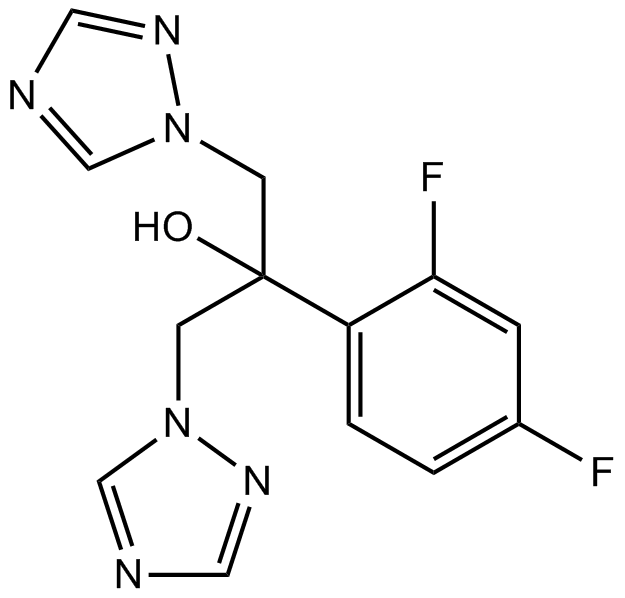
Cas No.: 86386-73-4
Sample solution is provided at 25 µL, 10mM.
_1-3.$$$39978408@51.jpg');)
_1-9.$$$38538795@65.jpg');)
_1-9.$$$39112701@51.jpg');)
_1-7.$$$37316672@70.jpg');)
_366-372.$$$36198801@70.jpg');)
.$$$38565142@65.jpg');)
_1867-1883.$$$33248023@67.jpg');)
_eads6055.$$$39977546@45.jpg');)
_eadm9805.$$$40080571@45.jpg');)
_eadj3020.$$$39666821@45.jpg');)
_1-20.$$$39757301@28.jpg');)
_1-24.$$$38898113@28.jpg');)
_273-287.$$$36806353@46.jpg');)
_1-16.$$$37156877@44.jpg');)
_1-19.$$$37460805@44.jpg');)
_1291-1307.$$$34518654@46.jpg');)
Fluconazole is a triazole broad-spectrum antifungal drug that inhibits Candida tropicalis (IC99=0.20μg/mL) and Candida kefyr (IC99=0.39μg/mL). Fluconazole blocks ergosterol biosynthesis by highly selectively inhibiting fungal cytochrome P450 sterol 14α-demethylase, thereby disrupting the integrity of the fungal cell membrane. Fluconazole can alter cell membrane permeability. Fluconazole can be used in research related to Candida infections and cryptococcal meningitis[1-4].
In vitro, Fluconazole (5-1000μM) was used to treat human adrenocortical carcinoma cell lines (H295R and HAC15) and primary human adrenocortical cell cultures (including normal adrenal glands, ACTH-independent macronodular adrenal hyperplasia, and cortisol-secreting adrenocortical adenomas) for 72 hours. Fluconazole significantly inhibited cortisol production. Fluconazole reduced steroid hormone levels by inhibiting 11β-hydroxylase and 17-hydroxylase activities[5]. Fluconazole (81.6-2612.1μM) was used to treat African green monkey kidney (Vero) cell lines for 24-48 hours, significantly reducing cell viability and inducing necrosis, while increasing micronucleus frequency and DNA damage index[6].
In vivo, Fluconazole (0.1-15mg/kg; oral administration; once daily) was used to treat ICR mice infected with Candida tropicalis for 10 days. Fluconazole significantly improved the survival rate and reduced tissue fungal burden in mice infected with Fluconazole-sensitive strains (510 and 681), but had limited efficacy against Fluconazole-resistant strains (168 and 231)[7]. Fluconazole (2mg/mL; 250μL oral gavage; once daily) was administered to OVA-induced asthmatic C57BL/6 mice for 1 week. Fluconazole significantly worsened lung inflammation and induced lung microbiome dysbiosis[8].
References:
[1] Montero-Gei F. Fluconazole: pharmacokinetics and indications. Arch Med Res. 1993 Winter;24(4):377-85.
[2] Kowalsky SF, Dixon DM. Fluconazole: a new antifungal agent. Clin Pharm. 1991 Mar;10(3):179-94.
[3] Reed BN, Caudle KE, Rogers PD. Fluconazole prophylaxis in high-risk neonates. Ann Pharmacother. 2010 Jan;44(1):178-84.
[4] Silling G. Fluconazole: optimized antifungal therapy based on pharmacokinetics. Mycoses. 2002;45 Suppl 3:39-41.
[5] van der Pas R, Hofland LJ, Hofland J, et al. Fluconazole inhibits human adrenocortical steroidogenesis in vitro. J Endocrinol. 2012 Dec;215(3):403-12.
[6] Correa RMDS, Mota TC, Guimarães AC, et al. Cytotoxic and Genotoxic Effects of Fluconazole on African Green Monkey Kidney (Vero) Cell Line. Biomed Res Int. 2018 Nov 1;2018:6271547.
[7] Graybill JR, Najvar LK, Holmberg JD, et al. Fluconazole, D0870, and flucytosine treatment of disseminated Candida tropicalis infections in mice. Antimicrob Agents Chemother. 1995 Apr;39(4):924-9.
[8] Worasilchai J, Thongchaichayakon P, Chansri K, et al. Fluconazole worsened lung inflammation, partly through lung microbiome dysbiosis in mice with ovalbumin-induced asthma. PeerJ. 2024 Oct 28;12:e18421.
| Cell experiment [1]: | |
Cell lines | African green monkey kidney (Vero) cell line |
Preparation Method | Vero cells were grown in Dulbecco's modified eagle's medium supplemented with 15% fetal bovine serum, streptomycin (0.1mg/ml), and penicillin (99U/ml) and were kept in an incubator at 37°C and 5% CO₂. Cells were treated with Fluconazole(81.6-2612.1μM). |
Reaction Conditions | 81.6-2612.1μM; 24-48h |
Applications | Fluconazole significantly reduced cell viability, induced necrosis at all concentrations for both 24 and 48h, increased micronucleus frequency, increased DNA damage index, and induced reactive oxygen species generation. |
| Animal experiment [2]: | |
Animal models | C57BL/6 mice (8-week-old male) |
Preparation Method | Mice were intraperitoneally injected with 50μL of Ovalbumin and 1.6mg of Alum Adjuvant on day 0 and day 7, then intratracheally administered with 50μg OVA solution on days 14, 21, and 22. Fluconazole was administered daily by oral gavage of 250μL of a 2mg/mL solution for 1 week. |
Dosage form | 2mg/mL in 250μL; oral gavage; once a day for 1 week |
Applications | Fluconazole worsened lung inflammation in OVA-induced asthmatic mice, demonstrated by higher lung TNF-α and IL-6 levels, increased pathological scores, and a higher number of mononuclear cells in bronchoalveolar lavage fluid (BALF), partly through lung microbiome dysbiosis. |
References: | |
| Cas No. | 86386-73-4 | SDF | |
| Synonyms | UK 49858 | ||
| Chemical Name | 2-(2,4-difluorophenyl)-1,3-bis(1,2,4-triazol-1-yl)propan-2-ol | ||
| Canonical SMILES | C1=CC(=C(C=C1F)F)C(CN2C=NC=N2)(CN3C=NC=N3)O | ||
| Formula | C13H12F2N6O | M.Wt | 306.27 |
| Solubility | ≥ 10.9mg/mL in DMSO | Storage | Store at -20°C |
| General tips | Please select the appropriate solvent to prepare the stock solution according to the
solubility of the product in different solvents; once the solution is prepared, please store it in
separate packages to avoid product failure caused by repeated freezing and thawing.Storage method
and period of the stock solution: When stored at -80°C, please use it within 6 months; when stored
at -20°C, please use it within 1 month. To increase solubility, heat the tube to 37°C and then oscillate in an ultrasonic bath for some time. |
||
| Shipping Condition | Evaluation sample solution: shipped with blue ice. All other sizes available: with RT, or with Blue Ice upon request. | ||
| Prepare stock solution | |||

|
1 mg | 5 mg | 10 mg |
| 1 mM | 3.2651 mL | 16.3255 mL | 32.6509 mL |
| 5 mM | 653 μL | 3.2651 mL | 6.5302 mL |
| 10 mM | 326.5 μL | 1.6325 mL | 3.2651 mL |
Step 1: Enter information below (Recommended: An additional animal making an allowance for loss during the experiment)
 g
μL
g
μL
Step 2: Enter the in vivo formulation (This is only the calculator, not formulation. Please contact us first if there is no in vivo formulation at the solubility Section.)
Calculation results:
Working concentration: mg/ml;
Method for preparing DMSO master liquid: mg drug pre-dissolved in μL DMSO ( Master liquid concentration mg/mL, Please contact us first if the concentration exceeds the DMSO solubility of the batch of drug. )
Method for preparing in vivo formulation: Take μL DMSO master liquid, next addμL PEG300, mix and clarify, next addμL Tween 80, mix and clarify, next add μL saline, mix and clarify.
Method for preparing in vivo formulation: Take μL DMSO master liquid, next add μL Corn oil, mix and clarify.
Note: 1. Please make sure the liquid is clear before adding the next solvent.
2. Be sure to add the solvent(s) in order. You must ensure that the solution obtained, in the previous addition, is a clear solution before proceeding to add the next solvent. Physical methods such as vortex, ultrasound or hot water bath can be used to aid dissolving.
3. All of the above co-solvents are available for purchase on the GlpBio website.
Quality Control & SDS
- View current batch:
- Purity: >99.00% Appearance: A solid
- COA (Certificate of Analysis)
- SDS (Safety Data Sheet)
- Datasheet
Average Rating: 5 (Based on Reviews and 20 reference(s) in Google Scholar.)