
Fluspirilene (Synonyms: McN-JR 6218,R 6218,Redeptin) |
| Catalog No.GC11492 |
potent, non-competitive antagonist of agonist-activated L-type calcium channels
Products are for research use only. Not for human use. We do not sell to patients.
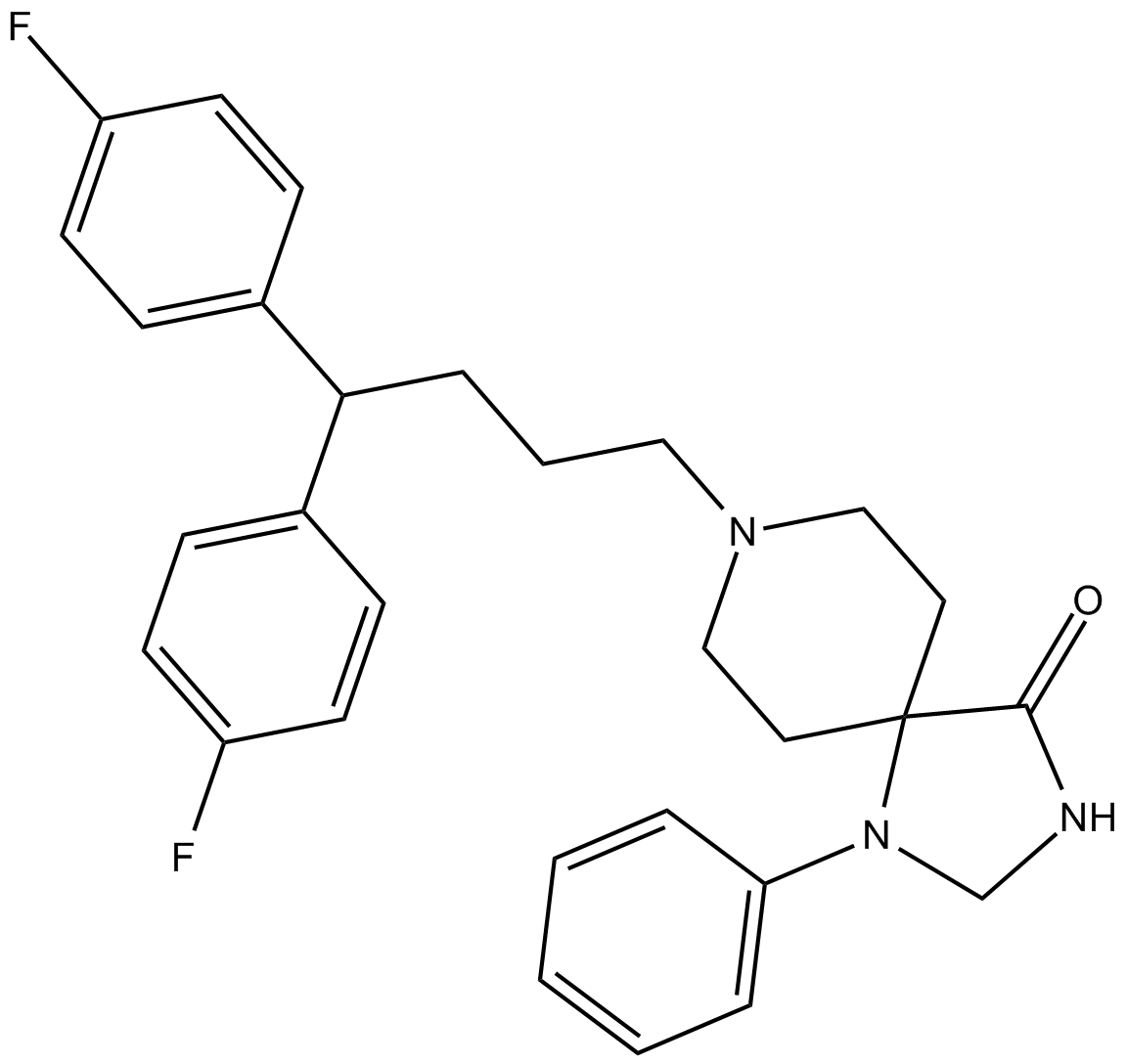
Cas No.: 1841-19-6
Sample solution is provided at 25 µL, 10mM.
IC50: 0.03 μM
Fluspirilene is a potent and non-competitive antagonist of agonist-activated L-type calcium channels.
Voltage-gated calcium channels are critical for coupling membrane depolarization to the influx of calcium. The calcium that flows into excitable cells via voltage-gated calcium channels generates both electrical and chemical signals.
In vitro: Fluspirilene was found to be weakly active as an antagonist of Ca2(+)-induced contractions in K(+)-depolarized taenia. In addition, fluspirilene at 10-1000 nM was a potent non-competitive antagonist of the effects of Bay K 8644 on Ca2(+)-induced contractions and could selectively antagonise the effects of Bay K 8644, without affecting the calcium antagonist effects of nitrendipine [1].
In vivo: In a previous animal study, adult male Wistar rats were intramuscularly injected with a 8 mg/kg dose of fluspirilene. Results showed that the excretion was slow but constant during the first 12 days. The identified metabolites of the urine and faeces showed oxidative N-dealkylation as the major metabolic pathway [2].
Clinical trial: A clinical trial was carried out in which fluspirilene was compared to chlorpromazine in the treatment of schizophrenic patients with acute exacerbation. Similar therapeutic improvement was obtained with both drugs, but men needed a significantly higher mean dose of fluspirilene than women. Fluspirilene induced more parkinsonism than chlorpromazine, but less drowsiness, dizziness, and dry mouth [3].
References:
[1] Kenny, B. A.,Fraser, S.,Kilpatrick, A.T., et al. Selective antagonism of calcium channel activators by fluspirilene. Br. J. Pharmacol. 100(2), 211-216 (1990).
[2] Heykants JP. The excretion and metabolism of the long-acting neuroleptic drug fluspirilene in the rat. Life Sci. 1969 Oct 1;8(19):1029-39.
[3] Chouinard G, Annable L, Steinberg S. A controlled clinical trial of fluspirilene, a long-acting injectable neuroleptic, in schizophrenic patients with acute exacerbation. J Clin Psychopharmacol. 1986 Feb;6(1):21-6.

Cell experiment: | To investigate the effect of fluspirilene on cell proliferation, cells are treated with 1.25, 2.5, and 5 μM of fluspirilene. GSC viability is assessed using a Cell Counting Kit-8[2]. |
Animal experiment: | Mice[2]The mice are randomly assigned to two groups and treated with either fluspirilene (n=5) or with DMSO as a control group (n=5). All mice are given intramuscular injections of 200 μL of DMSO or fluspirilene dissolved in DMSO at 1 mg/kg body weight four times[2]. |
References: [1]. Kenny BA, et al. Selective antagonism of calcium channel activators by fluspirilene. Br J Pharmacol. 1990 Jun;100(2):211-6. | |
| Cas No. | 1841-19-6 | SDF | |
| Synonyms | McN-JR 6218,R 6218,Redeptin | ||
| Chemical Name | 8-[4,4-bis(4-fluorophenyl)butyl]-1-phenyl-1,3,8-triazaspiro[4.5]decan-4-one | ||
| Canonical SMILES | FC1=CC=C(C(C2=CC=C(F)C=C2)CCCN3CCC4(C(NCN4C5=CC=CC=C5)=O)CC3)C=C1 | ||
| Formula | C29H31F2N3O | M.Wt | 475.6 |
| Solubility | ≤0.3mg/ml in ethanol;10mg/ml in DMSO;15mg/ml in dimethyl formamide | Storage | Store at -20°C |
| General tips | Please select the appropriate solvent to prepare the stock solution according to the
solubility of the product in different solvents; once the solution is prepared, please store it in
separate packages to avoid product failure caused by repeated freezing and thawing.Storage method
and period of the stock solution: When stored at -80°C, please use it within 6 months; when stored
at -20°C, please use it within 1 month. To increase solubility, heat the tube to 37°C and then oscillate in an ultrasonic bath for some time. |
||
| Shipping Condition | Evaluation sample solution: shipped with blue ice. All other sizes available: with RT, or with Blue Ice upon request. | ||
| Prepare stock solution | |||
|
1 mg | 5 mg | 10 mg |
| 1 mM | 2.1026 mL | 10.513 mL | 21.0261 mL |
| 5 mM | 420.5 μL | 2.1026 mL | 4.2052 mL |
| 10 mM | 210.3 μL | 1.0513 mL | 2.1026 mL |
Step 1: Enter information below (Recommended: An additional animal making an allowance for loss during the experiment)
Step 2: Enter the in vivo formulation (This is only the calculator, not formulation. Please contact us first if there is no in vivo formulation at the solubility Section.)
Calculation results:
Working concentration: mg/ml;
Method for preparing DMSO master liquid: mg drug pre-dissolved in μL DMSO ( Master liquid concentration mg/mL, Please contact us first if the concentration exceeds the DMSO solubility of the batch of drug. )
Method for preparing in vivo formulation: Take μL DMSO master liquid, next addμL PEG300, mix and clarify, next addμL Tween 80, mix and clarify, next add μL ddH2O, mix and clarify.
Method for preparing in vivo formulation: Take μL DMSO master liquid, next add μL Corn oil, mix and clarify.
Note: 1. Please make sure the liquid is clear before adding the next solvent.
2. Be sure to add the solvent(s) in order. You must ensure that the solution obtained, in the previous addition, is a clear solution before proceeding to add the next solvent. Physical methods such as vortex, ultrasound or hot water bath can be used to aid dissolving.
3. All of the above co-solvents are available for purchase on the GlpBio website.
Quality Control & SDS
- View current batch:
- Purity: >98.00%
- COA (Certificate Of Analysis)
- SDS (Safety Data Sheet)
- Datasheet
Average Rating: 5 (Based on Reviews and 1 reference(s) in Google Scholar.)
GLPBIO products are for RESEARCH USE ONLY. Please make sure your review or question is research based.
Required fields are marked with *


