

Epibrassinolide (Synonyms: EBL, 24-Epibrassinolide) |
Catalog No.GC11834
 One-Click Copy Product Info
|

Epibrassinolide is a ubiquitously occurring brassinosteroid plant growth hormone.
Products are for research use only. Not for human use. We do not sell to patients.
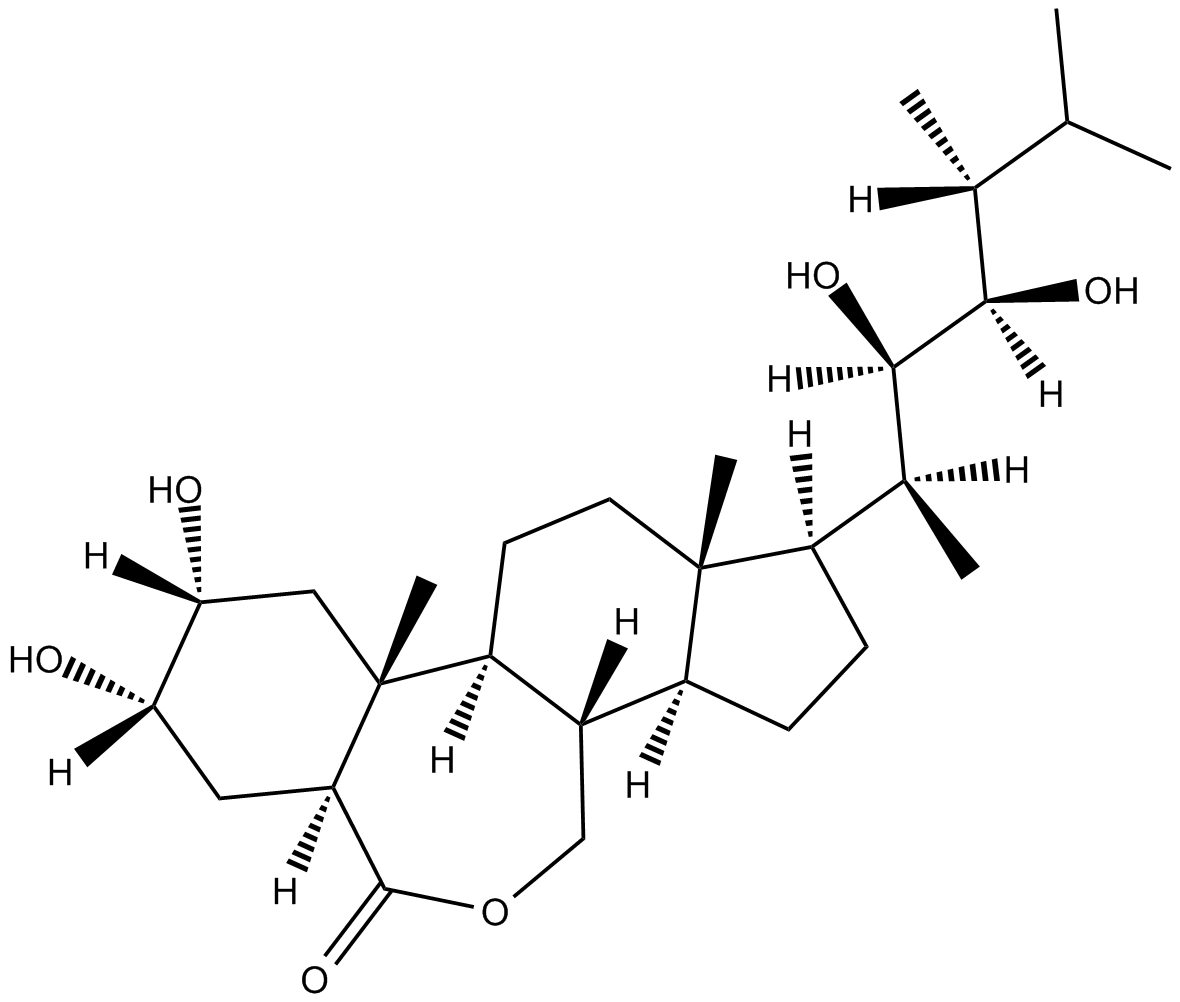
Cas No.: 78821-43-9
Sample solution is provided at 25 µL, 10mM.
_1-3.$$$39978408@51.jpg');)
_1-9.$$$38538795@65.jpg');)
_1-9.$$$39112701@51.jpg');)
_1-7.$$$37316672@70.jpg');)
_366-372.$$$36198801@70.jpg');)
.$$$38565142@65.jpg');)
_1867-1883.$$$33248023@67.jpg');)
_eads6055.$$$39977546@45.jpg');)
_eadm9805.$$$40080571@45.jpg');)
_eadj3020.$$$39666821@45.jpg');)
_1-20.$$$39757301@28.jpg');)
_1-24.$$$38898113@28.jpg');)
_273-287.$$$36806353@46.jpg');)
_1-16.$$$37156877@44.jpg');)
_1-19.$$$37460805@44.jpg');)
_1291-1307.$$$34518654@46.jpg');)
Epibrassinolide is a ubiquitously occurring brassinosteroid plant growth hormone[1]. Epibrassinolide is widely used as a plant growth regulator to alleviate heavy-metal and pesticide stress[2]. Epibrassinolide is also used as a potential apoptotic inducer in various cancer cells[3].
In vitro, treatment of LNCaP and DU145 prostate cancer cells with Epibrassinolide (25μM; 24h) induced mitochondria-mediated apoptosis, significantly decreased cell viability, increased sub-G1 DNA fragmentation, activated caspase cascades, and depleted intracellular polyamine levels[4]. Treatment of SW480 and DLD-1 colon cancer cells with Epibrassinolide (25μM; 48h) induced autophagy, depleted intracellular polyamines, activated Akt/mTOR signaling, and significantly increased LC3 lipidation and SSAT/PAO expression[5].
In vivo, Epibrassinolide (0–720μg/kg/day; 40 days; i.p.) reduced tumor volume and diameter, and decreased the CEA level in the serum in SW480-derived xenografts in SCID mice[6]. Epibrassinolide (1μM; 24h; aqueous exposure at 5mL/well) reversed ethanol-induced behavioral deficits and restored GSH/GSSG redox balance in zebrafish embryos[7].
References:
[1] Shahzad B, Tanveer M, Che Z, et al. Role of 24-epibrassinolide (EBL) in mediating heavy metal and pesticide induced oxidative stress in plants: A review. Ecotoxicol Environ Saf. 2018;147:935-944.
[2] Parrey ZA, Shah SH, Mohammad F, Siddiqui MH, Alamri S, Kalaji HM. Exogenous epibrassinolide application improves essential oil biosynthesis and trichome development in peppermint via modulating growth and physicochemical processes. Sci Rep. 2023;13(1):12924.
[3] Sadava D, Chen S. Molecular Interactions of the Plant Steroid Hormone Epibrassinolide on Human Drug-Sensitive and Drug-Resistant Small-Cell Lung Carcinoma Cells. Cancers (Basel). 2024;16(22):3812.
[4] Obakan P, Arisan ED, Calcabrini A, Agostinelli E, Bolkent S, Palavan-Unsal N. Activation of polyamine catabolic enzymes involved in diverse responses against epibrassinolide-induced apoptosis in LNCaP and DU145 prostate cancer cell lines. Amino Acids. 2014;46(3):553-564.
[5] Adacan K, Obakan Yerlİkaya P. Epibrassinolide activates AKT to trigger autophagy with polyamine metabolism in SW480 and DLD-1 colon cancer cell lines. Turk J Biol. 2020;44(6):417-426.
[6] Obakan Yerlikaya P, Adacan K, Karatug Kacar A, Coker Gurkan A, Arisan ED. Epibrassinolide impaired colon tumor progression and induced autophagy in SCID mouse xenograft model via acting on cell cycle progression without affecting endoplasmic reticulum stress observed in vitro. Int J Biochem Cell Biol. 2023;155:106360.
[7] Fernandes P, Monteiro SM, Venâncio C, Félix L. 24-Epibrassinolide protects against ethanol-induced behavioural teratogenesis in zebrafish embryo. Chem Biol Interact. 2020;328:109193.
| Cell experiment [1]: | |
Cell lines | SW480 and DLD-1 colon cancer cells |
Preparation Method | Human colon cancer cell lines SW480 (CCL228) and DLD-1 (CCL221) were used in this experiment. The DLD-1 cells were grown in McCoy’s 5A medium, and the SW480 cells were grown in MEM medium. All the media were supplemented with 10% fetal bovine serum, 1000U/ml penicillin, and 10μg/mL streptomycin. The cells were cultured at 37°C in humidified 5% CO2 incubator. Each colon cancer cell line was seeded at a density of 1×10⁵cells/well in 6-well plates and treated with 25μM Epibrassinolide for 48h. The polyamine content of each sample was determined by high-pressure liquid chromatography. Autophagy induction was determinated by acridine orange staining. Proteins were extracted for Immunoblotting analysis. |
Reaction Conditions | 25μM; 48h |
Applications | Treatment of SW480 and DLD-1 colon cancer cells with Epibrassinolide induced autophagy, depleted intracellular polyamines, activated Akt/mTOR signaling, and significantly increased LC3 lipidation and SSAT/PAO expression. |
| Animal experiment [2]: | |
Animal models | SCID mice |
Preparation Method | A total of 18 female, two weeks age, severe combined immunodeficiency (SCID) mice were used in the experiments. Experimental groups were as follows: Healthy mice receiving Epibrassinolide, tumor bearing control group, tumor bearing vehicle treated group, tumor bearing 240μg/kg/day Epibrassinolide treated group, tumor bearing 480μg/kg/day Epibrassinolide treated group, tumor bearing 720μg/kg/day Epibrassinolide treated group. 7×10⁶ SW480 colon cancer cells were inoculated with 200µl of matrigel into the right limb cavities of mice. Epibrassinolide was intraperitoneally injected consecutively for 40 days. After incubation period, SW480 tumor sizes became visible in mice. Tumor sizes of the mice divided into groups were measured with the help of an electronic caliper every two days. The mice were weighed at daily intervals of 5 days before the daily Epibrassinolide injections on the precision balance and their weights were noted. Before the mice were sacrificed, they were anesthetized with isofluorane and 500µl of blood was collected from the jugular vein of the mice, and serum was preserved for further ELISA experiments. The mice were then sacrificed, their tumors were removed and their pictures were taken. |
Dosage form | 0–720μg/kg/day; 40 days; i.p. |
Applications | Epibrassinolide reduced tumor volume and diameter, and decreased the CEA level in the serum in SW480-derived xenografts in SCID mice. |
References: | |
| Cas No. | 78821-43-9 | SDF | |
| Synonyms | EBL, 24-Epibrassinolide | ||
| Chemical Name | (3aS,5S,6R,7aR,7bS,9aS,10R,12aS,12bS)-10-((2S,3R,4R,5R)-3,4-dihydroxy-5,6-dimethylheptan-2-yl)-5,6-dihydroxy-7a,9a-dimethyltetradecahydro-1H-benzo[c]indeno[5,4-e]oxepin-3(12bH)-one | ||
| Canonical SMILES | CC([C@@]([C@](O)([H])[C@@](O)([H])[C@@]([C@@]1([H])CC[C@@]2([H])[C@]([C@]3([H])CC[C@]12C)([H])COC([C@@]4([H])C[C@@](O)([H])[C@@](O)([H])C[C@]34C)=O)([H])C)([H])C)C | ||
| Formula | C28H48O6 | M.Wt | 480.68 |
| Solubility | DMF: 5 mg/mL,DMF:PBS (pH 7.2)(1:3): 0.25 mg/mL,DMSO: 3 mg/mL,Ethanol: 3 mg/mL | Storage | Store at -20°C |
| General tips | Please select the appropriate solvent to prepare the stock solution according to the
solubility of the product in different solvents; once the solution is prepared, please store it in
separate packages to avoid product failure caused by repeated freezing and thawing.Storage method
and period of the stock solution: When stored at -80°C, please use it within 6 months; when stored
at -20°C, please use it within 1 month. To increase solubility, heat the tube to 37°C and then oscillate in an ultrasonic bath for some time. |
||
| Shipping Condition | Evaluation sample solution: shipped with blue ice. All other sizes available: with RT, or with Blue Ice upon request. | ||
| Prepare stock solution | |||

|
1 mg | 5 mg | 10 mg |
| 1 mM | 2.0804 mL | 10.4019 mL | 20.8039 mL |
| 5 mM | 416.1 μL | 2.0804 mL | 4.1608 mL |
| 10 mM | 208 μL | 1.0402 mL | 2.0804 mL |
Step 1: Enter information below (Recommended: An additional animal making an allowance for loss during the experiment)
 g
μL
g
μL
Step 2: Enter the in vivo formulation (This is only the calculator, not formulation. Please contact us first if there is no in vivo formulation at the solubility Section.)
Calculation results:
Working concentration: mg/ml;
Method for preparing DMSO master liquid: mg drug pre-dissolved in μL DMSO ( Master liquid concentration mg/mL, Please contact us first if the concentration exceeds the DMSO solubility of the batch of drug. )
Method for preparing in vivo formulation: Take μL DMSO master liquid, next addμL PEG300, mix and clarify, next addμL Tween 80, mix and clarify, next add μL saline, mix and clarify.
Method for preparing in vivo formulation: Take μL DMSO master liquid, next add μL Corn oil, mix and clarify.
Note: 1. Please make sure the liquid is clear before adding the next solvent.
2. Be sure to add the solvent(s) in order. You must ensure that the solution obtained, in the previous addition, is a clear solution before proceeding to add the next solvent. Physical methods such as vortex, ultrasound or hot water bath can be used to aid dissolving.
3. All of the above co-solvents are available for purchase on the GlpBio website.
Quality Control & SDS
- View current batch:
- Purity: >98.00% Appearance: A solid
- COA (Certificate of Analysis)
- SDS (Safety Data Sheet)
- Datasheet
Average Rating: 5 (Based on Reviews and 23 reference(s) in Google Scholar.)