

Gastrodin |
Catalog No.GN10277
 One-Click Copy Product Info
|

Gastrodin is a phenolic glucoside and the main active component of the Chinese herb Tianma and it has sedative, hypnotic and anticonvulsant effects.
Products are for research use only. Not for human use. We do not sell to patients.
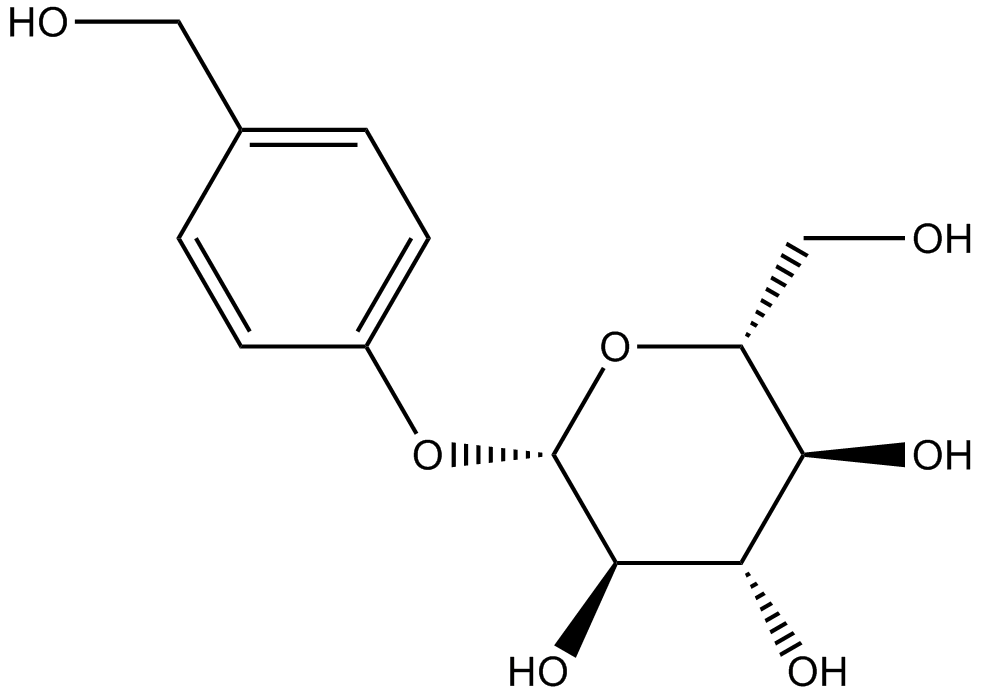
Cas No.: 62499-27-8
Sample solution is provided at 25 µL, 10mM.
Gastrodin is a phenolic glucoside and the main active component of the Chinese herb Tianma and it has sedative, hypnotic and anticonvulsant effects [1]. Gastrodin can penetrate the blood-brain barrier and restore the imbalance between excitation and inhibition processes in the cerebral cortex, showing good antihypertensive, sedative and hypnotic effects, and having certain therapeutic effects on neurasthenia, insomnia and headache. It can also dilate blood vessels, improve microcirculation of the myocardium, relieve cerebral vasospasm, increase myocardial nutritional blood flow and enhance oxygen supply capacity. Gastrodin also has anti-inflammatory and anti-obesity effects [2]. Gastrodin can be used in the research of treatment for dizziness, epilepsy, stroke and dementia [3].
In vitro, Gastrodin (30, 40 and 60μM; 1h) pretreatment significantly inhibited the protein and mRNA expression levels of iNOS, COX-2, TNF-α, IL-1β and NF-κB in lipopolysaccharide (LPS)-stimulated microglia, and weakened the phosphorylation of extracellular signal-regulated kinase 1/2 (ERK1/2), c-Jun N-terminal kinase (JNK) and p38 mitogen-activated protein kinase (p38MAPK) [4]. Gastrodin (5, 10 and 20μM; 1h) pretreatment significantly upregulated the (PI3-K)/Akt signaling pathway in LPS-induced H9c2 cardiomyocytes in a dose-dependent manner, while inhibiting the activation of NF-κB and MAPKs [5].
In vivo, Gastrodin (10, 50mg/kg/day; 2 weeks; i.p.) treatment significantly inhibited the loss of retinal ganglion cells (RGCs) in acute ocular hypertension (AOH) rats and reduced the number of Iba1-positive microglia in the retina [6]. Gastrodin (10, 20mg/kg/day; 28 days;) can improve the depressive-like behavior of depressed mice through oral administration, increase neurotransmitter levels, improve nerve cell damage, and inhibit the expression of Caspase-3 [7].
References:
[1] Liu Y, Gao J, Peng M, et al. A review on central nervous system effects of gastrodin[J]. Frontiers in pharmacology, 2018, 9: 24.
[2] Dai Y, Ban W, Yang Z. Gastrodin, a promising natural small molecule for the treatment of central nervous system disorders, and its recent progress in synthesis, pharmacology and pharmacokinetics[J]. International journal of molecular sciences, 2024, 25(17): 9540.
[3] Yang C S, Chiu S C, Liu P Y, et al. Gastrodin alleviates seizure severity and neuronal excitotoxicities in the rat lithium-pilocarpine model of temporal lobe epilepsy via enhancing GABAergic transmission[J]. Journal of ethnopharmacology, 2021, 269: 113751.
[4] Dai JN, Zong Y, Zhong LM, Li YM, Zhang W, Bian LG, Ai QL, Liu YD, Sun J, Lu D. Gastrodin inhibits expression of inducible NO synthase, cyclooxygenase-2 and proinflammatory cytokines in cultured LPS-stimulated microglia via MAPK pathways. PLoS One. 2011;6(7):e21891.
[5] Yang P, Han Y, Gui L, Sun J, Chen YL, Song R, Guo JZ, Xie YN, Lu D, Sun L. Gastrodin attenuation of the inflammatory response in H9c2 cardiomyocytes involves inhibition of NF-κB and MAPKs activation via the phosphatidylinositol 3-kinase signaling. Biochem Pharmacol. 2013 Apr 15;85(8):1124-33.
[6] Wang JW, Liu YM, Zhao XF, Zhang H. Gastrodin protects retinal ganglion cells through inhibiting microglial-mediated neuroinflammation in an acute ocular hypertension model. Int J Ophthalmol. 2017 Oct 18;10(10):1483-1489.
[7] Pei H, Shen H, Bi J, et al. Gastrodin improves nerve cell injury and behaviors of depressed mice through Caspase‐3‐mediated apoptosis[J]. CNS Neuroscience & Therapeutics, 2024, 30(3): e14444.
| Cell experiment [1]: | |
Cell lines | Mouse microglial cell line BV-2 cells |
Preparation Method | Cells were cultured in Dulbecco's modified Eagle's medium containing 2% fetal bovine serum and antibiotics (100IU/ml penicillin and 100µg/ml streptomycin) and maintained at 37°C in a humidified incubator with 5% CO2. Cells (approximately 1×10⁶ cells/ml) were seeded in six-well plates before being subjected to treatments. Five groups of BV-2 cells were subjected to various treatments. In group 1, the cells were incubated in serum-free DMEM. In group 2, the cells were treated with 1µg/ml lipopolysaccharide (LPS). In groups 3, 4, and 5, the cells were treated with 30µM, 40µM, and 60µM Gastrodin for 1h and then stimulated with LPS (1µg/ml). After incubation of the cells for 30min to 4h, reverse transcription polymerase chain reaction (RT-PCR) and protein blotting analysis were performed. |
Reaction Conditions | 30, 40 and 60μM; 1h |
Applications | Gastrodin pretreatment significantly inhibited the protein and mRNA expression levels of iNOS, COX-2, TNF-α, IL-1β and NF-κB in microglial cells stimulated by LPS. |
| Animal experiment [2]: | |
Animal models | SD rats (acute ocular hypertension (AOH) model) |
Preparation Method | All the operations were performed under general anesthesia with intraperitoneal injection of chloral hydrate (400mg/kg) and additional topical anesthesia (0.5% proparacaine hydrochloride eye drops). The anterior chamber of a randomly chosen eye was cannulated with a 30-Gauge infusion needle connected with a 500mL saline-filled bottle. By keeping the bottle to a height of 1500mm above the eye, the Intraocular pressure (IOP) could rise to 110mm Hg. The IOP was monitored using a Tono-Pen and continuously maintained for 60min. The rats with only anterior chamber penetration and without IOP elevation were served as the control group. After 60min, the needle was removed from the anterior chamber and the rats were intraperitoneally injected with Gastrodin at 10mg/kg (G10 group), 50mg/kg (G50 group) and 0.9% NS (NS group), respectively, once a day for the next 2wk. The loss of RGCs and the number of Iba1-positive retina microglia were determined at 2wk after rapid ocular hypertension. |
Dosage form | 10, 50mg/kg/day; 2 weeks; i.p. |
Applications | Gastrodin treatment dose-dependently significantly inhibited the loss of retinal ganglion cells (RGCs) in AOH rats, and reduced the number of Iba1-positive microglia in the retina. |
References: | |
| Cas No. | 62499-27-8 | SDF | |
| Chemical Name | (2R,3S,4S,5R,6S)-2-(hydroxymethyl)-6-[4-(hydroxymethyl)phenoxy]oxane-3,4,5-triol | ||
| Canonical SMILES | C1=CC(=CC=C1CO)OC2C(C(C(C(O2)CO)O)O)O | ||
| Formula | C13H18O7 | M.Wt | 286.28 |
| Solubility | Water : 100 mg/mL?(349.31 mM); DMSO : >50 mg/mL (174.65 mM) | Storage | Store at -20°C |
| General tips | Please select the appropriate solvent to prepare the stock solution according to the
solubility of the product in different solvents; once the solution is prepared, please store it in
separate packages to avoid product failure caused by repeated freezing and thawing.Storage method
and period of the stock solution: When stored at -80°C, please use it within 6 months; when stored
at -20°C, please use it within 1 month. To increase solubility, heat the tube to 37°C and then oscillate in an ultrasonic bath for some time. |
||
| Shipping Condition | Evaluation sample solution: shipped with blue ice. All other sizes available: with RT, or with Blue Ice upon request. | ||
| Prepare stock solution | |||

|
1 mg | 5 mg | 10 mg |
| 1 mM | 3.4931 mL | 17.4654 mL | 34.9308 mL |
| 5 mM | 698.6 μL | 3.4931 mL | 6.9862 mL |
| 10 mM | 349.3 μL | 1.7465 mL | 3.4931 mL |
Step 1: Enter information below (Recommended: An additional animal making an allowance for loss during the experiment)
 g
μL
g
μL
Step 2: Enter the in vivo formulation (This is only the calculator, not formulation. Please contact us first if there is no in vivo formulation at the solubility Section.)
Calculation results:
Working concentration: mg/ml;
Method for preparing DMSO master liquid: mg drug pre-dissolved in μL DMSO ( Master liquid concentration mg/mL, Please contact us first if the concentration exceeds the DMSO solubility of the batch of drug. )
Method for preparing in vivo formulation: Take μL DMSO master liquid, next addμL PEG300, mix and clarify, next addμL Tween 80, mix and clarify, next add μL saline, mix and clarify.
Method for preparing in vivo formulation: Take μL DMSO master liquid, next add μL Corn oil, mix and clarify.
Note: 1. Please make sure the liquid is clear before adding the next solvent.
2. Be sure to add the solvent(s) in order. You must ensure that the solution obtained, in the previous addition, is a clear solution before proceeding to add the next solvent. Physical methods such as vortex, ultrasound or hot water bath can be used to aid dissolving.
3. All of the above co-solvents are available for purchase on the GlpBio website.
Quality Control & SDS
- View current batch:
- Purity: >99.50% Appearance: A solid
- COA (Certificate of Analysis)
- SDS (Safety Data Sheet)
- Datasheet
Average Rating: 5 (Based on Reviews and 30 reference(s) in Google Scholar.)