

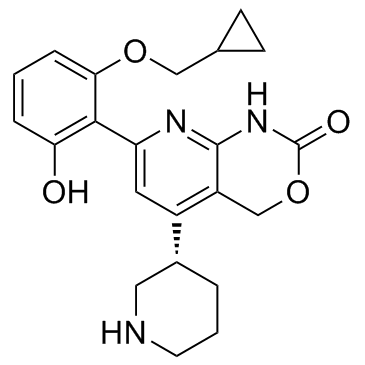
Bay 65-1942 free base |
Catalog No.GC35474
 One-Click Copy Product Info
|

Bay 65-1942 free base is an ATP-competitive and selective IKKβ inhibitor.
Products are for research use only. Not for human use. We do not sell to patients.
Cas No.: 600734-02-9
Sample solution is provided at 25 µL, 10mM.
_1-3.$$$39978408@51.jpg');)
_1-9.$$$38538795@65.jpg');)
_1-9.$$$39112701@51.jpg');)
_1-7.$$$37316672@70.jpg');)
_366-372.$$$36198801@70.jpg');)
.$$$38565142@65.jpg');)
_1867-1883.$$$33248023@67.jpg');)
_eads6055.$$$39977546@45.jpg');)
_eadm9805.$$$40080571@45.jpg');)
_eadj3020.$$$39666821@45.jpg');)
_1-20.$$$39757301@28.jpg');)
_1-24.$$$38898113@28.jpg');)
_273-287.$$$36806353@46.jpg');)
_1-16.$$$37156877@44.jpg');)
_1-19.$$$37460805@44.jpg');)
_1291-1307.$$$34518654@46.jpg');)
Bay 65-1942 free base is an ATP-competitive and selective IKKβ inhibitor. IKKβ
Delivery of Bay 65-1942 prior to ischemia significantly decreases left ventricular infarct size compared with animals receiving vehicle. Compared with sham animals, animals receiving vehicle have a significant increase in the infarct-to-area at risk (AAR) ratio (70.7±3.4 vs. 5.8±3.4%, P<0.05). This ratio is significantly reduced by treatment with Bay 65-1942 at each time point (prior to ischemia 42.7±4.1%, at reperfusion 42.7±7.5%, 2 h of reperfusion 29.4±5.2%; each group P<0.05 vs. vehicle). Animals pretreated with Bay 65-1942 (n=3) have significantly attenuated CK-MB levels compared with those animals without treatment prior to IR (14,170 ±3,219 units, P<0.05 vs. vehicle)[1].
Inhibitors of MEK (AZD6244) and IKK (BAY 65-1942) are used at their IC50 concentrations, as determined by a 48 hour MTS assay, which achieve sufficient inhibition of kinase activity. MYL-R cells are treated for 24 hours with AZD6244 (5 µM), BAY 65-1942 (10 µM), or a combination of these inhibitors at the same concentrations. AZD6244 and BAY 65-1942 demonstrate synergistic inhibition of cell viability at the dose combination (5 µM AZD6244+10 µM BAY 65-1942), which correlates with IC75 (CI = 0.48±0.01). Synergism is also indicated at the IC50 (CI = 0.56±0.09) and IC90 (CI = 0.46±0.02) dose combinations reported by the software (CI values are the mean of three independent experiments, ± standard deviation). AZD6244 and BAY 65-1942 treatment induces 2- and 1.3-fold caspase 3/7 activation, respectively, compared to the DMSO-treated cells. Treatment with a combination of AZD6244 plus BAY 65-1942 leads to a 3.2-fold increase in caspase 3/7 activity[2].
[1]. Moss NC, et al. IKKbeta inhibition attenuates myocardial injury and dysfunction following acute ischemia-reperfusion injury. Am J Physiol Heart Circ Physiol. 2007 Oct;293(4):H2248-53. [2]. Cooper MJ, et al. Application of multiplexed kinase inhibitor beads to study kinome adaptations in drug-resistant leukemia. PLoS One. 2013 Jun 24;8(6):e66755.
Cell experiment: | Cell viability is determined by seeding MYL-R cells on a 96-well plate at 4×10⁴ cells/well in 100 µL RPMI growth medium supplemented with kinase inhibitors. Growth media and kinase inhibitors are replenished at 24 hours, and at 48 hours. 20 µL of MTS assay reagent is added to each well. The plate is returned to the incubator for approximately 1 hour and the absorbance at 490 nm is recorded. For combination index (CI) experiments, cells are grown and assayed. To determine AZD6244 and BAY 65-1942 (10 µM) dose-effects, cells are treated with a series of three-fold dilutions of each drug singly, or in combination while maintaining a constant ratio of 1:2, respectively. Cell viability results are analyzed to derive CI values. The CI values from three independent experiments are averaged[2]. |
Animal experiment: | Mice[1]Male C57BL/6 mice, 8-10 wk of age are used. To investigate IKKβ inhibition in myocardial IR injury, mice are subjected to 30 min of cardiac ischemia followed by varying periods of reperfusion. An intraperitoneal injection of Bay 65-1942 (5 mg/kg) at appropriate dosing time points is administered. Nontreatment groups receive a vehicle of 10% cremaphor in water. In treatment groups, Bay 65-1942 is delivered either prior to ischemia, at the time of reperfusion, or 2 h after reperfusion injury. Infarct size is measured 24 h after reperfusion injury in sham, vehicle, and each treatment group. To confirm myocardial injury, serum creatine kinase-muscle-brain fraction (CK-MB) levels are measured 1 h after reperfusion in animals pretreated with Bay 65-1942. |
References: [1]. Moss NC, et al. IKKbeta inhibition attenuates myocardial injury and dysfunction following acute ischemia-reperfusion injury. Am J Physiol Heart Circ Physiol. 2007 Oct;293(4):H2248-53. | |
| Cas No. | 600734-02-9 | SDF | |
| Canonical SMILES | O=C1OCC2=C([C@H]3CNCCC3)C=C(C4=C(O)C=CC=C4OCC5CC5)N=C2N1 | ||
| Formula | C22H25N3O4 | M.Wt | 395.45 |
| Solubility | Soluble in DMSO | Storage | Store at -20°C |
| General tips | Please select the appropriate solvent to prepare the stock solution according to the
solubility of the product in different solvents; once the solution is prepared, please store it in
separate packages to avoid product failure caused by repeated freezing and thawing.Storage method
and period of the stock solution: When stored at -80°C, please use it within 6 months; when stored
at -20°C, please use it within 1 month. To increase solubility, heat the tube to 37°C and then oscillate in an ultrasonic bath for some time. |
||
| Shipping Condition | Evaluation sample solution: shipped with blue ice. All other sizes available: with RT, or with Blue Ice upon request. | ||
| Prepare stock solution | |||

|
1 mg | 5 mg | 10 mg |
| 1 mM | 2.5288 mL | 12.6438 mL | 25.2876 mL |
| 5 mM | 505.8 μL | 2.5288 mL | 5.0575 mL |
| 10 mM | 252.9 μL | 1.2644 mL | 2.5288 mL |
Step 1: Enter information below (Recommended: An additional animal making an allowance for loss during the experiment)
 g
μL
g
μL
Step 2: Enter the in vivo formulation (This is only the calculator, not formulation. Please contact us first if there is no in vivo formulation at the solubility Section.)
Calculation results:
Working concentration: mg/ml;
Method for preparing DMSO master liquid: mg drug pre-dissolved in μL DMSO ( Master liquid concentration mg/mL, Please contact us first if the concentration exceeds the DMSO solubility of the batch of drug. )
Method for preparing in vivo formulation: Take μL DMSO master liquid, next addμL PEG300, mix and clarify, next addμL Tween 80, mix and clarify, next add μL saline, mix and clarify.
Method for preparing in vivo formulation: Take μL DMSO master liquid, next add μL Corn oil, mix and clarify.
Note: 1. Please make sure the liquid is clear before adding the next solvent.
2. Be sure to add the solvent(s) in order. You must ensure that the solution obtained, in the previous addition, is a clear solution before proceeding to add the next solvent. Physical methods such as vortex, ultrasound or hot water bath can be used to aid dissolving.
3. All of the above co-solvents are available for purchase on the GlpBio website.
Quality Control & SDS
- View current batch:
- Purity: >98.00% Appearance: A solid
- COA (Certificate of Analysis)
- SDS (Safety Data Sheet)
- Datasheet
Average Rating: 5 (Based on Reviews and 8 reference(s) in Google Scholar.)