

Citicoline |
Catalog No.GC35703
 One-Click Copy Product Info
|

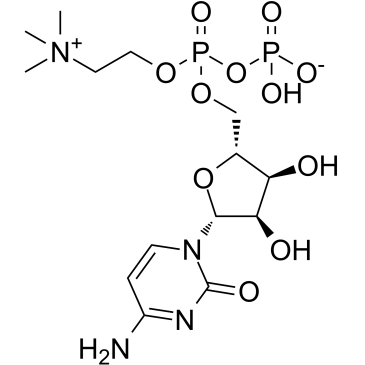
Citicoline (Cytidine diphosphate-choline) is an intermediate in the synthesis of phosphatidylcholine, a component of cell membranes.
Products are for research use only. Not for human use. We do not sell to patients.
Cas No.: 987-78-0
Sample solution is provided at 25 µL, 10mM.
_1-3.$$$39978408@51.jpg');)
_1-9.$$$38538795@65.jpg');)
_1-9.$$$39112701@51.jpg');)
_1-7.$$$37316672@70.jpg');)
_366-372.$$$36198801@70.jpg');)
.$$$38565142@65.jpg');)
_1867-1883.$$$33248023@67.jpg');)
_eads6055.$$$39977546@45.jpg');)
_eadm9805.$$$40080571@45.jpg');)
_eadj3020.$$$39666821@45.jpg');)
_1-20.$$$39757301@28.jpg');)
_1-24.$$$38898113@28.jpg');)
_273-287.$$$36806353@46.jpg');)
_1-16.$$$37156877@44.jpg');)
_1-19.$$$37460805@44.jpg');)
_1291-1307.$$$34518654@46.jpg');)
Citicoline is an intermediate in the synthesis of phosphatidylcholine, a component of cell membranes. Citicoline exerts neuroprotective effects.
To determine the potential neuroprotective activity of Citicoline and Homotaurine, treated retinal cells are treated with increasing concentrations of Citicoline or Homotaurine for 24 hours. 1 μM, 10 μM and 100 μM of Citicoline or Homotaurine are used to investigate whether may contribute to a reduced cell viability in retinal cells. Retinal cells are well preserved in Citicoline- or Homotaurine-treated cultures, with no evidence of toxicity or significant loss of viability after treatments. 100 μM of Citicoline is not harmful to retinal neuroglial cells in vitro and 100 μM of Homotaurine is an effective concentration to enhance neuroprotection in a model of experimental glaucoma. Therefore, this concentration of Citicoline and Homotaurine is used for all subsequent experiments. To evaluate whether cotreatment with Citicoline and Homotaurine is able to induce a synergistic neuroprotective effect against glutamate excitotoxicity, retinal cell cultures are exposed to Citicoline 100 μM, Homotaurine 100 μM, and Citicoline+Homotaurine 100 μM, 24 hours before glutamate treatment. In the presence of 100 μM Citicoline, a significant increase in cell viability is observed[1].
Administration of Citicoline in a dose of 1000 mg/kg produces more pronounced increase in the threshold of clonic seizures and tonic phase of seizures with lethal outcome (by 18.54 and 50.08% respectively, in comparison with the control). The anticonvulsant effect is most pronounced after injection of Citicoline in a dose of 1000 mg/kg[2].
[1]. Davinelli S, et al. Cytoprotective Effects of Citicoline and Homotaurine against Glutamate and High Glucose Neurotoxicity in Primary Cultured Retinal Cells. Oxid Med Cell Longev. 2017;2017:2825703. [2]. Karpova MN, et al. Increase of the seizure threshold in C57BL/6 mice after citicoline administration. Bull Exp Biol Med. 2015 Jan;158(3):315-7.
|
Cell experiment: |
The assay used to assess cell viability in retinal cells was the MTT reduction assay. To evaluate the effect of Citicoline and Homotaurine on cell survival, the cells are subdivided into three groups and treated for 24 hours with 1?μM, 10?μM, and 100?μM of Citicoline and with 1?μM, 10?μM and 100?μM of Homotaurine. To evaluate the neuroprotective effects of Citicoline and Homotaurine, cells are treated with Citicoline 100?μM, Homotaurine 100?μM, or Citicoline+Homotaurine 100?μM, 24 hours before glutamate treatment and 30?min before high glucose (HG) treatment. MTT is added to wells at a final concentration of 0.5mg/mL for 1 hour at 37°C. After this time, the medium is removed and reduced MTT (blue formazan product) is solubilized by adding 100?μL DMSO to each well. After agitation of plates for 15?min, the optical density of the solubilized formazan product in each well is measured using an automatic microplate reader with a 570?nm test wavelength and a 690?nm reference wavelength[1]. |
|
Animal experiment: |
Mice[1]Experiments are performed on male C57Bl/6 mice (n=69) weighing 23-27 g. The study is performed in two series. In series I, the dose-dependent effect of Citicoline on the seizure threshold in mice is evaluated. The measurements are performed 1 h after Citicoline administration. Citicoline in doses of 500 and 1000 mg/kg (0.04 mL per 20 g body weight) is injected intraperitoneally. The control animals receive an equivalent volume of physiological saline under similar conditions. In series II, the duration of Citicoline effect is estimated in 3 and 6 h after single intraperitoneal injection of Citicoline. |
|
References: [1]. Davinelli S, et al. Cytoprotective Effects of Citicoline and Homotaurine against Glutamate and High Glucose Neurotoxicity in Primary Cultured Retinal Cells. Oxid Med Cell Longev. 2017;2017:2825703. |
|
| Cas No. | 987-78-0 | SDF | |
| Canonical SMILES | O[C@@H]([C@H]([C@H](N1C(N=C(C=C1)N)=O)O2)O)[C@H]2COP(OCC[N+](C)(C)C)(OP([O-])(O)=O)=O | ||
| Formula | C14H26N4O11P2 | M.Wt | 488.32 |
| Solubility | Water : 300 mg/mL (586.73 mM); DMSO: < 1 mg/mL (insoluble or slightly soluble) | Storage | Store at -20°C |
| General tips | Please select the appropriate solvent to prepare the stock solution according to the
solubility of the product in different solvents; once the solution is prepared, please store it in
separate packages to avoid product failure caused by repeated freezing and thawing.Storage method
and period of the stock solution: When stored at -80°C, please use it within 6 months; when stored
at -20°C, please use it within 1 month. To increase solubility, heat the tube to 37°C and then oscillate in an ultrasonic bath for some time. |
||
| Shipping Condition | Evaluation sample solution: shipped with blue ice. All other sizes available: with RT, or with Blue Ice upon request. | ||
| Prepare stock solution | |||

|
1 mg | 5 mg | 10 mg |
| 1 mM | 2.0478 mL | 10.2392 mL | 20.4784 mL |
| 5 mM | 409.6 μL | 2.0478 mL | 4.0957 mL |
| 10 mM | 204.8 μL | 1.0239 mL | 2.0478 mL |
Step 1: Enter information below (Recommended: An additional animal making an allowance for loss during the experiment)
 g
μL
g
μL
Step 2: Enter the in vivo formulation (This is only the calculator, not formulation. Please contact us first if there is no in vivo formulation at the solubility Section.)
Calculation results:
Working concentration: mg/ml;
Method for preparing DMSO master liquid: mg drug pre-dissolved in μL DMSO ( Master liquid concentration mg/mL, Please contact us first if the concentration exceeds the DMSO solubility of the batch of drug. )
Method for preparing in vivo formulation: Take μL DMSO master liquid, next addμL PEG300, mix and clarify, next addμL Tween 80, mix and clarify, next add μL saline, mix and clarify.
Method for preparing in vivo formulation: Take μL DMSO master liquid, next add μL Corn oil, mix and clarify.
Note: 1. Please make sure the liquid is clear before adding the next solvent.
2. Be sure to add the solvent(s) in order. You must ensure that the solution obtained, in the previous addition, is a clear solution before proceeding to add the next solvent. Physical methods such as vortex, ultrasound or hot water bath can be used to aid dissolving.
3. All of the above co-solvents are available for purchase on the GlpBio website.
Quality Control & SDS
- View current batch:
- Purity: >99.50% Appearance: A solid
- COA (Certificate of Analysis)
- SDS (Safety Data Sheet)
- Datasheet
Average Rating: 5 (Based on Reviews and 28 reference(s) in Google Scholar.)