

Degarelix |
Catalog No.GC35828
 One-Click Copy Product Info
|

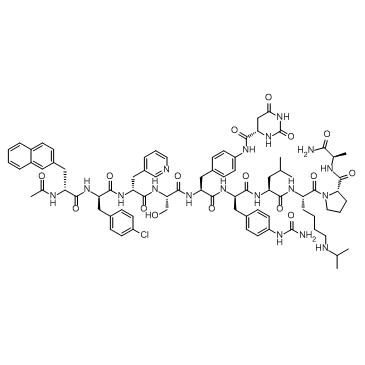
Degarelix is a synthetic peptide gonadotropin-releasing hormone (GnRH; IC50=3nM) receptor antagonist. Degarelix reversibly binds to pituitary GnRH receptors, thereby inhibiting the release of gonadotropins.
Products are for research use only. Not for human use. We do not sell to patients.
Cas No.: 214766-78-6
Sample solution is provided at 25 µL, 10mM.
_1-3.$$$39978408@51.jpg');)
_1-9.$$$38538795@65.jpg');)
_1-9.$$$39112701@51.jpg');)
_1-7.$$$37316672@70.jpg');)
_366-372.$$$36198801@70.jpg');)
.$$$38565142@65.jpg');)
_1867-1883.$$$33248023@67.jpg');)
_eads6055.$$$39977546@45.jpg');)
_eadm9805.$$$40080571@45.jpg');)
_eadj3020.$$$39666821@45.jpg');)
_1-20.$$$39757301@28.jpg');)
_1-24.$$$38898113@28.jpg');)
_273-287.$$$36806353@46.jpg');)
_1-16.$$$37156877@44.jpg');)
_1-19.$$$37460805@44.jpg');)
_1291-1307.$$$34518654@46.jpg');)
Degarelix is a synthetic peptide gonadotropin-releasing hormone (GnRH; IC50=3nM) receptor antagonist. Degarelix reversibly binds to pituitary GnRH receptors, thereby inhibiting the release of gonadotropins[1-2]. Degarelix is widely utilized in research related to the treatment of advanced prostate cancer[3-4].
In vitro, treatment of various human prostate cell lines (including normal stromal WPMY-1, normal epithelial WPE1-NA22, benign hyperplastic BPH-1, androgen-dependent LNCaP, and castration-resistant VCaP cells) with Degarelix (0.1–10μM) for 24 to 72 hours, Degarelix significantly inhibited cell viability and induced apoptosis[5]. Treatment of primary BPH epithelial and stromal cells (cultured alone or in co-culture) with Degarelix (5–30μM) for 24 to 72 hours, Degarelix significantly reducted cell viability and proliferation, activated of caspase 3/7[6].
In vivo, in a PTEN/p53-deficient genetically engineered mouse model of prostate cancer, treatment with Degarelix (0.625mg per mouse; subcutaneous injection; once every 28 days) in combination with Copanlisib (14mg/kg; intravenous injection; every other day) and an anti-PD-1 antibody (200μg per mouse; intraperitoneal injection; every other day) for 28 days, Degarelix significantly reduced serum testosterone to castration levels. Degarelix significantly increased the proportion of the MHC-IIhi/PD-1lo subpopulation of tumor-associated macrophages (TAMs) and enhanced their phagocytic activity[7]. In low-density lipoprotein receptor knockout (LDLR−/−) mice, following 4 months of treatment with Degarelix (50mg/kg; subcutaneous injection; once every 2 weeks), the mice exhibited reduced visceral fat accumulation, improved glucose tolerance, induced the least atherosclerotic plaque area and necrotic core area[8].
References:
[1] Doehn C, Sommerauer M, Jocham D. Degarelix and its therapeutic potential in the treatment of prostate cancer. Clin Interv Aging. 2009;4:215-23.
[2] Steinberg M. Degarelix: a gonadotropin-releasing hormone antagonist for the management of prostate cancer. Clin Ther. 2009;31 Pt 2:2312-31.
[3] Frampton JE, Lyseng-Williamson KA. Degarelix. Drugs. 2009 Oct 1;69(14):1967-76.
[4] Klotz L, Boccon-Gibod L, Shore ND, et al. The efficacy and safety of degarelix: a 12-month, comparative, randomized, open-label, parallel-group phase III study in patients with prostate cancer. BJU Int. 2008 Dec;102(11):1531-8.
[5] Sakai M, Martinez-Arguelles DB, Patterson NH, et al. In search of the molecular mechanisms mediating the inhibitory effect of the GnRH antagonist degarelix on human prostate cell growth. PLoS One. 2015 Mar 26;10(3):e0120670.
[6] Sakai M, Elhilali M, Papadopoulos V. The GnRH Antagonist Degarelix Directly Inhibits Benign Prostate Hyperplasia Cell Growth. Horm Metab Res. 2015 Nov;47(12):925-931.
[7] Chaudagar K, Hieromnimon HM, Khurana R, et al. Reversal of Lactate and PD-1-mediated Macrophage Immunosuppression Controls Growth of PTEN/p53-deficient Prostate Cancer. Clin Cancer Res. 2023 May 15;29(10):1952-1968.
[8] Hopmans SN, Duivenvoorden WC, Werstuck GH, et al. GnRH antagonist associates with less adiposity and reduced characteristics of metabolic syndrome and atherosclerosis compared with orchiectomy and GnRH agonist in a preclinical mouse model. Urol Oncol. 2014 Nov;32(8):1126-34.
| Cell experiment [1]: | |
Cell lines | Human prostate cell lines (WPMY-1, WPE1-NA22, BPH-1, LNCaP, VCaP, PC-3) |
Preparation Method | Cells were maintained in their respective media (e.g., keratinocyte-SFM for WPE1-NA22, RPMI-1640 + 5% FBS for BPH-1, DMEM + 10% FBS for VCaP) at 37°C, 5% CO₂. Cells were treated with Degarelix at concentrations of 0.1–10µM for 24–72 hours. |
Reaction Conditions | 0.1–10μM; 24-72 hours |
Applications | Degarelix significantly reduced cell viability in all prostate cell lines with the most pronounced effects observed at 72 hours. This reduction was attributed to increased apoptosis, evidenced by elevated caspase 3/7, 8, and 9 activities. Degarelix treatment also induced distinct protein and lipid fingerprint changes in cells, and altered gene expression profiles related to cell growth, apoptosis, and MAPK signaling. |
| Animal experiment [2]: | |
Animal models | Low-density lipoprotein receptor knockout (LDLR-/-) mice |
Preparation Method | Mice were subcutaneously administered Degarelix (50mg/kg in 2.5% mannitol vehicle) once every two weeks for 4 months. Control groups received sham surgery plus vehicle, orchiectomy plus vehicle, or Leuprolide (2mg/kg) on the same schedule. Body weight, serum hormones, glucose tolerance, and tissue samples were collected longitudinally. |
Dosage form | 50mg/kg; s.c.; Once every 2 weeks for 4 months. |
Applications | Degarelix treatment significantly reduced serum testosterone levels, with a faster onset of action than Leuprolide. Degarelix resulted in less visceral fat accumulation and smaller adipocyte size compared to orchiectomy and Leuprolide. Degarelix also improved glucose tolerance and induced the least atherosclerotic plaque area and necrotic core area. |
[1] Sakai M, Martinez-Arguelles DB, Patterson NH, et al. In search of the molecular mechanisms mediating the inhibitory effect of the GnRH antagonist degarelix on human prostate cell growth. PLoS One. 2015 Mar 26;10(3):e0120670. | |
| Cas No. | 214766-78-6 | SDF | |
| Formula | C82H103ClN18O16 | M.Wt | 1632.26 |
| Solubility | Water: 25 mg/mL (15.32 mM); DMSO: 10 mg/mL (6.13 mM) | Storage | Store at -20°C |
| General tips | Please select the appropriate solvent to prepare the stock solution according to the
solubility of the product in different solvents; once the solution is prepared, please store it in
separate packages to avoid product failure caused by repeated freezing and thawing.Storage method
and period of the stock solution: When stored at -80°C, please use it within 6 months; when stored
at -20°C, please use it within 1 month. To increase solubility, heat the tube to 37°C and then oscillate in an ultrasonic bath for some time. |
||
| Shipping Condition | Evaluation sample solution: shipped with blue ice. All other sizes available: with RT, or with Blue Ice upon request. | ||
| Prepare stock solution | |||

|
1 mg | 5 mg | 10 mg |
| 1 mM | 612.6 μL | 3.0632 mL | 6.1265 mL |
| 5 mM | 122.5 μL | 612.6 μL | 1.2253 mL |
| 10 mM | 61.3 μL | 306.3 μL | 612.6 μL |
Step 1: Enter information below (Recommended: An additional animal making an allowance for loss during the experiment)
 g
μL
g
μL
Step 2: Enter the in vivo formulation (This is only the calculator, not formulation. Please contact us first if there is no in vivo formulation at the solubility Section.)
Calculation results:
Working concentration: mg/ml;
Method for preparing DMSO master liquid: mg drug pre-dissolved in μL DMSO ( Master liquid concentration mg/mL, Please contact us first if the concentration exceeds the DMSO solubility of the batch of drug. )
Method for preparing in vivo formulation: Take μL DMSO master liquid, next addμL PEG300, mix and clarify, next addμL Tween 80, mix and clarify, next add μL saline, mix and clarify.
Method for preparing in vivo formulation: Take μL DMSO master liquid, next add μL Corn oil, mix and clarify.
Note: 1. Please make sure the liquid is clear before adding the next solvent.
2. Be sure to add the solvent(s) in order. You must ensure that the solution obtained, in the previous addition, is a clear solution before proceeding to add the next solvent. Physical methods such as vortex, ultrasound or hot water bath can be used to aid dissolving.
3. All of the above co-solvents are available for purchase on the GlpBio website.
Quality Control & SDS
- View current batch:
- Purity: >98.00% Appearance: A solid
- COA (Certificate of Analysis)
- SDS (Safety Data Sheet)
- Datasheet
Average Rating: 5 (Based on Reviews and 16 reference(s) in Google Scholar.)