

KP136 (AL136) (Synonyms: AL136) |
Catalog No.GC32001
 One-Click Copy Product Info
|

KP136 (AL136) (AL136) is an orally effective antiallergic agent.
Products are for research use only. Not for human use. We do not sell to patients.
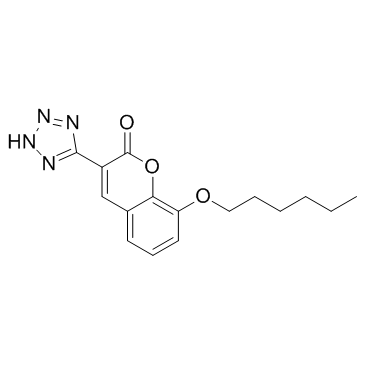
Cas No.: 76239-32-2
Sample solution is provided at 25 µL, 10mM.
_1-3.$$$39978408@51.jpg');)
_1-9.$$$38538795@65.jpg');)
_1-9.$$$39112701@51.jpg');)
_1-7.$$$37316672@70.jpg');)
_366-372.$$$36198801@70.jpg');)
.$$$38565142@65.jpg');)
_1867-1883.$$$33248023@67.jpg');)
_eads6055.$$$39977546@45.jpg');)
_eadm9805.$$$40080571@45.jpg');)
_eadj3020.$$$39666821@45.jpg');)
_1-20.$$$39757301@28.jpg');)
_1-24.$$$38898113@28.jpg');)
_273-287.$$$36806353@46.jpg');)
_1-16.$$$37156877@44.jpg');)
_1-19.$$$37460805@44.jpg');)
_1291-1307.$$$34518654@46.jpg');)
KP136 is an orally effective antiallergic agent. The IC50 is 76.1 μg/mL for histamine release and 63 ug/mL for degranulation.
KP136 (0.01 μg/mL) inhibits this histamine release and degranulation in a dose-dependent manner, confirming that it is an inhibitor of mast cell activation. The IC50 is 76.1 μg/mL for histamine release and 63 ug/mL for degranulation[1].
C4C at 0.2 mg/kg produces an equipotent effect to 1 mg/kg KP136 (KP-136) or 5 mg/kg DSCG. However, C4C is less effective by the oral route because it only produces a maximum inhibition of about 35% even at the high dose of 100 mg/kg, whereas KP136 shows an overt inhibitory effect of about 66% at the oral dose of 2 mg/kg. On the other hand, KP136 (1 mg/kg, i.v.) also remarkably inhibits 5-h homologous PCA, having an activity similar to that of C4C[1].
[1]. Kuriyama K, et al. Antiallergic effects of 4-[2-oxo-3-(1H-tetrazol-5-yl)-2H-chromen-8-yloxy]-bu tyric acid. Jpn J Pharmacol. 1989 Jun;50(2):111-8.
Kinase experiment: | The sensitized peritoneal exudate cells are taken from rats weighing 140-180 g with a 24-hr latent period, into which anti-DNP-As serum (0.1 mL) is injected in traperitoneally and suspended at a density of 5×10⁴ mast cells/mL in PBS, pH 7.2 [137 mM NaCl, 2.7 mM KCl, 1 mM CaCl2, 1 mM MgCl2 6H20, 5.6 mM glucose and 5% (v/v) of 0.1 M phosphate buffer]. For histamine release assay, 2.5 mL of the cell suspension are mixed with 0.5 mL of PBS containing a test compound and DNP-As. The mixture is incubated at 37°C for 10 min and centrifuged at 670× g for 10 min. The histamine contents of the precipitate and the supernatant are measured by the fluorometric method. The mast cell degranulaton assay is carried out. The sensitized cell suspension (50 μL) is mixed with 50 μL of PBS containing a test compound and DNP-As in a Bellco micro-slide culture chamber. The chamber is incubated at 37°C for 10 min, and the cells on microscope slides are fixed and stained by the addition (100 μL/chamber) of 20% neutral formalin solution containing 0.2% toluidine blue. The proportion of mast cells undergoing degranulation is assessed for about 200 mast cells under microscopic observation[1]. |
Animal experiment: | Pigs[1] The trachea is taken from male guinea pigs, weighing 500-590 g, that are sacrificed by bleeding and then cut into 1.5 mm wide to make tracheal rings. Five specimens are tied at cartilage sites crossing each smooth muscle layer. This preparation is incubated in Tyrode's solution at 37°C, which is bubbled with 95% O2/5% CO2. The tension change of the tracheal muscle preparation is recorded through an isotonic transducer. C4C and KP136 in 0.5% KHCO3 or isoproterenol in saline is added cumulatively to the Tyrode's solution at a 1/200 volume. Relaxation percentage is calculated from the maximum relaxation value (100%) produces by re placement of the bathing medium with Tyrode's solution containing no CaCl2. |
References: [1]. Kuriyama K, et al. Antiallergic effects of 4-[2-oxo-3-(1H-tetrazol-5-yl)-2H-chromen-8-yloxy]-bu tyric acid. Jpn J Pharmacol. 1989 Jun;50(2):111-8. | |
| Cas No. | 76239-32-2 | SDF | |
| Synonyms | AL136 | ||
| Canonical SMILES | O=C1C(C2=NNN=N2)=CC3=CC=CC(OCCCCCC)=C3O1 | ||
| Formula | C16H18N4O3 | M.Wt | 314.34 |
| Solubility | Soluble in DMSO | Storage | Store at -20°C |
| General tips | Please select the appropriate solvent to prepare the stock solution according to the
solubility of the product in different solvents; once the solution is prepared, please store it in
separate packages to avoid product failure caused by repeated freezing and thawing.Storage method
and period of the stock solution: When stored at -80°C, please use it within 6 months; when stored
at -20°C, please use it within 1 month. To increase solubility, heat the tube to 37°C and then oscillate in an ultrasonic bath for some time. |
||
| Shipping Condition | Evaluation sample solution: shipped with blue ice. All other sizes available: with RT, or with Blue Ice upon request. | ||
| Prepare stock solution | |||

|
1 mg | 5 mg | 10 mg |
| 1 mM | 3.1813 mL | 15.9063 mL | 31.8127 mL |
| 5 mM | 636.3 μL | 3.1813 mL | 6.3625 mL |
| 10 mM | 318.1 μL | 1.5906 mL | 3.1813 mL |
Step 1: Enter information below (Recommended: An additional animal making an allowance for loss during the experiment)
 g
μL
g
μL
Step 2: Enter the in vivo formulation (This is only the calculator, not formulation. Please contact us first if there is no in vivo formulation at the solubility Section.)
Calculation results:
Working concentration: mg/ml;
Method for preparing DMSO master liquid: mg drug pre-dissolved in μL DMSO ( Master liquid concentration mg/mL, Please contact us first if the concentration exceeds the DMSO solubility of the batch of drug. )
Method for preparing in vivo formulation: Take μL DMSO master liquid, next addμL PEG300, mix and clarify, next addμL Tween 80, mix and clarify, next add μL saline, mix and clarify.
Method for preparing in vivo formulation: Take μL DMSO master liquid, next add μL Corn oil, mix and clarify.
Note: 1. Please make sure the liquid is clear before adding the next solvent.
2. Be sure to add the solvent(s) in order. You must ensure that the solution obtained, in the previous addition, is a clear solution before proceeding to add the next solvent. Physical methods such as vortex, ultrasound or hot water bath can be used to aid dissolving.
3. All of the above co-solvents are available for purchase on the GlpBio website.
Quality Control & SDS
- View current batch:
- Purity: >98.00% Appearance: A solid
- COA (Certificate of Analysis)
- SDS (Safety Data Sheet)
- Datasheet
Average Rating: 5 (Based on Reviews and 16 reference(s) in Google Scholar.)