

Neurotensin(8-13) |
Catalog No.GC36729
 One-Click Copy Product Info
|

Neurotensin(8-13) is the core active fragment of neurotensin and functions as a biologically active neurotensin receptor (NTSR1) agonist. By binding to NTSR1 with high affinity (Kd≈1–10nM), Neurotensin(8-13) activates the Gq/11 protein signaling pathway, thereby regulating intracellular calcium ion concentration and the activity of protein kinase C (PKC).
Products are for research use only. Not for human use. We do not sell to patients.
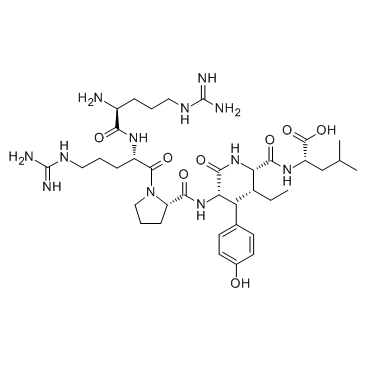
Cas No.: 60482-95-3
Sample solution is provided at 25 µL, 10mM.
_1-3.$$$39978408@51.jpg');)
_1-9.$$$38538795@65.jpg');)
_1-9.$$$39112701@51.jpg');)
_1-7.$$$37316672@70.jpg');)
_366-372.$$$36198801@70.jpg');)
.$$$38565142@65.jpg');)
_1867-1883.$$$33248023@67.jpg');)
_eads6055.$$$39977546@45.jpg');)
_eadm9805.$$$40080571@45.jpg');)
_eadj3020.$$$39666821@45.jpg');)
_1-20.$$$39757301@28.jpg');)
_1-24.$$$38898113@28.jpg');)
_273-287.$$$36806353@46.jpg');)
_1-16.$$$37156877@44.jpg');)
_1-19.$$$37460805@44.jpg');)
_1291-1307.$$$34518654@46.jpg');)
Neurotensin(8-13) is the core active fragment of neurotensin and functions as a biologically active neurotensin receptor (NTSR1) agonist. By binding to NTSR1 with high affinity (Kd≈1–10nM), Neurotensin(8-13) activates the Gq/11 protein signaling pathway, thereby regulating intracellular calcium ion concentration and the activity of protein kinase C (PKC)[1-2]. Neurotensin(8-13) can be used in research related to pain management, psychiatric disorders (such as schizophrenia and depression), and tumor-targeted therapy[3-4].
In vitro, human colon adenocarcinoma HT-29 cells were treated with Neurotensin(8-13) (3–100nM) for 1–2 hours. Neurotensin(8-13) significantly induced rapid internalization mediated by the neurotensin receptor NTR1 and caused a time-dependent downregulation of NTR1 receptors on the cell surface[5]. Human non-small cell lung cancer cells NCI-H1299 were treated with Neurotensin(8-13) (100nM) for 2.5 minutes, which significantly induced tyrosine phosphorylation of focal adhesion kinase (FAK). After treating NCI-H1299 cells with Neurotensin(8-13) (10nM) for 24 hours, Neurotensin(8-13) promoted the proliferation of NCI-H1299 cells[6].
In vivo, normotensive rats were injected via the femoral vein with Neurotensin(8-13) (0.1–100nmol/kg). Neurotensin(8-13) dose-dependently reduced diastolic and systolic blood pressure without altering heart rate and showed no direct vasodilatory effect on isolated rat aortic rings[7]. Male Long-Evans rats received microinjections of Neurotensin(8-13) (3nmol in 0.5μl) into the ventral midbrain tegmental area. Neurotensin(8-13) significantly enhanced the reward effect of brain stimulation in the midbrain central gray matter 15–55 minutes after injection[8].
References:
[1] Gilbert JA, McCormick DJ, Pfenning MA, et al. Neurotensin(8-13): comparison of novel analogs for stimulation of cyclic GMP formation in neuroblastoma clone N1E-115 and receptor binding to human brain and intact N1E-115 cells. Biochem Pharmacol. 1989 Oct 1;38(19):3377-82.
[2] Cocioabă D, Fonseca AI, Leonte R, et al. Neurotensin (8-13) and Neuromedin N Neuropeptides Radiolabelling with Copper-64 Produced on Solid or Liquid Targets. Molecules. 2024 Mar 20;29(6):1390.
[3] Li XM, Von Euler G, Hedlund PB, et al. The C-terminal neurotensin-(8-13) fragment potently modulates rat neostriatal dopamine D2 receptors. Eur J Pharmacol. 1993 Mar 30;234(1):125-8.
[4] Pinnock RD, Woodruff GN. The non-peptide neurotensin receptor antagonist SR48692 is not a potent antagonist of neurotensin(8-13) responses of rat substantia nigra neurones in vitro. Neurosci Lett. 1994 May 19;172(1-2):175-8.
[5] García-Garayoa E, Bläuenstein P, Bruehlmeier M, et al. Preclinical evaluation of a new, stabilized neurotensin(8--13) pseudopeptide radiolabeled with (99m)tc. J Nucl Med. 2002 Mar;43(3):374-83.
[6] Leyton J, Garcia-Marin L, Jensen RT, et al. Neurotensin causes tyrosine phosphorylation of focal adhesion kinase in lung cancer cells. Eur J Pharmacol. 2002 May 10;442(3):179-86.
[7] Di Paola ED, Richelson E. Cardiovascular effects of neurotensin and some analogues on rats. Eur J Pharmacol. 1990 Jan 17;175(3):279-83.
[8] Rompré PP, Gratton A. Mesencephalic microinjections of neurotensin-(1-13) and its C-terminal fragment, neurotensin-(8-13), potentiate brain stimulation reward. Brain Res. 1993 Jul 9;616(1-2):154-62.
| Cell experiment [1]: | |
Cell lines | NCI-H1299 cells (human non-small cell lung cancer cell line) |
Preparation Method | NCI-H1299 cells were maintained in RPMI-1640 medium supplemented with 10% heat-inactivated fetal bovine serum (FBS) at 37°C, 5% CO₂. Cells were treated with Neurotensin(8-13) at concentrations ranging from 1nM to 1μM for 2.5 minutes to 24 hours. |
Reaction Conditions | 1nM to 1μM; 2.5 minutes to 24 hours |
Applications | Neurotensin(8-13) induced transient tyrosine phosphorylation of focal adhesion kinase (FAK) in NCI-H1299 cells, with maximal phosphorylation observed 1–2.5 minutes after treatment. This effect was specific to the C-terminal fragment. The tyrosine phosphorylation was inhibited by the nonpeptide neurotensin receptor antagonist SR48692 (10μM). Neurotensin(8-13) also bound with high affinity to NCI-H1299 cells (IC₅₀=10nM) and stimulated clonal growth in soft agar assays, while SR48692 suppressed proliferation. |
| Animal experiment [2]: | |
Animal models | Normotensive rats |
Preparation Method | Rats were anesthetized with Pentobarbital (55mg/kg; i.p.), and a cannula was inserted into the femoral vein for peptide administration. Neurotensin(8-13) was dissolved in 0.9% NaCl and injected intravenously at doses ranging from 0.1 to 100nmol/kg. Blood pressure and heart rate were monitored via the carotid artery. |
Dosage form | 0.1–100nmol/kg; i.v.; Single injection. |
Applications | Neurotensin(8-13) induced a dose-dependent decrease in diastolic blood pressure (ED₅₀=6.0nmol/kg) without altering heart rate. At higher doses (≥3nmol/kg), Neurotensin(8-13) elicited a triphasic depressor-pressor-depressor response, with effects lasting over 40 minutes at the highest dose (100nmol/kg). Tachyphylaxis was observed upon repeated administration. |
References: | |
| Cas No. | 60482-95-3 | SDF | |
| Formula | C38H64N12O8 | M.Wt | 816.99 |
| Solubility | Water: 50 mg/mL (61.20 mM) | Storage | Store at -20°C |
| General tips | Please select the appropriate solvent to prepare the stock solution according to the
solubility of the product in different solvents; once the solution is prepared, please store it in
separate packages to avoid product failure caused by repeated freezing and thawing.Storage method
and period of the stock solution: When stored at -80°C, please use it within 6 months; when stored
at -20°C, please use it within 1 month. To increase solubility, heat the tube to 37°C and then oscillate in an ultrasonic bath for some time. |
||
| Shipping Condition | Evaluation sample solution: shipped with blue ice. All other sizes available: with RT, or with Blue Ice upon request. | ||
| Prepare stock solution | |||

|
1 mg | 5 mg | 10 mg |
| 1 mM | 1.224 mL | 6.12 mL | 12.2401 mL |
| 5 mM | 244.8 μL | 1.224 mL | 2.448 mL |
| 10 mM | 122.4 μL | 612 μL | 1.224 mL |
Step 1: Enter information below (Recommended: An additional animal making an allowance for loss during the experiment)
 g
μL
g
μL
Step 2: Enter the in vivo formulation (This is only the calculator, not formulation. Please contact us first if there is no in vivo formulation at the solubility Section.)
Calculation results:
Working concentration: mg/ml;
Method for preparing DMSO master liquid: mg drug pre-dissolved in μL DMSO ( Master liquid concentration mg/mL, Please contact us first if the concentration exceeds the DMSO solubility of the batch of drug. )
Method for preparing in vivo formulation: Take μL DMSO master liquid, next addμL PEG300, mix and clarify, next addμL Tween 80, mix and clarify, next add μL saline, mix and clarify.
Method for preparing in vivo formulation: Take μL DMSO master liquid, next add μL Corn oil, mix and clarify.
Note: 1. Please make sure the liquid is clear before adding the next solvent.
2. Be sure to add the solvent(s) in order. You must ensure that the solution obtained, in the previous addition, is a clear solution before proceeding to add the next solvent. Physical methods such as vortex, ultrasound or hot water bath can be used to aid dissolving.
3. All of the above co-solvents are available for purchase on the GlpBio website.
Quality Control & SDS
- View current batch:
- Purity: >98.00% Appearance: A solid
- COA (Certificate of Analysis)
- SDS (Safety Data Sheet)
- Datasheet
Average Rating: 5 (Based on Reviews and 39 reference(s) in Google Scholar.)