

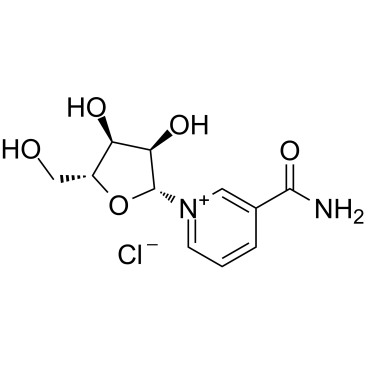
Nicotinamide riboside chloride |
Catalog No.GC36738
 One-Click Copy Product Info
|

Nicotinamide riboside chloride, a new form of vitamin B3 supplement, has also been shown to be an NAD+ precursor that is orally available and can roughly double the level of NAD+ in mammalian cells.
Products are for research use only. Not for human use. We do not sell to patients.
Cas No.: 23111-00-4
Sample solution is provided at 25 µL, 10mM.
_1-3.$$$39978408@51.jpg');)
_1-9.$$$38538795@65.jpg');)
_1-9.$$$39112701@51.jpg');)
_1-7.$$$37316672@70.jpg');)
_366-372.$$$36198801@70.jpg');)
.$$$38565142@65.jpg');)
_1867-1883.$$$33248023@67.jpg');)
_eads6055.$$$39977546@45.jpg');)
_eadm9805.$$$40080571@45.jpg');)
_eadj3020.$$$39666821@45.jpg');)
_1-20.$$$39757301@28.jpg');)
_1-24.$$$38898113@28.jpg');)
_273-287.$$$36806353@46.jpg');)
_1-16.$$$37156877@44.jpg');)
_1-19.$$$37460805@44.jpg');)
_1291-1307.$$$34518654@46.jpg');)
Nicotinamide riboside chloride, a new form of vitamin B3 supplement, has also been shown to be an NAD+ precursor that is orally available and can roughly double the level of NAD+ in mammalian cells[1].
In vitro, Nicotinamide riboside chloride (800μM) can inhibit ferroptosis by suppressing excessive mitophagy and reducing iron accumulation, while restoring mitochondrial function and osteogenic capacity in MC3T3-E1 pre-osteoblasts[2]. In H9c2 cells, Nicotinamide riboside chloride (0, 0.01, 0.1, 1, 5 and 10mM; 24h) pretreatment reduced the levels of lactate dehydrogenase, CK-MB, malondialdehyde, superoxide dismutase and ROS, and reduced cell mortality after the induction of hypoxia/reoxygenation (H/R) injury[3].
In vivo, Acute treatment with Nicotinamide riboside chloride (300mg/kg; 20min after reperfusion; i.p.) reduces hippocampal damage and preserves the cognitive function of mice with ischemic injury[4]. Nicotinamide riboside chloride (500mg/kg; daily; i.p.) treatment improved cardiac dysfunction and blocked progression of heart failure in both WT and Sirt3 KO mice[5].
References:
[1] Zarei A, Khazdooz L, Madarshahian S, et al. Synthesis, Stability, and Bioavailability of Nicotinamide Riboside Trioleate Chloride. Nutrients. 2021 Dec 27;14(1):113.
[2] Hu Y, Lu H, Fang H, et al. Targeting SIRT3 to regulate mitophagy-dependent ferroptosis for preventing glucocorticoid-induced osteoporosis. Int J Surg. 2025 Jul 2.
[3] Yuan C, Yang H, Lan W, et al. Nicotinamide ribose ameliorates myocardial ischemia/reperfusion injury by regulating autophagy and regulating oxidative stress. Exp Ther Med. 2024 Mar 7;27(5):187.
[4] Cheng YH, Zhao JH, Zong WF, et al. Acute Treatment with Nicotinamide Riboside Chloride Reduces Hippocampal Damage and Preserves the Cognitive Function of Mice with Ischemic Injury. Neurochem Res. 2022 Aug;47(8):2244-2253.
[5] Walker MA, Chen H, Yadav A, et al. Raising NAD+ Level Stimulates Short-Chain Dehydrogenase/Reductase Proteins to Alleviate Heart Failure Independent of Mitochondrial Protein Deacetylation. Circulation. 2023 Dec 19;148(25):2038-2057.
| Cell experiment [1]: | |
Cell lines | H9c2 cells |
Preparation Method | Prior to simulating ischemia-reperfusion (I/R) injury, the cell culture medium was discarded, the cells were rinsed with PBS, and DMEM without fetal bovine serum (FBS) was added. The cells were then cultured for 24h. First, the effect of treatment with different concentrations of Nicotinamide riboside chloride alone on the survival of H9c2 cells was investigated. The cells were pre-treated with different concentrations of Nicotinamide riboside chloride, and their survival status was determined using a Cell Counting Kit-8 (CCK-8) assay. Second, the minimum effective concentration of Nicotinamide riboside chloride for protecting against H/R injury was determined. The cells were pre-treated with different concentrations of Nicotinamide riboside chloride followed by H/R treatment, and cell survival status was detected using the CCK-8 assay. In these experiments, various dilutions of Nicotinamide riboside chloride (0, 0.01, 0.1, 1, 5 and 10mM) were prepared using DMEM. The cells were seeded in six-well plates and treated with the different dilutions of Nicotinamide riboside chloride. The cells were pre-treated with Nicotinamide riboside chloride at 37°C for 24h. Subsequently, the cells were placed in a three-gas anoxic incubator (1% O₂ + 94% N₂ + 5% CO₂) for 3h. After this hypoxic treatment, the cell culture medium was replaced with DMEM containing 10% FBS, and the plate was placed in a normal 37°C incubator with 95% air and 5% CO₂ for another 3h. The cell culture supernatant was then collected and transferred to an Eppendorf tube, which was stored in a -80°C freezer for later use. The control group consisted of normally cultured cells without any treatment; the H/R group was cultured at 37°C for 3h in an anoxic incubator; the H/R + Nicotinamide riboside chloride group was pre-treated with Nicotinamide riboside chloride for 24h before undergoing hypoxia-reoxygenation; the H/R + Nicotinamide riboside chloride + EX527 and Nicotinamide riboside chloride + EX527 groups were pre-treated with Nicotinamide riboside chloride and EX527 for 24h before undergoing hypoxia-reoxygenation. |
Reaction Conditions | 0, 0.01, 0.1, 1, 5 and 10mM; 24h |
Applications | In H9c2 cells, Nicotinamide riboside chloride pretreatment reduced the levels of lactate dehydrogenase, CK-MB, malondialdehyde, superoxide dismutase and ROS, and reduced cell mortality after the induction of hypoxia/reoxygenation (H/R) injury. |
| Animal experiment [2]: | |
Animal models | Male C57BL/6 mice |
Preparation Method | Pathologic hypertrophy was induced by treating male (3-4 months old) Sirt3 KO and WT mice with isoproterenol (ISO) or vehicle for 14 days. Mice with and without GW6471(4.5mg/kg/day) were treated with Nicotinamide riboside chloride (500mg/kg; daily; i.p.) or vehicle starting at day one after mini-pump insertion. Briefly, an incision was made in the skin between the shoulder blades. A deep subcutaneous pocket was made caudal to the incision using blunt dissection. The sterile minipump was inserted into the pocket, and the incision was closed with wound clips. Isoproterenol (30mg/kg/day) was delivered by osmotic minipump for 14 days. Minipumps carrying saline were used as a control. |
Dosage form | 500mg/kg; daily; i.p. |
Applications | Nicotinamide riboside chloride treatment improved cardiac dysfunction and blocked progression of heart failure in both WT and Sirt3 KO mice. |
References: | |
| Cas No. | 23111-00-4 | SDF | |
| Canonical SMILES | NC(C1=C[N+]([C@H]2[C@@H]([C@@H]([C@H](O2)CO)O)O)=CC=C1)=O.[Cl-] | ||
| Formula | C11H15ClN2O5 | M.Wt | 290.7 |
| Solubility | Water : 250 mg/mL (859.99 mM) | Storage | Store at -20°C, protect from light |
| General tips | Please select the appropriate solvent to prepare the stock solution according to the
solubility of the product in different solvents; once the solution is prepared, please store it in
separate packages to avoid product failure caused by repeated freezing and thawing.Storage method
and period of the stock solution: When stored at -80°C, please use it within 6 months; when stored
at -20°C, please use it within 1 month. To increase solubility, heat the tube to 37°C and then oscillate in an ultrasonic bath for some time. |
||
| Shipping Condition | Evaluation sample solution: shipped with blue ice. All other sizes available: with RT, or with Blue Ice upon request. | ||
| Prepare stock solution | |||

|
1 mg | 5 mg | 10 mg |
| 1 mM | 3.44 mL | 17.1999 mL | 34.3997 mL |
| 5 mM | 688 μL | 3.44 mL | 6.8799 mL |
| 10 mM | 344 μL | 1.72 mL | 3.44 mL |
Step 1: Enter information below (Recommended: An additional animal making an allowance for loss during the experiment)
 g
μL
g
μL
Step 2: Enter the in vivo formulation (This is only the calculator, not formulation. Please contact us first if there is no in vivo formulation at the solubility Section.)
Calculation results:
Working concentration: mg/ml;
Method for preparing DMSO master liquid: mg drug pre-dissolved in μL DMSO ( Master liquid concentration mg/mL, Please contact us first if the concentration exceeds the DMSO solubility of the batch of drug. )
Method for preparing in vivo formulation: Take μL DMSO master liquid, next addμL PEG300, mix and clarify, next addμL Tween 80, mix and clarify, next add μL saline, mix and clarify.
Method for preparing in vivo formulation: Take μL DMSO master liquid, next add μL Corn oil, mix and clarify.
Note: 1. Please make sure the liquid is clear before adding the next solvent.
2. Be sure to add the solvent(s) in order. You must ensure that the solution obtained, in the previous addition, is a clear solution before proceeding to add the next solvent. Physical methods such as vortex, ultrasound or hot water bath can be used to aid dissolving.
3. All of the above co-solvents are available for purchase on the GlpBio website.
Quality Control & SDS
- View current batch:
- Purity: >99.50% Appearance: A solid
- COA (Certificate of Analysis)
- SDS (Safety Data Sheet)
- Datasheet
Average Rating: 5 (Based on Reviews and 8 reference(s) in Google Scholar.)