

Norepinephrine hydrochloride (Synonyms: (±)-Arterenol, DL-Noradrenaline, DL-Norepinephrine, (±)-Noradrenaline, NSC 7930) |
Catalog No.GC36758
 One-Click Copy Product Info
|

Norepinephrine hydrochloride is a catecholamine neurotransmitter that acts on adrenergic receptors such as α1, α2, and β1, exhibiting pharmacological effects including vasoconstriction and blood pressure regulation.
Products are for research use only. Not for human use. We do not sell to patients.
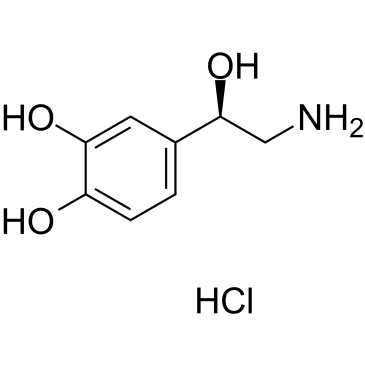
Cas No.: 329-56-6
Sample solution is provided at 25 µL, 10mM.
_1-3.$$$39978408@51.jpg');)
_1-9.$$$38538795@65.jpg');)
_1-9.$$$39112701@51.jpg');)
_1-7.$$$37316672@70.jpg');)
_366-372.$$$36198801@70.jpg');)
.$$$38565142@65.jpg');)
_1867-1883.$$$33248023@67.jpg');)
_eads6055.$$$39977546@45.jpg');)
_eadm9805.$$$40080571@45.jpg');)
_eadj3020.$$$39666821@45.jpg');)
_1-20.$$$39757301@28.jpg');)
_1-24.$$$38898113@28.jpg');)
_273-287.$$$36806353@46.jpg');)
_1-16.$$$37156877@44.jpg');)
_1-19.$$$37460805@44.jpg');)
_1291-1307.$$$34518654@46.jpg');)
Norepinephrine hydrochloride is a catecholamine neurotransmitter that acts on adrenergic receptors such as α1, α2, and β1, exhibiting pharmacological effects including vasoconstriction and blood pressure regulation[1, 2]. Norepinephrine hydrochloride is commonly used as a neuroscience research tool to simulate sympathetic nervous system function and to investigate mechanisms related to drug addiction and sleep regulation[3, 4].
In vitro, Norepinephrine hydrochloride (100μM) enhanced the growth of Yersinia ruckeri strains cultured in Tryptic Soy Broth (TSB) containing 30% serum for 48h, but this growth-promoting effect was blocked by the adrenergic receptor antagonist labetalol (50, 100μM)[5]. Treatment of primary adipocytes isolated from mouse inguinal white adipose tissue (iWAT) with Norepinephrine hydrochloride (10μM) for 6h significantly increased intracellular cAMP levels and promoted lipolysis[6]. Treatment of PD 15 mouse Leydig cells with Norepinephrine hydrochloride (10μM) for 24h significantly increased the proportion of 3β-hydroxysteroid dehydrogenase (3β-HSD) positive cells, promoting cell differentiation[7].
In vivo, continuous intravenous infusion of Norepinephrine hydrochloride (5μg/kg/min) via osmotic minipumps in endotoxemic C57BL/6 mice for 3h dose-dependently suppressed LPS-induced plasma levels of pro-inflammatory cytokines (TNF-α, IP-10, MIP-1α, and MCP-1) and elevated the level of the anti-inflammatory cytokine IL-10[8]. Intraperitoneal injection of Norepinephrine hydrochloride (1mg/kg/day) for 4 weeks in female C57BL/6J mice resulted in decreased ovarian weight, disrupted estrous cycles, reduced numbers of follicles at various developmental stages, and an increased number of atretic follicles[9].
References:
[1] XU X, KAINDL J, CLARK M J, et al. Binding pathway determines norepinephrine selectivity for the human β1AR over β2AR[J]. Cell research, 2021, 31(5): 569-579.
[2] GU P, LI L, FU A, et al. High-performance fluorescence probe for fast and specific visualization of norepinephrine in vivo and depression-like mice[J]. Bioorganic Chemistry, 2023, 131: 106306.
[3] RAMOS B P, ARNSTEN A F. Adrenergic pharmacology and cognition: focus on the prefrontal cortex[J]. Pharmacology & therapeutics, 2007, 113(3): 523-536.
[4] VAN EGROO M, KOSHMANOVA E, VANDEWALLE G, et al. Importance of the locus coeruleus-norepinephrine system in sleep-wake regulation: implications for aging and Alzheimer's disease[J]. Sleep medicine reviews, 2022, 62: 101592.
[5] TORABI DELSHAD S, SOLTANIAN S, SHARIFIYAZDI H, et al. Effect of catecholamine stress hormones (dopamine and norepinephrine) on growth, swimming motility, biofilm formation and virulence factors of Yersinia ruckeri in vitro and an in vivo evaluation in rainbow trout[J]. Journal of fish diseases, 2019, 42(4): 477-487.
[6] LITTLEJOHN N K, KEEN H L, WEIDEMANN B J, et al. Suppression of resting metabolism by the angiotensin AT2 receptor[J]. Cell reports, 2016, 16(6): 1548-1560.
[7] HUO S, ZHONG X, WU X, et al. Effects of norepinephrine and acetylcholine on the development of cultured Leydig cells in mice[J]. BioMed Research International, 2012, 2012: 503093.
[8] STOLK R F, VAN DER PASCH E, NAUMANN F, et al. Norepinephrine dysregulates the immune response and compromises host defense during sepsis[J]. American journal of respiratory and critical care medicine, 2020, 202(6): 830-842.
[9] HONG H, XIAO C, WENG L, et al. The effect of norepinephrine on ovarian dysfunction by mediating ferroptosis in mice model: Norepinephrine and ferroptosis[J]. Acta Biochimica et Biophysica Sinica, 2024, 57(4): 542.
| Cell experiment [1]: | |
|
Cell lines |
Mouse primary inguinal white adipocytes (iWA) |
|
Preparation Method |
White adipocytes from mouse iWAT were treated with Norepinephrine hydrochloride (10μM) for 6h, and cAMP levels in the cells and glycerol levels in the medium from iWAT were measured. |
|
Reaction Conditions |
10μM; 6h |
|
Applications |
A significant increase in intracellular cAMP levels and a promotion of lipolysis were observed following treatment with Norepinephrine hydrochloride. |
| Animal experiment [2]: | |
|
Animal models |
Endotoxemic C57BL/6J mice |
|
Preparation Method |
For the endotoxemia experiments, microosmotic pumps with connected jugular vein catheters were filled with Norepinephrine hydrochloride and implanted 3h before LPS challenge, and animals were killed 90min after LPS, and blood was obtained for cytokine analysis. |
|
Dosage form |
5μg/kg/min; 3h; i.v. |
|
Applications |
Norepinephrine hydrochloride infusion dose-dependently attenuated LPS-induced TNF-α (p = 0.04), IP-10 (p = 0.0004), MIP-1α (p = 0.01) and MCP-1 (p = 0.001) responses, whereas plasma concentrations of IL-10 were enhanced (p = 0.0004), indicating broad antiinflammatory effects. |
|
References: |
|
| Cas No. | 329-56-6 | SDF | |
| Synonyms | (±)-Arterenol, DL-Noradrenaline, DL-Norepinephrine, (±)-Noradrenaline, NSC 7930 | ||
| Canonical SMILES | OC1=CC=C([C@@H](O)CN)C=C1O.Cl | ||
| Formula | C8H12ClNO3 | M.Wt | 205.64 |
| Solubility | 5 mg/mL in DMSO (ultrasonic and warming and heat to 40°C) | Storage | Store at -20°C,protect from light |
| General tips | Please select the appropriate solvent to prepare the stock solution according to the
solubility of the product in different solvents; once the solution is prepared, please store it in
separate packages to avoid product failure caused by repeated freezing and thawing.Storage method
and period of the stock solution: When stored at -80°C, please use it within 6 months; when stored
at -20°C, please use it within 1 month. To increase solubility, heat the tube to 37°C and then oscillate in an ultrasonic bath for some time. |
||
| Shipping Condition | Evaluation sample solution: shipped with blue ice. All other sizes available: with RT, or with Blue Ice upon request. | ||
| Prepare stock solution | |||

|
1 mg | 5 mg | 10 mg |
| 1 mM | 4.8629 mL | 24.3143 mL | 48.6287 mL |
| 5 mM | 972.6 μL | 4.8629 mL | 9.7257 mL |
| 10 mM | 486.3 μL | 2.4314 mL | 4.8629 mL |
Step 1: Enter information below (Recommended: An additional animal making an allowance for loss during the experiment)
 g
μL
g
μL
Step 2: Enter the in vivo formulation (This is only the calculator, not formulation. Please contact us first if there is no in vivo formulation at the solubility Section.)
Calculation results:
Working concentration: mg/ml;
Method for preparing DMSO master liquid: mg drug pre-dissolved in μL DMSO ( Master liquid concentration mg/mL, Please contact us first if the concentration exceeds the DMSO solubility of the batch of drug. )
Method for preparing in vivo formulation: Take μL DMSO master liquid, next addμL PEG300, mix and clarify, next addμL Tween 80, mix and clarify, next add μL saline, mix and clarify.
Method for preparing in vivo formulation: Take μL DMSO master liquid, next add μL Corn oil, mix and clarify.
Note: 1. Please make sure the liquid is clear before adding the next solvent.
2. Be sure to add the solvent(s) in order. You must ensure that the solution obtained, in the previous addition, is a clear solution before proceeding to add the next solvent. Physical methods such as vortex, ultrasound or hot water bath can be used to aid dissolving.
3. All of the above co-solvents are available for purchase on the GlpBio website.
Quality Control & SDS
- View current batch:
- Purity: >98.00% Appearance: A solid
- COA (Certificate of Analysis)
- SDS (Safety Data Sheet)
- Datasheet
Average Rating: 5 (Based on Reviews and 39 reference(s) in Google Scholar.)