

Pilaralisib (Synonyms: Pilaralisib, SAR245408) |
Catalog No.GC36917
 One-Click Copy Product Info
|

A class I PI3K inhibitor
Products are for research use only. Not for human use. We do not sell to patients.
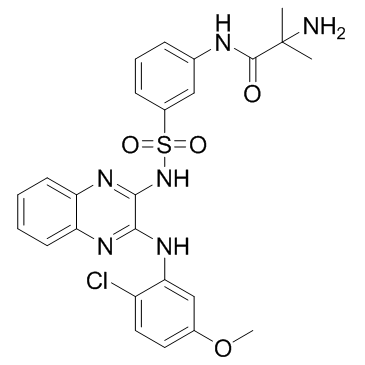
Cas No.: 934526-89-3
Sample solution is provided at 25 µL, 10mM.
_1-3.$$$39978408@51.jpg');)
_1-9.$$$38538795@65.jpg');)
_1-9.$$$39112701@51.jpg');)
_1-7.$$$37316672@70.jpg');)
_366-372.$$$36198801@70.jpg');)
.$$$38565142@65.jpg');)
_1867-1883.$$$33248023@67.jpg');)
_eads6055.$$$39977546@45.jpg');)
_eadm9805.$$$40080571@45.jpg');)
_eadj3020.$$$39666821@45.jpg');)
_1-20.$$$39757301@28.jpg');)
_1-24.$$$38898113@28.jpg');)
_273-287.$$$36806353@46.jpg');)
_1-16.$$$37156877@44.jpg');)
_1-19.$$$37460805@44.jpg');)
_1291-1307.$$$34518654@46.jpg');)
Pilaralisib (XL147; SAR245408) is a potent and highly selective class I PI3Ks inhibitor with IC50s of 39 nM, 383 nM, 23 nM and 36 nM for PI3Kα, PI3Kβ, PI3Kγ, and PI3Kδ. PI3Kα|39 nM (IC50)|PI3Kβ|383 nM (IC50)|PI3Kδ|36 nM (IC50)|PI3Kγ|23 nM (IC50)|Vps34|6974 nM (IC50)|DNA-PK|4750 nM (IC50)
Pilaralisib (XL147) displays potent inhibitory activity against Class I PI3K isoforms p110α, p110δ, and p110γ, with IC50s of 39, 36, and 23 nM, respectively. Pilaralisib (XL147) is less potent against the remaining Class I isoform, p110β, with an IC50 value of 383 nM. The IC50 value for inhibition of PI3Kα by Pilaralisib (XL147) is determined at various concentrations of ATP, revealing XL147 to be an ATP-competitive inhibitor with an equilibrium inhibition constant (Ki) value of 42 nM. Pilaralisib (XL147) has relatively weak inhibitory activity toward the class III PI3K vacuolar sorting protein 34 (VPS34; IC50 value of ~7.0 M) and the PI3K-related DNA-dependent protein kinase (DNA-PK; IC50 value of 4.75 μM). In an mTOR kinase immunoprecipitation assay using cell lysates, Pilaralisib (XL147) does not inhibit mTOR activity toward the physiologic substrate protein eukaryotic translation initiation factor 4E-binding protein 1 (4EBP1; IC50>15 μM). Consistent with its inhibitory activity against purified PI3K proteins, Pilaralisib (XL147) inhibits EGF-induced PIP3 production in PC-3 and MCF7 cells in serum-free medium with IC50s of 220 and 347 nM, respectively. The ability of Pilaralisib (XL147) to inhibit phosphorylation of key signaling proteins downstream of PI3K is examined by assessing its effects on EGF-stimulated phosphorylation of AKT and on nonstimulated phosphorylation of S6 in PC-3 cells in serum-free media by cell-based ELISA. Pilaralisib (XL147) inhibits these activities with IC50s of 477 and 776 nM, respectively[1].
The ability of Pilaralisib (XL147) to inhibit this endogenous phosphorylation of AKT, p70S6K, and S6 is examined following a single oral dose of 10, 30, 100, or 300 mg/kg. The tumors are harvested 4, 24, or 48 hours postdose and homogenized in lysis buffer. Tumor lysates from each animal (n=4) are then pooled for each group and analyzed for levels of total and phosphorylated AKT, p70S6K, and S6 by Western immunoblotting. Administration of Pilaralisib (XL147) causes a dose-dependent decrease in phosphorylation of AKT, p70S6K, and S6 in the tumors, reaching a maximum of 81% inhibition of AKT phosphorylation at 300 mg/kg at 4 hours. The dose-response relationships derived from the 4-hour time point predict 50% inhibition of AKT, p70S6K, and S6 phosphorylation at doses of approximately 100 mg/kg (pAKTT308), 54 mg/kg (pAKTS473), 71 mg/kg (p-p70S6K), and 103 mg/kg (pS6). The inhibition of AKT, p70S6K, and S6 phosphorylation in MCF7 tumors following a 100 mg/kg dose of Pilaralisib (XL147) is maximal at 4 hours, reaching 55% to 75%; however, the level of inhibition decreased to 8% to 45% by 24 hours, and only minimal or no inhibition was evident by 48 hours. Following a 300 mg/kg dose of Pilaralisib (XL147), inhibition is also maximal at 4 hours (65%-81%). However, in contrast with the 100 mg/kg dose, inhibition at 24 hours (51%-78%) is almost comparable with that seen at 4 hours, and partial inhibition (25%-51%) persisted through 48 hours[1].
[1]. Foster P, et al. The Selective PI3K Inhibitor XL147 (SAR245408) Inhibits Tumor Growth and Survival and Potentiates the Activity of Chemotherapeutic Agents in Preclinical Tumor Models. Mol Cancer Ther. 2015 Apr;14(4):931-40.
| Cas No. | 934526-89-3 | SDF | |
| Synonyms | Pilaralisib, SAR245408 | ||
| Canonical SMILES | CC(C)(N)C(NC1=CC=CC(S(=O)(NC2=NC3=CC=CC=C3N=C2NC4=CC(OC)=CC=C4Cl)=O)=C1)=O | ||
| Formula | C25H25ClN6O4S | M.Wt | 541.02 |
| Solubility | DMSO: ≥ 100 mg/mL (184.84 mM); Water: < 0.1 mg/mL (insoluble) | Storage | Store at -20°C |
| General tips | Please select the appropriate solvent to prepare the stock solution according to the
solubility of the product in different solvents; once the solution is prepared, please store it in
separate packages to avoid product failure caused by repeated freezing and thawing.Storage method
and period of the stock solution: When stored at -80°C, please use it within 6 months; when stored
at -20°C, please use it within 1 month. To increase solubility, heat the tube to 37°C and then oscillate in an ultrasonic bath for some time. |
||
| Shipping Condition | Evaluation sample solution: shipped with blue ice. All other sizes available: with RT, or with Blue Ice upon request. | ||
| Prepare stock solution | |||

|
1 mg | 5 mg | 10 mg |
| 1 mM | 1.8484 mL | 9.2418 mL | 18.4836 mL |
| 5 mM | 369.7 μL | 1.8484 mL | 3.6967 mL |
| 10 mM | 184.8 μL | 924.2 μL | 1.8484 mL |
Step 1: Enter information below (Recommended: An additional animal making an allowance for loss during the experiment)
 g
μL
g
μL
Step 2: Enter the in vivo formulation (This is only the calculator, not formulation. Please contact us first if there is no in vivo formulation at the solubility Section.)
Calculation results:
Working concentration: mg/ml;
Method for preparing DMSO master liquid: mg drug pre-dissolved in μL DMSO ( Master liquid concentration mg/mL, Please contact us first if the concentration exceeds the DMSO solubility of the batch of drug. )
Method for preparing in vivo formulation: Take μL DMSO master liquid, next addμL PEG300, mix and clarify, next addμL Tween 80, mix and clarify, next add μL saline, mix and clarify.
Method for preparing in vivo formulation: Take μL DMSO master liquid, next add μL Corn oil, mix and clarify.
Note: 1. Please make sure the liquid is clear before adding the next solvent.
2. Be sure to add the solvent(s) in order. You must ensure that the solution obtained, in the previous addition, is a clear solution before proceeding to add the next solvent. Physical methods such as vortex, ultrasound or hot water bath can be used to aid dissolving.
3. All of the above co-solvents are available for purchase on the GlpBio website.
Quality Control & SDS
- View current batch:
- Purity: >99.50% Appearance: A solid
- COA (Certificate of Analysis)
- SDS (Safety Data Sheet)
- Datasheet
Average Rating: 5 (Based on Reviews and 11 reference(s) in Google Scholar.)