

RC-3095 |
Catalog No.GC37072
 One-Click Copy Product Info
|

RC-3095 is a gastrin-releasing peptide (GRP) receptor antagonist.
Products are for research use only. Not for human use. We do not sell to patients.
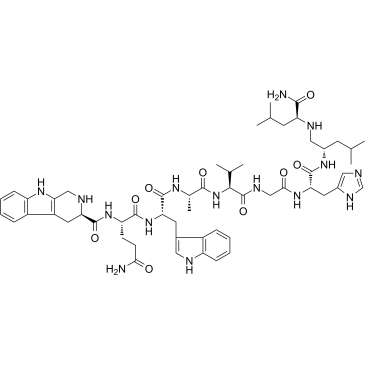
Cas No.: 138147-78-1
Sample solution is provided at 25 µL, 10mM.
_1-3.$$$39978408@51.jpg');)
_1-9.$$$38538795@65.jpg');)
_1-9.$$$39112701@51.jpg');)
_1-7.$$$37316672@70.jpg');)
_366-372.$$$36198801@70.jpg');)
.$$$38565142@65.jpg');)
_1867-1883.$$$33248023@67.jpg');)
_eads6055.$$$39977546@45.jpg');)
_eadm9805.$$$40080571@45.jpg');)
_eadj3020.$$$39666821@45.jpg');)
_1-20.$$$39757301@28.jpg');)
_1-24.$$$38898113@28.jpg');)
_273-287.$$$36806353@46.jpg');)
_1-16.$$$37156877@44.jpg');)
_1-19.$$$37460805@44.jpg');)
_1291-1307.$$$34518654@46.jpg');)
RC-3095 is a gastrin-releasing peptide (GRP) receptor antagonist[1]. GRP affects several systems in mammals, including neuroendocrine regulation, gastrointestinal secretion, and cell proliferation[2]. RC-3095 works by blocking bombesin/GRP receptors and is considered an anticancer drug with clinical application value[3].
In vitro, treatment with RC-3095 for 48h inhibited proliferation at 0.1nM but stimulated proliferation at 100nM in Neuro2a murine neuroblastoma cells[4].
In vivo, RC-3095 treatment (1mg/kg; s.c.; twice daily for 2 or 10 days) significantly reduced neutrophil migration, mechanical hypernociception, and proteoglycan loss in mice with AIA (antigen-induced arthritis)[2]. Administration of RC-3095 (0.3 or 1mg/kg; s.c.; twice daily for 10 days) significantly decreased arthritis clinical scores and reduced disease severity as assessed by histological analysis in mice with CIA (collagen-induced arthritis)[2]. A single intraperitoneal injection of RC-3095 (0.2 or 1.0mg/kg) 30 minutes before behavioral testing impaired short-term and long-term inhibitory avoidance memory in mice, but did not affect their cognitive memory[3].
References:
[1]Qin Y, Halmos G, Cai RZ, Szoke B, Ertl T, Schally AV. Bombesin antagonists inhibit in vitro and in vivo growth of human gastric cancer and binding of bombesin to its receptors. J Cancer Res Clin Oncol. 1994;120(9):519-528.
[2] Oliveira PG, Grespan R, Pinto LG, et al. Protective effect of RC-3095, an antagonist of the gastrin-releasing peptide receptor, in experimental arthritis. Arthritis Rheum. 2011;63(10):2956-2965.
[3] Roesler R, Kopschina MI, Rosa RM, Henriques JA, Souza DO, Schwartsmann G. RC-3095, a bombesin/gastrin-releasing peptide receptor antagonist, impairs aversive but not recognition memory in rats. Eur J Pharmacol. 2004;486(1):35-41.
[4] Abujamra AL, Almeida VR, Brunetto AL, Schwartsmann G, Roesler R. A gastrin-releasing peptide receptor antagonist stimulates Neuro2a neuroblastoma cell growth: prevention by a histone deacetylase inhibitor. Cell Biol Int. 2009;33(8):899-903.
| Cell experiment [1]: | |
Cell lines | Neuro2a neuroblastoma cells |
Preparation Method | Cells were seeded at 5x10⁴ cells/well in 24-well plates and treated 24h later with RC-3095 (0.1, 1, 10, or 100nM). 48 hours later, the medium was removed and the cells were washed twice with HBSS. They were detached with 0.25% trypsin/EDTA and 10mL of cellular suspension was homogenized 1:1 with 0.4% trypan blue solution. Cells were counted immediately in a hemocytometer. |
Reaction Conditions | 0.1, 1, 10, or 100nM; 48h |
Applications | RC-3095, at 0.1nM inhibited, whereas at 100nM stimulated proliferation of Neuro2a murine neuroblastoma cells |
| Animal experiment [2]: | |
Animal models | Male Balb/c wild-type mice with AIA (antigen-induced arthritis) model; Male DBA/1J inbred mice with CIA (collagen-induced arthritis) model |
Preparation Method | AIA studies: The Balb/c mice were injected with RC-3095 (1mg/kg; s.c.) or vehicle (0.9% saline) twice a day for a total of 2 or 10 days, starting on the second day before the induction of arthritis. CIA studies: mice were randomly divided into 4 groups. Group 1 comprised mice that were not manipulated, group 2 comprised immunized mice treated with vehicle, and groups 3 and 4 comprised immunized mice treated with either 0.3mg/kg (group 3) or 1mg/kg (group 4) RC-3095, administered s.c. twice a day for 10 days after the onset of the disease. |
Dosage form | AIA studies: 2mg/kg/d; 2 or 10d; s.c. CIA studies: 0.6 or 2mg/kg/d; 10d; s.c. |
Applications | In mice with AIA, administration of RC-3095 reduced neutrophil migration, mechanical hypernociception, and proteoglycan loss. In the CIA model, treatment with RC-3095 led to a significant reduction in arthritis clinical scores and the severity of disease determined histologically. |
References: | |
| Cas No. | 138147-78-1 | SDF | |
| Formula | C56H79N15O9 | M.Wt | 1106.32 |
| Solubility | Soluble in DMSO | Storage | Store at -20°C |
| General tips | Please select the appropriate solvent to prepare the stock solution according to the
solubility of the product in different solvents; once the solution is prepared, please store it in
separate packages to avoid product failure caused by repeated freezing and thawing.Storage method
and period of the stock solution: When stored at -80°C, please use it within 6 months; when stored
at -20°C, please use it within 1 month. To increase solubility, heat the tube to 37°C and then oscillate in an ultrasonic bath for some time. |
||
| Shipping Condition | Evaluation sample solution: shipped with blue ice. All other sizes available: with RT, or with Blue Ice upon request. | ||
| Prepare stock solution | |||

|
1 mg | 5 mg | 10 mg |
| 1 mM | 903.9 μL | 4.5195 mL | 9.039 mL |
| 5 mM | 180.8 μL | 903.9 μL | 1.8078 mL |
| 10 mM | 90.4 μL | 451.9 μL | 903.9 μL |
Step 1: Enter information below (Recommended: An additional animal making an allowance for loss during the experiment)
 g
μL
g
μL
Step 2: Enter the in vivo formulation (This is only the calculator, not formulation. Please contact us first if there is no in vivo formulation at the solubility Section.)
Calculation results:
Working concentration: mg/ml;
Method for preparing DMSO master liquid: mg drug pre-dissolved in μL DMSO ( Master liquid concentration mg/mL, Please contact us first if the concentration exceeds the DMSO solubility of the batch of drug. )
Method for preparing in vivo formulation: Take μL DMSO master liquid, next addμL PEG300, mix and clarify, next addμL Tween 80, mix and clarify, next add μL saline, mix and clarify.
Method for preparing in vivo formulation: Take μL DMSO master liquid, next add μL Corn oil, mix and clarify.
Note: 1. Please make sure the liquid is clear before adding the next solvent.
2. Be sure to add the solvent(s) in order. You must ensure that the solution obtained, in the previous addition, is a clear solution before proceeding to add the next solvent. Physical methods such as vortex, ultrasound or hot water bath can be used to aid dissolving.
3. All of the above co-solvents are available for purchase on the GlpBio website.
Quality Control & SDS
- View current batch:
- Purity: >98.00% Appearance: A solid
- COA (Certificate of Analysis)
- SDS (Safety Data Sheet)
- Datasheet
Average Rating: 5 (Based on Reviews and 16 reference(s) in Google Scholar.)