

Tetracycline |
Catalog No.GC37769
 One-Click Copy Product Info
|

Tetracycline (TC) is a broad-spectrum antibiotic with oral activity.
Products are for research use only. Not for human use. We do not sell to patients.
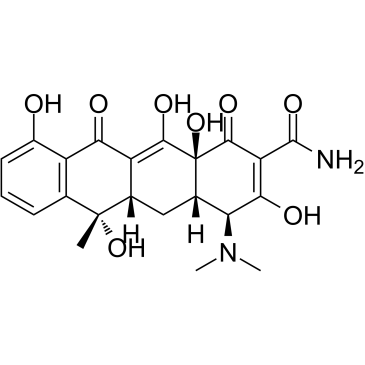
Cas No.: 60-54-8
Sample solution is provided at 25 µL, 10mM.
_1-3.$$$39978408@51.jpg');)
_1-9.$$$38538795@65.jpg');)
_1-9.$$$39112701@51.jpg');)
_1-7.$$$37316672@70.jpg');)
_366-372.$$$36198801@70.jpg');)
.$$$38565142@65.jpg');)
_1867-1883.$$$33248023@67.jpg');)
_eads6055.$$$39977546@45.jpg');)
_eadm9805.$$$40080571@45.jpg');)
_eadj3020.$$$39666821@45.jpg');)
_1-20.$$$39757301@28.jpg');)
_1-24.$$$38898113@28.jpg');)
_273-287.$$$36806353@46.jpg');)
_1-16.$$$37156877@44.jpg');)
_1-19.$$$37460805@44.jpg');)
_1291-1307.$$$34518654@46.jpg');)
Tetracycline (TC) is a broad-spectrum antibiotic with oral activity. It is effective against a variety of bacteria, including gram-positive and gram-negative bacteria, chlamydia, mycoplasma, and Rickettsia. It is used in the study of infections and can induce gene expression in the corresponding system[1-4].
Tetracycline (6.25-250 μM) was dose-dependent on NO synthetase activity and nitrite formation in J774 cells[5].
Tetracycline treatment delays the onset and slows the progression of diabetes in human amylin/islet amyloid polypeptide (hA/hIAPP) transgenic mice. Chronic oral administration of tetracycline (0.03 mg/ml in drinking water) from weaning enhances glycemic control and extends lifespan in hemizygous mice [6]. In a dog model of acute ischemia, 4mg/kg tetracycline injected 30 min prior to the occlusion improved the functional recovery from stunning of myocardium caused by ischemia[7]. Tetracycline injection at single doses of 1.5, 10, and 20 mg/kg significantly protected mice from a lethal intraperitoneal injection of LPS[8].
References:
[1]. Platt BN, Jacobs CA, et,al. Tetracycline use in treating osteoarthritis: a systematic review. Inflamm Res. 2021 Mar;70(3):249-259. doi: 10.1007/s00011-021-01435-4. Epub 2021 Jan 29. PMID: 33512569.
[2]. Chopra I, Roberts M. Tetracycline antibiotics: mode of action, applications, molecular biology, and epidemiology of bacterial resistance. Microbiol Mol Biol Rev. 2001 Jun;65(2):232-60 ; second page, table of contents. doi: 10.1128/MMBR.65.2.232-260.2001. PMID: 11381101; PMCID: PMC99026.
[3]. Roberts MC. Tetracycline therapy: update. Clin Infect Dis. 2003 Feb 15;36(4):462-7. doi: 10.1086/367622. Epub 2003 Jan 28. PMID: 12567304.
[4]. Aiba A, Nakao H. Conditional mutant mice using tetracycline-controlled gene expression system in the brain. Neurosci Res. 2007 Jun;58(2):113-7. doi: 10.1016/j.neures.2007.01.009. Epub 2007 Jan 20. PMID: 17316857.
[5]. D'Agostino P, Arcoleo F, et,al. Tetracycline inhibits the nitric oxide synthase activity induced by endotoxin in cultured murine macrophages. Eur J Pharmacol. 1998 Apr 10;346(2-3):283-90. doi: 10.1016/s0014-2999(98)00046-6. PMID: 9652371.
[6]. Aitken JF, Loomes KM, et,al. Tetracycline treatment retards the onset and slows the progression of diabetes in human amylin/islet amyloid polypeptide transgenic mice. Diabetes. 2010 Jan;59(1):161-71. doi: 10.2337/db09-0548. Epub 2009 Sep 30. PMID: 19794060; PMCID: PMC2797917.
[7]. Kagawa N, Senbonmatsu TA, et,al. Tetracycline protects myocardium against ischemic injury. Front Biosci. 2005 Jan 1;10:608-19. doi: 10.2741/1557. PMID: 15569603.
[8]. Milano S, Arcoleo F, et,al. Intraperitoneal injection of tetracyclines protects mice from lethal endotoxemia downregulating inducible nitric oxide synthase in various organs and cytokine and nitrate secretion in blood. Antimicrob Agents Chemother. 1997 Jan;41(1):117-21. doi: 10.1128/AAC.41.1.117. PMID: 8980766; PMCID: PMC163671.
| Cell experiment [1]: | |
Cell lines | J774 macrophage |
Preparation Method | Cells were cultured in medium stimulated with lipopolysaccharide (1 μg/ml) and treated with varying doses of tetracycline. |
Reaction Conditions | 6.25-250 μM; 6h |
Applications | Tetracycline reduced lipopolysaccharide-stimulated inducible NO synthase activity and nitrite formation in a dose-dependent manner. |
| Animal experiment [2]: | |
Animal models | Adult mongrel dogs (acute ischemia model) |
Preparation Method | Saline or tetracycline (4 mg/kg in saline) was administered intravenously at a volume of 0.5 mL/kg, 30 minutes before the ligation. The ligature around the coronary artery was tightened for 20 minutes and then released to allow reperfusion. |
Dosage form | 4 mg/kg; i.p |
Applications | Tetracycline, injected 30 minutes before the occlusion, enhanced the functional recovery of the myocardium from stunning caused by ischemia. |
References: | |
| Cas No. | 60-54-8 | SDF | |
| Canonical SMILES | O=C(C(C1=O)=C(O)[C@@H](N(C)C)[C@]2([H])C[C@]3([H])[C@](C)(O)C4=C(C(C3=C(O)[C@@]21O)=O)C(O)=CC=C4)N | ||
| Formula | C22H24N2O8 | M.Wt | 444.43 |
| Solubility | DMSO: 125 mg/mL (281.26 mM) | Storage | Store at 2-8°C,unstable in solution, ready to use. |
| General tips | Please select the appropriate solvent to prepare the stock solution according to the
solubility of the product in different solvents; once the solution is prepared, please store it in
separate packages to avoid product failure caused by repeated freezing and thawing.Storage method
and period of the stock solution: When stored at -80°C, please use it within 6 months; when stored
at -20°C, please use it within 1 month. To increase solubility, heat the tube to 37°C and then oscillate in an ultrasonic bath for some time. |
||
| Shipping Condition | Evaluation sample solution: shipped with blue ice. All other sizes available: with RT, or with Blue Ice upon request. | ||
| Prepare stock solution | |||

|
1 mg | 5 mg | 10 mg |
| 1 mM | 2.2501 mL | 11.2504 mL | 22.5007 mL |
| 5 mM | 450 μL | 2.2501 mL | 4.5001 mL |
| 10 mM | 225 μL | 1.125 mL | 2.2501 mL |
Step 1: Enter information below (Recommended: An additional animal making an allowance for loss during the experiment)
 g
μL
g
μL
Step 2: Enter the in vivo formulation (This is only the calculator, not formulation. Please contact us first if there is no in vivo formulation at the solubility Section.)
Calculation results:
Working concentration: mg/ml;
Method for preparing DMSO master liquid: mg drug pre-dissolved in μL DMSO ( Master liquid concentration mg/mL, Please contact us first if the concentration exceeds the DMSO solubility of the batch of drug. )
Method for preparing in vivo formulation: Take μL DMSO master liquid, next addμL PEG300, mix and clarify, next addμL Tween 80, mix and clarify, next add μL saline, mix and clarify.
Method for preparing in vivo formulation: Take μL DMSO master liquid, next add μL Corn oil, mix and clarify.
Note: 1. Please make sure the liquid is clear before adding the next solvent.
2. Be sure to add the solvent(s) in order. You must ensure that the solution obtained, in the previous addition, is a clear solution before proceeding to add the next solvent. Physical methods such as vortex, ultrasound or hot water bath can be used to aid dissolving.
3. All of the above co-solvents are available for purchase on the GlpBio website.
Quality Control & SDS
- View current batch:
- Purity: >98.00% Appearance: A solid
- COA (Certificate of Analysis)
- SDS (Safety Data Sheet)
- Datasheet
Average Rating: 5 (Based on Reviews and 28 reference(s) in Google Scholar.)