

SC 26196 (Synonyms: α,αDiphenyl4(3pyridinylmethylene)amino1piperazinepentanenitrile) |
Catalog No.GC13772
 One-Click Copy Product Info
|

SC 26196 is an orally active Delta6 desaturase (D6D, FADS2) inhibitor that regulates lipid metabolism by inhibiting the conversion of linoleic acid and α-linolenic acid into long-chain unsaturated fatty acids.
Products are for research use only. Not for human use. We do not sell to patients.
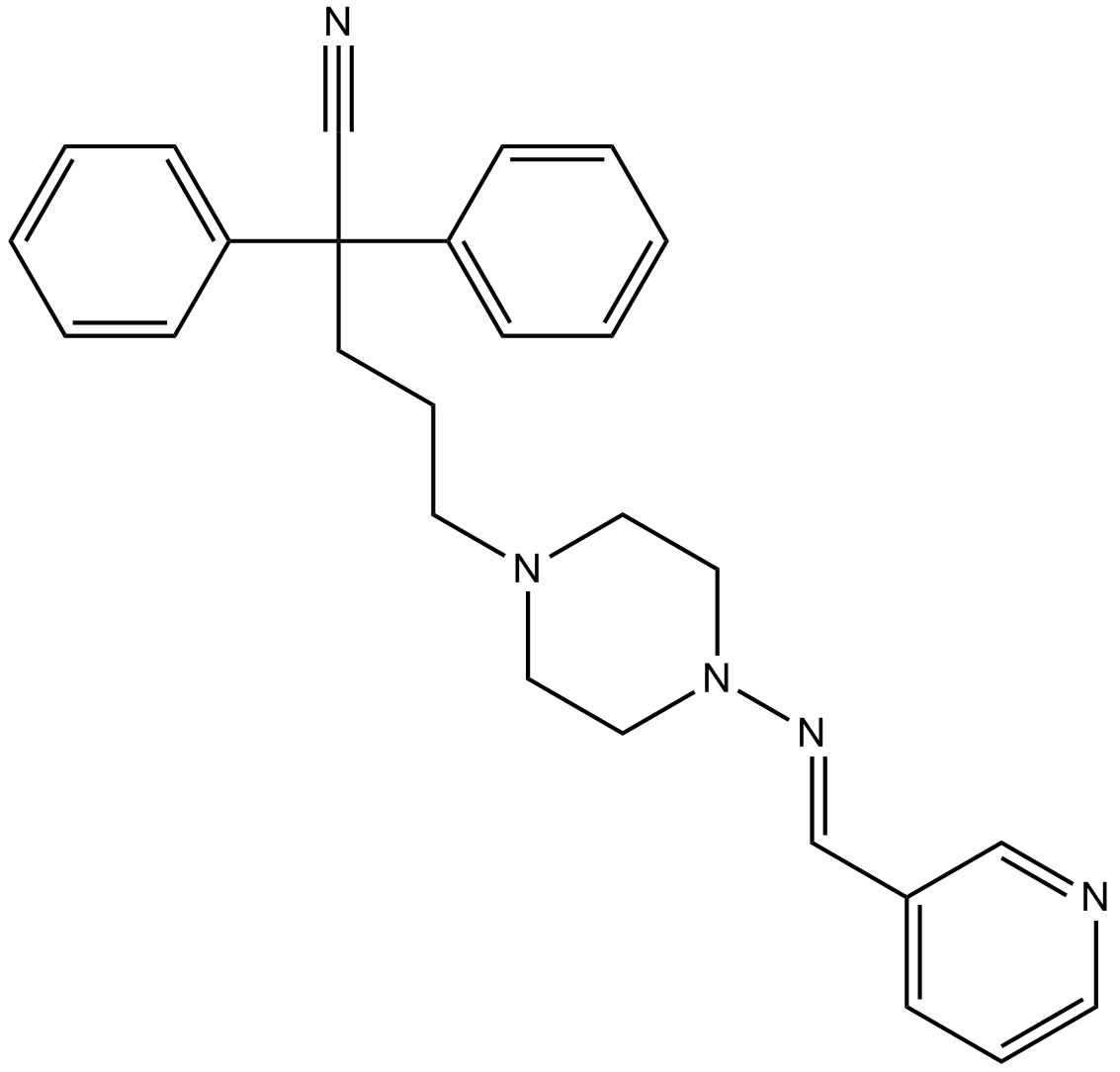
Cas No.: 218136-59-5
Sample solution is provided at 25 µL, 10mM.
_1-3.$$$39978408@51.jpg');)
_1-9.$$$38538795@65.jpg');)
_1-9.$$$39112701@51.jpg');)
_1-7.$$$37316672@70.jpg');)
_366-372.$$$36198801@70.jpg');)
.$$$38565142@65.jpg');)
_1867-1883.$$$33248023@67.jpg');)
_eads6055.$$$39977546@45.jpg');)
_eadm9805.$$$40080571@45.jpg');)
_eadj3020.$$$39666821@45.jpg');)
_1-20.$$$39757301@28.jpg');)
_1-24.$$$38898113@28.jpg');)
_273-287.$$$36806353@46.jpg');)
_1-16.$$$37156877@44.jpg');)
_1-19.$$$37460805@44.jpg');)
_1291-1307.$$$34518654@46.jpg');)
SC 26196 is an orally active Delta6 desaturase (D6D, FADS2) inhibitor that regulates lipid metabolism by inhibiting the conversion of linoleic acid and α-linolenic acid into long-chain unsaturated fatty acids[1-2]. SC 26196 is applicable for research related to inflammatory diseases and lipid metabolism disorders[3-4].
In vitro, in skin fibroblasts, coronary artery smooth muscle cells, and astrocytes, SC 26196 (2μM; 24 hours) inhibited the desaturation of 2μM [1-14C]18:2n-6 and significantly reduced the synthesis of arachidonic acid, EPA, and DHA[5]. During the differentiation of 3T3-L1 adipocytes, SC 26196 (5μM; 8 days) blocked the conversion of α-linolenic acid (ALA) to eicosapentaenoic acid (EPA) and docosapentaenoic acid (DPAn-3), and reduced triacylglycerol accumulation in adipocytes. SC 26196 treatment increased the release of non-esterified fatty acids and glycerol into the culture medium and decreased the expression of the fatty acid re-esterification markers PEPCK and CD36[6].
In vivo, in athymic mice bearing U-87 MG cell xenografts, SC 26196 (30mg/kg) administered via intraperitoneal injection (every three days for four weeks). SC 26196 synergistically inhibited the growth of U-87 MG xenograft tumors when combined with radiation therapy (5Gy local X-ray irradiation, every three days)[7]. In ApcMin/+ mice bearing HT-29 colon cancer cell xenografts, dietary administration of SC 26196 (100mg/kg) for seven weeks. SC 26196 reduced number of intestinal tumors and a significant decrease in tumor size[8].
References:
[1] Sibbons CM, Irvine NA, Pérez-Mojica JE, et al. Polyunsaturated Fatty Acid Biosynthesis Involving Δ8 Desaturation and Differential DNA Methylation of FADS2 Regulates Proliferation of Human Peripheral Blood Mononuclear Cells. Front Immunol. 2018 Mar 5;9:432.
[2] Hargrave-Barnes KM, Azain MJ, Miner JL. Conjugated linoleic acid-induced fat loss dependence on Delta6-desaturase or cyclooxygenase. Obesity (Silver Spring). 2008 Oct;16(10):2245-52.
[3] Duffin KL, Obukowicz MG, Salsgiver WJ, et al. Lipid remodeling in mouse liver and plasma resulting from delta6 fatty acid desaturase inhibition. Lipids. 2001 Nov;36(11):1203-8.
[4] Obukowicz MG, Welsch DJ, Salsgiver WJ, et al. Novel, selective delta6 or delta5 fatty acid desaturase inhibitors as antiinflammatory agents in mice. J Pharmacol Exp Ther. 1998 Oct;287(1):157-66.
[5] Harmon SD, Kaduce TL, Manuel TD, et al. Effect of the delta6-desaturase inhibitor SC-26196 on PUFA metabolism in human cells. Lipids. 2003 Apr;38(4):469-76.
[6] Wang C, MacIntyre B, Mutch DM. Inhibition of Δ-6 desaturase reduces fatty acid re-esterification in 3T3-L1 adipocytes independent of changes in n3-PUFA cellular content. Biochim Biophys Acta Mol Cell Biol Lipids. 2022 Jul;1867(7):159160.
[7] Wang J, Liang H, Sun M, et al. Delta-6-desaturase inhibitor enhances radiation therapy in glioblastoma in vitro and in vivo. Cancer Manag Res. 2018 Dec 7;10:6779-6790.
[8] Hansen-Petrik MB, McEntee MF, Johnson BT, et al. Selective inhibition of Delta-6 desaturase impedes intestinal tumorigenesis. Cancer Lett. 2002 Jan 25;175(2):157-63.
| Cell experiment [1]: | |
Cell lines | 3T3-L1 adipocytes (murine preadipocyte cell line) |
Preparation Method | 3T3-L1 pre-adipocytes were differentiated in high-glucose DMEM supplemented with 10% FBS, a standard differentiation cocktail (IBMX, DEX, insulin), and treated with the Δ-6 desaturase (D6D) inhibitor SC 26196 (5μM) throughout the 8-day differentiation process, either in the presence or absence of α-linolenic acid (ALA, 50μM) or eicosapentaenoic acid (EPA, 50μM). |
Reaction Conditions | 5μM; treatment throughout differentiation (8 days). |
Applications | SC 26196 treatment significantly reduced triacylglycerol (TAG) accumulation in differentiated 3T3-L1 adipocytes. SC 26196 inhibited the conversion of ALA to EPA and docosapentaenoic acid (DPAn-3). SC 26196 increased the release of non-esterified fatty acids (NEFA) and glycerol into the medium, elevated the NEFA/glycerol ratio, and decreased the expression of fatty acid re-esterification markers PEPCK and CD36 at both mRNA and protein levels. These effects on TAG accumulation and fatty acid re-esterification were observed independently of changes in cellular n-3 polyunsaturated fatty acid (PUFA) content. |
| Animal experiment [2]: | |
Animal models | ApcMin/+ mice (intestinal tumorigenesis model) and nude mice bearing HT-29 human colon cancer cell xenografts. |
Preparation Method | ApcMin/+ mice were fed SC 26196 mixed into their diet (AIN-93G diet or US17 diet) at a dosage of 100mg/kg/day for 7 weeks. In a separate xenograft study, nude mice were inoculated with HT-29 cells, maintained on the US17 diet, and then fed SC 26196 mixed into the same diet (100mg/kg/day) starting 5 days after tumor cell implantation. Primary tumor growth in the xenograft model was monitored. |
Dosage form | 100mg/kg/day; Administered in the diet; Daily for 7 weeks (ApcMin/+ mice) and for the study duration post-implantation (xenograft mice). |
Applications | SC 26196 treatment resulted fewer intestinal tumors in ApcMin/+ mice and reduced average primary tumor size. In nude mice bearing HT-29 xenografts, SC 26196 treatment inhibited tumor growth at 4 weeks. The anti-tumorigenic effects on ApcMin/+ mice were nullified by concomitant dietary supplementation of arachidonic acid (AA), which bypassed the SC 26196-mediated inhibition of Δ-6 desaturase. |
References: | |
| Cas No. | 218136-59-5 | SDF | |
| Synonyms | α,αDiphenyl4(3pyridinylmethylene)amino1piperazinepentanenitrile | ||
| Chemical Name | (E)-2,2-diphenyl-5-(4-((pyridin-3-ylmethylene)amino)piperazin-1-yl)pentanenitrile | ||
| Canonical SMILES | N#CC(C1=CC=CC=C1)(C2=CC=CC=C2)CCCN(CC3)CCN3/N=C/C4=CC=CN=C4 | ||
| Formula | C27H29N5 | M.Wt | 423.55 |
| Solubility | DMF: 12 mg/mL,DMF:PBS (pH 7.2) (1:4): 0.2 mg/mL,DMSO: 5 mg/mL | Storage | Store at -20°C |
| General tips | Please select the appropriate solvent to prepare the stock solution according to the
solubility of the product in different solvents; once the solution is prepared, please store it in
separate packages to avoid product failure caused by repeated freezing and thawing.Storage method
and period of the stock solution: When stored at -80°C, please use it within 6 months; when stored
at -20°C, please use it within 1 month. To increase solubility, heat the tube to 37°C and then oscillate in an ultrasonic bath for some time. |
||
| Shipping Condition | Evaluation sample solution: shipped with blue ice. All other sizes available: with RT, or with Blue Ice upon request. | ||
| Prepare stock solution | |||

|
1 mg | 5 mg | 10 mg |
| 1 mM | 2.361 mL | 11.805 mL | 23.61 mL |
| 5 mM | 472.2 μL | 2.361 mL | 4.722 mL |
| 10 mM | 236.1 μL | 1.1805 mL | 2.361 mL |
Step 1: Enter information below (Recommended: An additional animal making an allowance for loss during the experiment)
 g
μL
g
μL
Step 2: Enter the in vivo formulation (This is only the calculator, not formulation. Please contact us first if there is no in vivo formulation at the solubility Section.)
Calculation results:
Working concentration: mg/ml;
Method for preparing DMSO master liquid: mg drug pre-dissolved in μL DMSO ( Master liquid concentration mg/mL, Please contact us first if the concentration exceeds the DMSO solubility of the batch of drug. )
Method for preparing in vivo formulation: Take μL DMSO master liquid, next addμL PEG300, mix and clarify, next addμL Tween 80, mix and clarify, next add μL saline, mix and clarify.
Method for preparing in vivo formulation: Take μL DMSO master liquid, next add μL Corn oil, mix and clarify.
Note: 1. Please make sure the liquid is clear before adding the next solvent.
2. Be sure to add the solvent(s) in order. You must ensure that the solution obtained, in the previous addition, is a clear solution before proceeding to add the next solvent. Physical methods such as vortex, ultrasound or hot water bath can be used to aid dissolving.
3. All of the above co-solvents are available for purchase on the GlpBio website.
Quality Control & SDS
- View current batch:
- Purity: >98.00% Appearance: A solid
- COA (Certificate of Analysis)
- SDS (Safety Data Sheet)
- Datasheet
Average Rating: 5 (Based on Reviews and 8 reference(s) in Google Scholar.)