

Thaxtomin A |
Catalog No.GC18697
 One-Click Copy Product Info
|

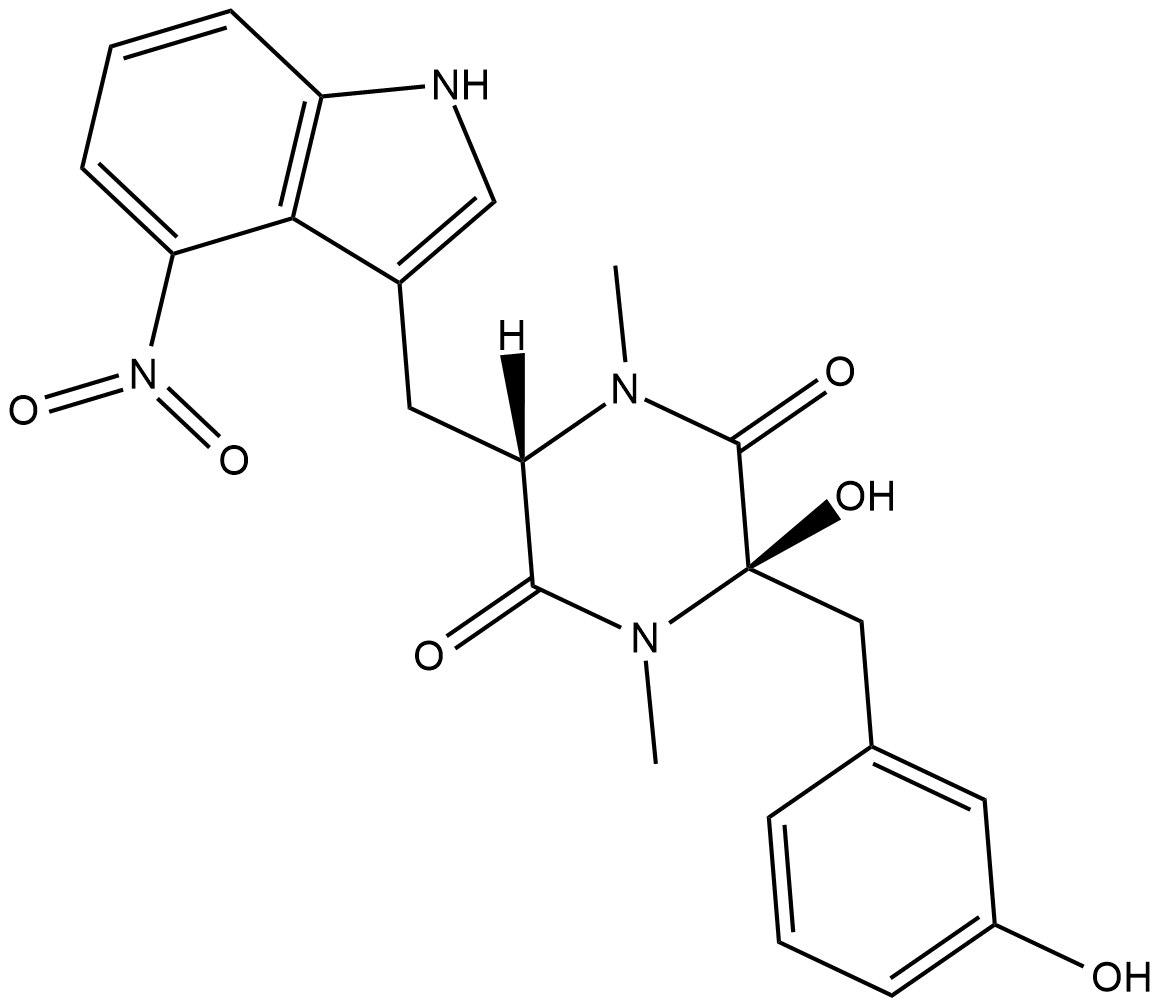
Thaxtomin A is a diketopiperazine phytotoxin produced by plant pathogenic bacteria such as Streptomyces scabies.
Products are for research use only. Not for human use. We do not sell to patients.
Cas No.: 122380-18-1
Sample solution is provided at 25 µL, 10mM.
_1-3.$$$39978408@51.jpg');)
_1-9.$$$38538795@65.jpg');)
_1-9.$$$39112701@51.jpg');)
_1-7.$$$37316672@70.jpg');)
_366-372.$$$36198801@70.jpg');)
.$$$38565142@65.jpg');)
_1867-1883.$$$33248023@67.jpg');)
_eads6055.$$$39977546@45.jpg');)
_eadm9805.$$$40080571@45.jpg');)
_eadj3020.$$$39666821@45.jpg');)
_1-20.$$$39757301@28.jpg');)
_1-24.$$$38898113@28.jpg');)
_273-287.$$$36806353@46.jpg');)
_1-16.$$$37156877@44.jpg');)
_1-19.$$$37460805@44.jpg');)
_1291-1307.$$$34518654@46.jpg');)
Thaxtomin A is a diketopiperazine phytotoxin produced by plant pathogenic bacteria such as Streptomyces scabies[1-2]. Thaxtomin A disrupts cell wall integrity by inhibiting plant cellulose biosynthesis and induces programmed cell death (PCD) in plant cells. Thaxtomin A can be used in research related to the pathogenic mechanisms of Streptomyces scabiesand the development of novel natural herbicides[3-4].
In vitro, A. thaliana cells were treated with Thaxtomin A (10μM) for 6 hours. Thaxtomin A induced an early, transient Ca²⁺ influx. N. tabacum BY2 cells were treated with Thaxtomin A (20μM) for 6 hours, which did not cause an increase in cytoplasmic Ca²⁺ concentration[5]. A. thaliana cells were treated with Thaxtomin A (2.0–10.0μM) for 24–72 hours. Thaxtomin A caused DNA fragmentation in the nucleus and induced programmed cell death (PCD)[6].
References:
[1] Clarke CR, Kramer CG, Kotha RR, et al. The Phytotoxin Thaxtomin A Is the Primary Virulence Determinant for Scab Disease of Beet, Carrot, and Radish Caused by Streptomyces scabiei. Phytopathology. 2022 Nov;112(11):2288-2295.
[2] Li Y, Liu J, Adekunle D, et al. TxtH is a key component of the thaxtomin biosynthetic machinery in the potato common scab pathogen Streptomyces scabies. Mol Plant Pathol. 2019 Oct;20(10):1379-1393.
[3] Casey C, Köcher T, Champion C, et al. Reduced coenzyme Q synthesis confers non-target site resistance to the herbicide thaxtomin A. PLoS Genet. 2023 Jan 6;19(1):e1010423.
[4] Zhang H, Wang Q, Ning X, et al. Synthesis and biological evaluations of a series of thaxtomin analogues. J Agric Food Chem. 2015 Apr 15;63(14):3734-41.
[5] Meimoun P, Tran D, Baz M, et al. Two different signaling pathways for thaxtomin A-induced cell death in Arabidopsis and tobacco BY2. Plant Signal Behav. 2009 Feb;4(2):142-4.
[6] Duval I, Brochu V, Simard M, et al. Thaxtomin A induces programmed cell death in Arabidopsis thaliana suspension-cultured cells. Planta. 2005 Nov;222(5):820-31.
| Cell experiment [1]: | |
Cell lines | Arabidopsis thaliana (A. thaliana) suspension-cultured cells; Nicotiana tabacum BY2 suspension-cultured cells. |
Preparation Method | Arabidopsis thaliana suspension cells were grown in Gamborg medium (pH=5.8). Nicotiana tabacum BY2 suspension cells were grown in Murashige and Skoog medium (pH=5.8). All experiments were performed using log-phase cells (4 days after sub-culture for Arabidopsis and 6 days for BY2). Arabidopsis treated with Thaxtomin A (10μM) for 6h, BY2 treated with Thaxtomin A (20μM) for 6h. |
Reaction Conditions | 10 or 20μM; 6h. |
Applications | In A. thaliana cells, 10μM Thaxtomin A induces an early, short-lived Ca2+ influx, which is an upstream event in the signaling pathway leading to Thaxtomin A-induced cell death. In BY2 cells, 20μM Thaxtomin A did not induce a significant increase in cytosolic calcium concentration. |
References: | |
| Cas No. | 122380-18-1 | SDF | |
| Chemical Name | (3R,6S)-3-hydroxy-3-[(3-hydroxyphenyl)methyl]-1,4-dimethyl-6-[(4-nitro-1H-indol-3-yl)methyl]-2,5-piperazinedione | ||
| Canonical SMILES | O=C(N(C)[C@H]1CC2=CNC3=C2C([N+]([O-])=O)=CC=C3)[C@@](CC4=CC=CC(O)=C4)(O)N(C)C1=O | ||
| Formula | C22H22N4O6 | M.Wt | 438.4 |
| Solubility | DMF: Soluble,DMSO: Soluble,Ethanol: Partially soluble,Methanol: Partially soluble | Storage | Store at -20°C |
| General tips | Please select the appropriate solvent to prepare the stock solution according to the
solubility of the product in different solvents; once the solution is prepared, please store it in
separate packages to avoid product failure caused by repeated freezing and thawing.Storage method
and period of the stock solution: When stored at -80°C, please use it within 6 months; when stored
at -20°C, please use it within 1 month. To increase solubility, heat the tube to 37°C and then oscillate in an ultrasonic bath for some time. |
||
| Shipping Condition | Evaluation sample solution: shipped with blue ice. All other sizes available: with RT, or with Blue Ice upon request. | ||
| Prepare stock solution | |||

|
1 mg | 5 mg | 10 mg |
| 1 mM | 2.281 mL | 11.4051 mL | 22.8102 mL |
| 5 mM | 456.2 μL | 2.281 mL | 4.562 mL |
| 10 mM | 228.1 μL | 1.1405 mL | 2.281 mL |
Step 1: Enter information below (Recommended: An additional animal making an allowance for loss during the experiment)
 g
μL
g
μL
Step 2: Enter the in vivo formulation (This is only the calculator, not formulation. Please contact us first if there is no in vivo formulation at the solubility Section.)
Calculation results:
Working concentration: mg/ml;
Method for preparing DMSO master liquid: mg drug pre-dissolved in μL DMSO ( Master liquid concentration mg/mL, Please contact us first if the concentration exceeds the DMSO solubility of the batch of drug. )
Method for preparing in vivo formulation: Take μL DMSO master liquid, next addμL PEG300, mix and clarify, next addμL Tween 80, mix and clarify, next add μL saline, mix and clarify.
Method for preparing in vivo formulation: Take μL DMSO master liquid, next add μL Corn oil, mix and clarify.
Note: 1. Please make sure the liquid is clear before adding the next solvent.
2. Be sure to add the solvent(s) in order. You must ensure that the solution obtained, in the previous addition, is a clear solution before proceeding to add the next solvent. Physical methods such as vortex, ultrasound or hot water bath can be used to aid dissolving.
3. All of the above co-solvents are available for purchase on the GlpBio website.
Quality Control & SDS
- View current batch:
- Purity: >98.00% Appearance: A solid
- COA (Certificate of Analysis)
- SDS (Safety Data Sheet)
- Datasheet
Average Rating: 5 (Based on Reviews and 13 reference(s) in Google Scholar.)