

Veratramine (Synonyms: NSC 17821, NSC 23880) |
Catalog No.GC37895
 One-Click Copy Product Info
|

Veratramine, a lipid-soluble alkaloid, is found in a variety of plants of the lily family.
Products are for research use only. Not for human use. We do not sell to patients.
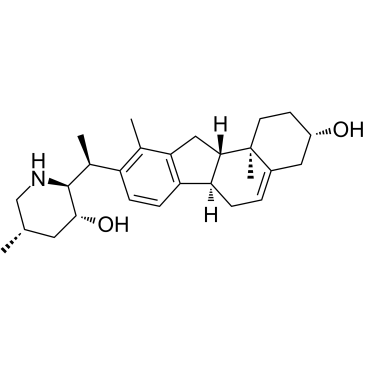
Cas No.: 60-70-8
Sample solution is provided at 25 µL, 10mM.
_1-3.$$$39978408@51.jpg');)
_1-9.$$$38538795@65.jpg');)
_1-9.$$$39112701@51.jpg');)
_1-7.$$$37316672@70.jpg');)
_366-372.$$$36198801@70.jpg');)
.$$$38565142@65.jpg');)
_1867-1883.$$$33248023@67.jpg');)
_eads6055.$$$39977546@45.jpg');)
_eadm9805.$$$40080571@45.jpg');)
_eadj3020.$$$39666821@45.jpg');)
_1-20.$$$39757301@28.jpg');)
_1-24.$$$38898113@28.jpg');)
_273-287.$$$36806353@46.jpg');)
_1-16.$$$37156877@44.jpg');)
_1-19.$$$37460805@44.jpg');)
_1291-1307.$$$34518654@46.jpg');)
Veratramine, a lipid-soluble alkaloid, is found in a variety of plants of the lily family [1]. Veratramine can reduce blood pressure, antagonize sodium ion channels and function as an analgesic [2]. Veratramine is widely used as an anti-cancer agent to inhibit the vitality of cancer cells in various cell models[3].
In vitro, Veratramine treatment for 24 hours can significantly inhibited cell proliferation of A172 cells, HS-683 cells, and T98G cells, with IC50 values of 88.81μM, 77.82μM, and 87.12μM, respectively[4]. The 10μM Veratramine treatment of Vero-E6 cells for 2 hours significantly reduced the PEDV-nucleocapsid (N) protein after α-coronavirus porcine epidemic diarrhea virus (PEDV) infection and inhibited the PI3K/Akt activity induced by PEDV[5]. Treatment with 20μM Veratramine for 60 minutes significantly inhibited EGF-induced activator protein-1 (AP-1) transcriptional activation and EGF-induced transformation of JB6 P+ cells[6].
In vivo, Veratramine treatment via daily tail vein injection at 50μg/kg/day for 4 weeks alleviated neuropathic pain in the diabetic rat model and reduced spinal cord and sciatic nerve damage[7]. Veratramine treatment (2mg/kg; 3 times a week) via tail vein injection for 4 weeks significantly inhibited subcutaneous tumor growth of liver cancer cells in the xenograft model of mice, with a low systemic toxicity[8].
References:
[1] Seale J T, McDougal O M. Veratrum parviflorum: an underexplored source for bioactive steroidal alkaloids[J]. Molecules, 2022, 27(16): 5349.
[2] Dirks M L, Seale J T, Collins J M, et al. Veratrum californicum alkaloids[J]. Molecules, 2021, 26(19): 5934.
[3] Tang J, Li H L, Shen Y H, et al. Antitumor and antiplatelet activity of alkaloids from veratrum dahuricum[J]. Phytotherapy Research, 2010, 24(6): 821-826.
[4] Kim D, Kwon W, Park S, et al. Anticancer effects of veratramine via the phosphatidylinositol-3-kinase/serine-threonine kinase/mechanistic target of rapamycin and its downstream signaling pathways in human glioblastoma cell lines[J]. Life Sciences, 2022, 288: 120170.
[5] Chen H, Zhao P, Zhang C, et al. Veratramine inhibits porcine epidemic diarrhea virus entry through macropinocytosis by suppressing PI3K/Akt pathway[J]. Virus Research, 2024, 339: 199260.
[6] Bai F, Liu K, Li H, et al. Veratramine modulates AP-1-dependent gene transcription by directly binding to programmable DNA[J]. Nucleic acids research, 2018, 46(2): 546-557.
[7] Zhang Y, Ye G, Chen Y, et al. Veratramine ameliorates pain symptoms in rats with diabetic peripheral neuropathy by inhibiting activation of the SIGMAR1-NMDAR pathway[J]. Pharmaceutical Biology, 2022, 60(1): 2145-2154.
[8] Yin L, Xia Y, Xu P, et al. Veratramine suppresses human HepG2 liver cancer cell growth in vitro and in vivo by inducing autophagic cell death[J]. Oncology Reports, 2020, 44(2): 477-486.
| Cell experiment [1]: | |
Cell lines | A172 cells |
Preparation Method | A172 cells were cultured in RPMI-1640 medium containing 10% FBS, penicillin (100units/ml) and streptomycin (100units/ml), and were placed in a humidified incubator at 37°C and 5% CO2. A172 cells (1×10³ cells per well) were seeded in 96-well plates and cultured for 24 hours. Then, the cells were treated with different concentrations of Veratramine (0, 10, 25, and 50µM) for 24, 48 and 72 hours. 10µl of CCK-8 solution was added to each well and the cells were further cultured for 4 hours. The absorbance was measured at 450nm using an enzyme reader. |
Reaction Conditions | 0, 10, 25, and 50µM; 24, 48 and 72h |
Applications | Veratramine treatment significantly inhibited A172 cell proliferation in a time- and dose-dependent manner. |
| Animal experiment [2]: | |
Animal models | Female BALB/c mice |
Preparation Method | The liver cancer xenograft model was established by subcutaneous injection of human HepG2 cells (1×10⁶ cells suspended in 0.1ml PBS for each mouse) into the armpits of female BALB/c mice (6–8 weeks old). Once the tumors reached a volume of approximately 75-100mm3, the mice were randomly divided into two groups, with five mice per group, a PBS group and Veratramine group. PBS (200µl) or Veratramine (2mg/kg) were injected into the mice via the tail vein. The mice were treated three times a week for 4 weeks. During the treatment, the weights of the mice and the volume of the tumors were measured every week. The volume of the tumors was calculated according to the following formula: V = 0.5 × length × width2. Three days after the last treatment, the mice were sacrificed. Subcutaneous tumors from the mice were excised and weighed. |
Dosage form | 2mg/kg; three times a week for 4 weeks; tail vein injection |
Applications | Veratramine treatment inhibited the subcutaneous tumor growth in mice. |
References: | |
| Cas No. | 60-70-8 | SDF | |
| Synonyms | NSC 17821, NSC 23880 | ||
| Canonical SMILES | O[C@H]1[C@H]([C@H](C2=C(C)C3=C(C=C2)[C@]4([H])CC=C(C[C@@H](O)CC5)[C@@]5(C)[C@@]4([H])C3)C)NC[C@@H](C)C1 | ||
| Formula | C27H39NO2 | M.Wt | 409.6 |
| Solubility | DMSO: ≥ 100 mg/mL (244.14 mM) | Storage | Store at -20°C,protect from light |
| General tips | Please select the appropriate solvent to prepare the stock solution according to the
solubility of the product in different solvents; once the solution is prepared, please store it in
separate packages to avoid product failure caused by repeated freezing and thawing.Storage method
and period of the stock solution: When stored at -80°C, please use it within 6 months; when stored
at -20°C, please use it within 1 month. To increase solubility, heat the tube to 37°C and then oscillate in an ultrasonic bath for some time. |
||
| Shipping Condition | Evaluation sample solution: shipped with blue ice. All other sizes available: with RT, or with Blue Ice upon request. | ||
| Prepare stock solution | |||

|
1 mg | 5 mg | 10 mg |
| 1 mM | 2.4414 mL | 12.207 mL | 24.4141 mL |
| 5 mM | 488.3 μL | 2.4414 mL | 4.8828 mL |
| 10 mM | 244.1 μL | 1.2207 mL | 2.4414 mL |
Step 1: Enter information below (Recommended: An additional animal making an allowance for loss during the experiment)
 g
μL
g
μL
Step 2: Enter the in vivo formulation (This is only the calculator, not formulation. Please contact us first if there is no in vivo formulation at the solubility Section.)
Calculation results:
Working concentration: mg/ml;
Method for preparing DMSO master liquid: mg drug pre-dissolved in μL DMSO ( Master liquid concentration mg/mL, Please contact us first if the concentration exceeds the DMSO solubility of the batch of drug. )
Method for preparing in vivo formulation: Take μL DMSO master liquid, next addμL PEG300, mix and clarify, next addμL Tween 80, mix and clarify, next add μL saline, mix and clarify.
Method for preparing in vivo formulation: Take μL DMSO master liquid, next add μL Corn oil, mix and clarify.
Note: 1. Please make sure the liquid is clear before adding the next solvent.
2. Be sure to add the solvent(s) in order. You must ensure that the solution obtained, in the previous addition, is a clear solution before proceeding to add the next solvent. Physical methods such as vortex, ultrasound or hot water bath can be used to aid dissolving.
3. All of the above co-solvents are available for purchase on the GlpBio website.
Quality Control & SDS
- View current batch:
- Purity: >99.50% Appearance: A solid
- COA (Certificate of Analysis)
- SDS (Safety Data Sheet)
- Datasheet
Average Rating: 5 (Based on Reviews and 7 reference(s) in Google Scholar.)