

Yohimbine |
Catalog No.GC37952
 One-Click Copy Product Info
|

Yohimbine is a natural, orally active α2-adrenergic receptor antagonist.
Products are for research use only. Not for human use. We do not sell to patients.
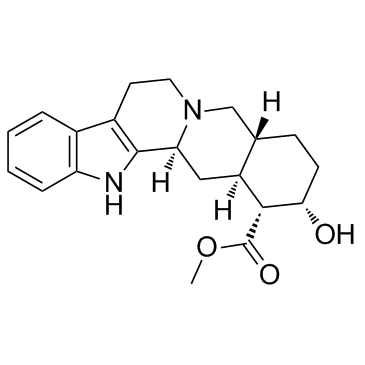
Cas No.: 146-48-5
Sample solution is provided at 25 µL, 10mM.
_1-3.$$$39978408@51.jpg');)
_1-9.$$$38538795@65.jpg');)
_1-9.$$$39112701@51.jpg');)
_1-7.$$$37316672@70.jpg');)
_366-372.$$$36198801@70.jpg');)
.$$$38565142@65.jpg');)
_1867-1883.$$$33248023@67.jpg');)
_eads6055.$$$39977546@45.jpg');)
_eadm9805.$$$40080571@45.jpg');)
_eadj3020.$$$39666821@45.jpg');)
_1-20.$$$39757301@28.jpg');)
_1-24.$$$38898113@28.jpg');)
_273-287.$$$36806353@46.jpg');)
_1-16.$$$37156877@44.jpg');)
_1-19.$$$37460805@44.jpg');)
_1291-1307.$$$34518654@46.jpg');)
Yohimbine is a natural, orally active α2-adrenergic receptor antagonist. Yohimbine can promote norepinephrine release and dilate peripheral blood vessels by blocking α2-adrenergic receptors, while also increasing blood flow to the corpus cavernosum to facilitate erection. Yohimbine can be used in research related to erectile dysfunction, pain, and antiepileptic effects[1-4].
In vitro, Yohimbine (10-100μM) was used to treat KB-ChR-8-5 cells for 24 hours. Yohimbine significantly induced apoptosis, increased reactive oxygen species generation, and reduced mitochondrial membrane potential[5]. Yohimbine (10-100μM) was used to treat MOVAS-1 cells for 24 hours. Yohimbine significantly inhibited cell proliferation and migration, downregulated MMP-2 and MMP-9 expression, and caused cell cycle arrest in the G0/G1 phase[6].
In vivo, Yohimbine (25μg; subcutaneous injection) was administered to male Balb/c mice 4 hours before LPS (100μg; intraperitoneal injection) treatment. Yohimbine significantly improved gastric emptying delay and gastrointestinal transit inhibition in endotoxemic mice and downregulated LPS-induced iNOS expression in the small intestine[7]. Yohimbine (10mM; 10μL) was locally injected into the left TMJ region once a week for 4 weeks in an 8-week-old male BalB/C mouse model of temporomandibular joint osteoarthritis. Yohimbine significantly improved cartilage destruction in the temporomandibular joint[8].
References:
[1] Docherty JR. Yohimbine antagonises α1A- and α1D-adrenoceptor mediated components in addition to the α2A-adrenoceptor component to pressor responses in the pithed rat. Eur J Pharmacol. 2012 Mar 15;679(1-3):90-4.
[2] Damase-Michel C, Tran MA, Llau ME, et al. The effect of yohimbine on sympathetic responsiveness in essential hypertension. Eur J Clin Pharmacol. 1993;44(2):199-201.
[3] Musso NR, Vergassola C, Pende A, et al. Yohimbine effects on blood pressure and plasma catecholamines in human hypertension. Am J Hypertens. 1995 Jun;8(6):565-71.
[4] Sáiz J, Pazos A, Del Olmo E, Sáiz V, et al. Yohimbine-induced alterations in alpha(2)-adrenoceptors in kidney regions of the spontaneously hypertensive rats: an autoradiographic analysis. Pharmacol Rep. 2008 May-Jun;60(3):391-8.
[5] Chiu CW, Hsieh CY, Yang CH, et al. Yohimbine, an α2-Adrenoceptor Antagonist, Suppresses PDGF-BB-Stimulated Vascular Smooth Muscle Cell Proliferation by Downregulating the PLCγ1 Signaling Pathway. Int J Mol Sci. 2022 Jul 21;23(14):8049.
[6] Jabir NR, Khan MS, Alafaleq NO, et al. Anticancer potential of yohimbine in drug-resistant oral cancer KB-ChR-8-5 cells. Mol Biol Rep. 2022 Oct;49(10):9565-9573.
[7] Hamano N, Inada T, Iwata R, et al. The alpha2-adrenergic receptor antagonist yohimbine improves endotoxin-induced inhibition of gastrointestinal motility in mice. Br J Anaesth. 2007 Apr;98(4):484-90.
[8] Ou F, Huang Y, Sun J, et al. Yohimbine Ameliorates Temporomandibular Joint Chondrocyte Inflammation with Suppression of NF-κB Pathway. Inflammation. 2021 Feb;44(1):80-90.
| Cell experiment [1]: | |
Cell lines | MOVAS-1 cells (a mouse vascular smooth muscle cell line) |
Preparation Method | MOVAS-1 cells were cultured in Dulbecco's modified Eagle's medium (DMEM) supplemented with 10% fetal bovine serum (FBS) at 37°C in a humidified atmosphere. MOVAS-1 cells were pretreated with Yohimbine (5-20μM) and then stimulated with platelet-derived growth factor (PDGF)-BB. |
Reaction Conditions | 5-20μM; 24h. |
Applications | Yohimbine significantly suppressed PDGF-BB-stimulated MOVAS-1 cell proliferation without inducing cytotoxicity. Yohimbine also exhibited antimigratory effects and downregulated matrix metalloproteinase-2 and -9 expression in PDGF-BB-stimulated MOVAS-1 cells. Yohimbine promoted cell cycle arrest in the initial gap/first gap (G0/G1) phase. |
| Animal experiment [2]: | |
Animal models | Male Balb/c mice aged 6-7 weeks |
Preparation Method | Mice were subcutaneously administered Yohimbine (25μg) or saline, followed by intraperitoneal injection of lipopolysaccharide (100μg) or saline 4 hours later. Gastric emptying and gastrointestinal transit were measured 8 hours after LPS administration. |
Dosage form | 25μg; s.c.; single injection. |
Applications | Yohimbine significantly attenuated the inhibitory effects of lipopolysaccharide on gastric emptying and gastrointestinal transit, and suppressed lipopolysaccharide-induced increased expression of iNOS in the small intestine. |
References: | |
| Cas No. | 146-48-5 | SDF | |
| Canonical SMILES | [H][C@]12C(NC3=C4C=CC=C3)=C4CCN1C[C@@]5(CC[C@H](O)[C@H](C(OC)=O)[C@]5(C2)[H])[H] | ||
| Formula | C21H26N2O3 | M.Wt | 354.44 |
| Solubility | Soluble in DMSO | Storage | Store at -20°C |
| General tips | Please select the appropriate solvent to prepare the stock solution according to the
solubility of the product in different solvents; once the solution is prepared, please store it in
separate packages to avoid product failure caused by repeated freezing and thawing.Storage method
and period of the stock solution: When stored at -80°C, please use it within 6 months; when stored
at -20°C, please use it within 1 month. To increase solubility, heat the tube to 37°C and then oscillate in an ultrasonic bath for some time. |
||
| Shipping Condition | Evaluation sample solution: shipped with blue ice. All other sizes available: with RT, or with Blue Ice upon request. | ||
| Prepare stock solution | |||

|
1 mg | 5 mg | 10 mg |
| 1 mM | 2.8214 mL | 14.1068 mL | 28.2135 mL |
| 5 mM | 564.3 μL | 2.8214 mL | 5.6427 mL |
| 10 mM | 282.1 μL | 1.4107 mL | 2.8214 mL |
Step 1: Enter information below (Recommended: An additional animal making an allowance for loss during the experiment)
 g
μL
g
μL
Step 2: Enter the in vivo formulation (This is only the calculator, not formulation. Please contact us first if there is no in vivo formulation at the solubility Section.)
Calculation results:
Working concentration: mg/ml;
Method for preparing DMSO master liquid: mg drug pre-dissolved in μL DMSO ( Master liquid concentration mg/mL, Please contact us first if the concentration exceeds the DMSO solubility of the batch of drug. )
Method for preparing in vivo formulation: Take μL DMSO master liquid, next addμL PEG300, mix and clarify, next addμL Tween 80, mix and clarify, next add μL saline, mix and clarify.
Method for preparing in vivo formulation: Take μL DMSO master liquid, next add μL Corn oil, mix and clarify.
Note: 1. Please make sure the liquid is clear before adding the next solvent.
2. Be sure to add the solvent(s) in order. You must ensure that the solution obtained, in the previous addition, is a clear solution before proceeding to add the next solvent. Physical methods such as vortex, ultrasound or hot water bath can be used to aid dissolving.
3. All of the above co-solvents are available for purchase on the GlpBio website.
Quality Control & SDS
- View current batch:
- Purity: >98.00% Appearance: A solid
- COA (Certificate of Analysis)
- SDS (Safety Data Sheet)
- Datasheet
Average Rating: 5 (Based on Reviews and 12 reference(s) in Google Scholar.)