

Demethyleneberberine |
Catalog No.GC38101
 One-Click Copy Product Info
|

Demethyleneberberine (DMB), as a natural active component of medicinal plant Cortex phellodendri chinensis, has favorable bioactivity.
Products are for research use only. Not for human use. We do not sell to patients.
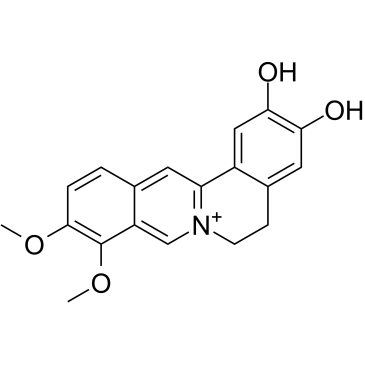
Cas No.: 25459-91-0
Sample solution is provided at 25 µL, 10mM.
_1-3.$$$39978408@51.jpg');)
_1-9.$$$38538795@65.jpg');)
_1-9.$$$39112701@51.jpg');)
_1-7.$$$37316672@70.jpg');)
_366-372.$$$36198801@70.jpg');)
.$$$38565142@65.jpg');)
_1867-1883.$$$33248023@67.jpg');)
_eads6055.$$$39977546@45.jpg');)
_eadm9805.$$$40080571@45.jpg');)
_eadj3020.$$$39666821@45.jpg');)
_1-20.$$$39757301@28.jpg');)
_1-24.$$$38898113@28.jpg');)
_273-287.$$$36806353@46.jpg');)
_1-16.$$$37156877@44.jpg');)
_1-19.$$$37460805@44.jpg');)
_1291-1307.$$$34518654@46.jpg');)
Demethyleneberberine (DMB), as a natural active component of medicinal plant Cortex phellodendri chinensis, has favorable bioactivity[1]. Demethyleneberberine also, as a natural mitochondria-targeted antioxidant, can inhibit oxidative stress, mitochondrial dysfunction, and steatosis in an alcoholic hepatic disease model[2].
In vitro, Demethyleneberberine (0-160µM; 24-48h) obviously inhibited proliferation of HSC-T6 cells in a concentration dependent manner. The IC50 of Demethyleneberberine for HSC-T6 cells at 48h was 36.7µM[3]. Demethyleneberberine had the inhibition of monoamine oxidase B (MAO-B) with IC50 of 9.06µM[4].
In vivo, Demethyleneberberine (50mg/kg/d; p.o.; 98d) markedly improved colon atrophy, colonic tissue mass score, neutrophil infiltration and histological damage in mice, which was mainly attributed to the anti-inflammatory effect of Demethyleneberberine[5]. Demethyleneberberine (20 or 40mg/kg; i.p.; 4 weeks) reduced hepatic lipid accumulation and attenuated oxidative stress and inflammation associated with Non-alcoholic Fatty Liver Disease (NAFLD) in Methionine- and Choline-deficient (MCD) high-fat diet-fed and db/db mice[6]. Demethyleneberberine (150 or 300mg/kg; p.o.; 14 days) reduced weight loss and myeloperoxidase (MPO) activity, significantly decreased the levels of pro-inflammatory cytokines including interleukin-6 (IL-6) and tumor necrosis factor-α (TNF-α), and inhibited NF-κB signaling pathway activation in mice with inflammatory colitis[7].
References:
[1] Liu J, et al. Demethyleneberberine induces cell cycle arrest and cellular senescence of NSCLC cells via c-Myc/HIF-1α pathway. Phytomedicine. 2021 Oct;91:153678.
[2] Zhang P., et al. Demethyleneberberine, a natural mitochondria-targeted antioxidant, inhibits mitochondrial dysfunction, oxidative stress, and steatosis in alcoholic liver disease mouse model. J. Pharmacol. Exp. Ther. 2015;352:139–147.
[3] Wang Y, et al. Demethyleneberberine Protects against Hepatic Fibrosis in Mice by Modulating NF-κB Signaling. Int J Mol Sci. 2016 Jun 30;17(7):1036.
[4] Tao C, et al. Highly efficient synthesis and monoamine oxidase B inhibitory profile of demethyleneberberine, columbamine and palmatine. Neurochem Int. 2020 Oct;139:104807.
[5] Zhao Y, et al. Demethyleneberberine blocked the maturation of IL-1β in inflammation by inhibiting TLR4-mitochondria signaling. Int Immunopharmacol. 2022 Dec;113(Pt A):109319.
[6] Qiang X, et al. Demethyleneberberine attenuates non-alcoholic fatty liver disease with activation of AMPK and inhibition of oxidative stress. Biochem Biophys Res Commun. 2016 Apr 15;472(4):603-9.
[7] Chen YY, et al. Demethyleneberberine alleviates inflammatory bowel disease in mice through regulating NF-κB signaling and T-helper cell homeostasis. Inflamm Res. 2017 Feb;66(2):187-196.
| Cell experiment [1]: | |
|
Cell lines |
RAW264.7 |
|
Preparation Method |
Demethyleneberberine (10, 20, 40µM) and N-acetyl cysteine (NAC, 5mM) were co-cultured with RAW264.7 for 2h prior to lipopolysaccharide (LPS) stimulation, and splenocytes from the mice were cultured ex vivo for 48h for immune response test. |
|
Reaction Conditions |
10, 20, 40µM; 2h |
|
Applications |
In vitro, ROS production and pro-inflammation cytokines were markedly inhibited by Demethyleneberberine in RAW264.7 cell. |
| Animal experiment [2]: | |
|
Animal models |
Male ICR mice (24-26g) |
|
Preparation Method |
Mice were injected with TAA (250mg/kg; i.p.) to induce fulminant hepatic failure. Demethyleneberberine (10mg/kg; i.p.) and BBR (10mg/kg; i.p.) were administered to mice for five days after TAA challenge. |
|
Dosage form |
10mg/kg; i.p.; 5d |
|
Applications |
All mice in the model group showed activity reduction; 50% mice in BBR (Berberine)-treated group and 20% mice in Demethyleneberberine-treated group showed activity reduction. All animals died from fulminant hepatic failure during the four days after TAA (thioacetamide) injection. These data showed that Demethyleneberberine is able to improve the survival rate of mice with TAA-induced fulminant hepatic failure as compared to BBR. |
References: | |
| Cas No. | 25459-91-0 | SDF | |
| Canonical SMILES | COC1=C(OC)C2=C[N+]3=C(C4=CC(O)=C(O)C=C4CC3)C=C2C=C1 | ||
| Formula | C19H18NO4+ | M.Wt | 324.35 |
| Solubility | DMSO: 33.33 mg/mL (102.76 mM) | Storage | 4°C, protect from light |
| Shipping Condition | Evaluation sample solution: shipped with blue ice. All other sizes available: with RT, or with Blue Ice upon request. | ||
| Prepare stock solution | |||

|
1 mg | 5 mg | 10 mg |
| 1 mM | 3.0831 mL | 15.4154 mL | 30.8309 mL |
| 5 mM | 616.6 μL | 3.0831 mL | 6.1662 mL |
| 10 mM | 308.3 μL | 1.5415 mL | 3.0831 mL |
Step 1: Enter information below (Recommended: An additional animal making an allowance for loss during the experiment)
 g
μL
g
μL
Step 2: Enter the in vivo formulation (This is only the calculator, not formulation. Please contact us first if there is no in vivo formulation at the solubility Section.)
Calculation results:
Working concentration: mg/ml;
Method for preparing DMSO master liquid: mg drug pre-dissolved in μL DMSO ( Master liquid concentration mg/mL, Please contact us first if the concentration exceeds the DMSO solubility of the batch of drug. )
Method for preparing in vivo formulation: Take μL DMSO master liquid, next addμL PEG300, mix and clarify, next addμL Tween 80, mix and clarify, next add μL saline, mix and clarify.
Method for preparing in vivo formulation: Take μL DMSO master liquid, next add μL Corn oil, mix and clarify.
Note: 1. Please make sure the liquid is clear before adding the next solvent.
2. Be sure to add the solvent(s) in order. You must ensure that the solution obtained, in the previous addition, is a clear solution before proceeding to add the next solvent. Physical methods such as vortex, ultrasound or hot water bath can be used to aid dissolving.
3. All of the above co-solvents are available for purchase on the GlpBio website.
Quality Control & SDS
- View current batch:
- Purity: >98.00% Appearance: A solid
- COA (Certificate of Analysis)
- SDS (Safety Data Sheet)
- Datasheet
Average Rating: 5 (Based on Reviews and 15 reference(s) in Google Scholar.)