

N3-C2-NHS ester |
Catalog No.GC38335
 One-Click Copy Product Info
|

N3-C2-NHS ester is a bifunctional linker molecule containing both an azide group (N3) and an N-hydroxysuccinimide ester (NHS ester), widely used in bioconjugation and for the modification and labeling of proteins or peptide compounds.
Products are for research use only. Not for human use. We do not sell to patients.
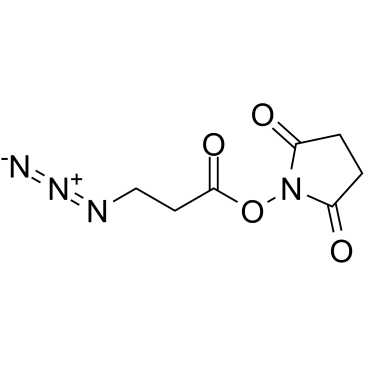
Cas No.: 850180-76-6
Sample solution is provided at 25 µL, 10mM.
_1-3.$$$39978408@51.jpg');)
_1-9.$$$38538795@65.jpg');)
_1-9.$$$39112701@51.jpg');)
_1-7.$$$37316672@70.jpg');)
_366-372.$$$36198801@70.jpg');)
.$$$38565142@65.jpg');)
_1867-1883.$$$33248023@67.jpg');)
_eads6055.$$$39977546@45.jpg');)
_eadm9805.$$$40080571@45.jpg');)
_eadj3020.$$$39666821@45.jpg');)
_1-20.$$$39757301@28.jpg');)
_1-24.$$$38898113@28.jpg');)
_273-287.$$$36806353@46.jpg');)
_1-16.$$$37156877@44.jpg');)
_1-19.$$$37460805@44.jpg');)
_1291-1307.$$$34518654@46.jpg');)
N3-C2-NHS ester is a bifunctional linker molecule containing both an azide group (N3) and an N-hydroxysuccinimide ester (NHS ester), widely used in bioconjugation and for the modification and labeling of proteins or peptide compounds. The NHS ester efficiently reacts with primary amine groups to form stable amide bonds, while the azide group enables specific conjugation with alkynes via copper-catalyzed or copper-free click reactions[1,2]. N3-C2-NHS ester is suitable for fields including protein labeling, click chemistry, nucleic acid modification, and biomolecular crosslinking (such as antibody-drug conjugates (ADCs))[3,4,5].
Reference:
[1] NANDA J S, LORSCH J R. Labeling a protein with fluorophores using NHS ester derivitization[J]. Methods in Enzymology, 2014, 536: 87-94.
[2] LIANG L, ASTRUC D. The copper (I)-catalyzed alkyne-azide cycloaddition (CuAAC)“click” reaction and its applications. An overview[J]. Coordination Chemistry Reviews, 2011, 255(23-24): 2933-2945.
[3] KANG M S, KONG T W, KHOO J Y, et al. Recent developments in chemical conjugation strategies targeting native amino acids in proteins and their applications in antibody–drug conjugates[J]. Chemical Science, 2021, 12(41): 13613-13647.
[4] HOLMES K L, LANTZ L M. Protein labeling with fluorescent probes[J]. Methods in Cell Biology, 2001, 63: 185-204.
[5] LUTZ J F, ZARAFSHANI Z. Efficient construction of therapeutics, bioconjugates, biomaterials and bioactive surfaces using azide–alkyne “click” chemistry[J]. Advanced Drug Delivery Reviews, 2008, 60(9): 958-970.
Experimental procedure for using N3-C2-NHS ester as a linker molecule[1]:
1. Synthesis of linear ASO-peptide conjugate
(1) Phosphorothioate DNA oligonucleotides were synthesized on 3’-amino-modifier C7 CPG, and C6-NHS phosphoramidite linker was coupled to the 5’ end under standard phosphoramidite chemistry.
(2) 1µM CPG-bound oligonucleotide was reacted with 1.2mg synthetic peptides in 40µL dry DMF with 2% DIPEA at 25℃ for 24h, followed by cleavage, deprotection, HPLC purification and ESI-MS characterization.
2. 3′-terminal azidation modification
(1) 3µM N3-C2-NHS ester was reacted with 10nM purified peptide-oligonucleotide conjugates in 50µL 1 × PBS and 50µL 1 × DMSO at 25℃ for 24h.
(2) The 3’-azide-functionalized linear ASO conjugates were purified by HPLC and characterized by ESI-MS.
3. Click chemistry cyclization
(1) The reaction was performed in 200µL of 6% CH3CN/H2O with 5µL CuSO4 (20mM), 6µL TCEP (20mM) and 10µL NaHCO3 (200mM) at 25℃ for 4h.
(2) The cyclization products were purified by HPLC or gel recycling methods and further characterized by ESI-MS and PAGE gels.
Reference:
[1] WANG Z, FAN X, MU G, et al. Cathepsin B-activatable cyclic antisense oligonucleotides for cell-specific target gene knockdown in vitro and in vivo[J]. Molecular Therapy Nucleic Acids, 2023, 33: 548-558.
| Cas No. | 850180-76-6 | SDF | |
| Canonical SMILES | O=C(ON1C(CCC1=O)=O)CCN=[N+]=[N-] | ||
| Formula | C7H8N4O4 | M.Wt | 212.16 |
| Solubility | Soluble in DMSO | Storage | Store at -20°C |
| General tips | Please select the appropriate solvent to prepare the stock solution according to the
solubility of the product in different solvents; once the solution is prepared, please store it in
separate packages to avoid product failure caused by repeated freezing and thawing.Storage method
and period of the stock solution: When stored at -80°C, please use it within 6 months; when stored
at -20°C, please use it within 1 month. To increase solubility, heat the tube to 37°C and then oscillate in an ultrasonic bath for some time. |
||
| Shipping Condition | Evaluation sample solution: shipped with blue ice. All other sizes available: with RT, or with Blue Ice upon request. | ||
| Prepare stock solution | |||

|
1 mg | 5 mg | 10 mg |
| 1 mM | 4.7134 mL | 23.5671 mL | 47.1342 mL |
| 5 mM | 942.7 μL | 4.7134 mL | 9.4268 mL |
| 10 mM | 471.3 μL | 2.3567 mL | 4.7134 mL |
Step 1: Enter information below (Recommended: An additional animal making an allowance for loss during the experiment)
 g
μL
g
μL
Step 2: Enter the in vivo formulation (This is only the calculator, not formulation. Please contact us first if there is no in vivo formulation at the solubility Section.)
Calculation results:
Working concentration: mg/ml;
Method for preparing DMSO master liquid: mg drug pre-dissolved in μL DMSO ( Master liquid concentration mg/mL, Please contact us first if the concentration exceeds the DMSO solubility of the batch of drug. )
Method for preparing in vivo formulation: Take μL DMSO master liquid, next addμL PEG300, mix and clarify, next addμL Tween 80, mix and clarify, next add μL saline, mix and clarify.
Method for preparing in vivo formulation: Take μL DMSO master liquid, next add μL Corn oil, mix and clarify.
Note: 1. Please make sure the liquid is clear before adding the next solvent.
2. Be sure to add the solvent(s) in order. You must ensure that the solution obtained, in the previous addition, is a clear solution before proceeding to add the next solvent. Physical methods such as vortex, ultrasound or hot water bath can be used to aid dissolving.
3. All of the above co-solvents are available for purchase on the GlpBio website.
Quality Control & SDS
- View current batch:
- Purity: >95.00% Appearance: An oil
- COA (Certificate of Analysis)
- SDS (Safety Data Sheet)
- Datasheet
Average Rating: 5 (Based on Reviews and 7 reference(s) in Google Scholar.)