

Cyanine5.5 amine (Synonyms: Cy 5.5 amine; Lumiprobe Cy 5.5 amine) |
Catalog No.GC59167
 One-Click Copy Product Info
|

Cyanine5.5 amine is a near-infrared fluorescent dye containing a free amino group that can be covalently coupled to biomolecules containing carboxyl, aldehyde or other reactive functionalities.
Products are for research use only. Not for human use. We do not sell to patients.
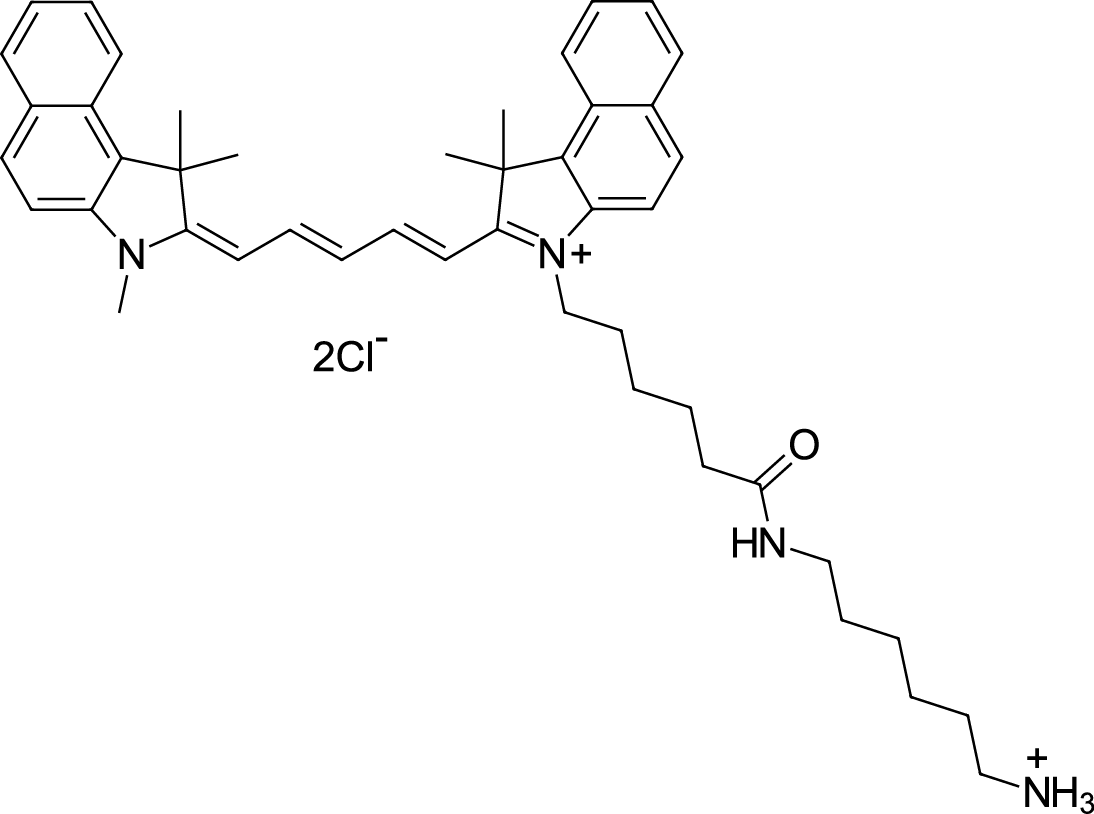
Cas No.: 2097714-44-6 (without anion), 2097714-45-7 (chloride)
Sample solution is provided at 25 µL, 10mM.
_1-3.$$$39978408@51.jpg');)
_1-9.$$$38538795@65.jpg');)
_1-9.$$$39112701@51.jpg');)
_1-7.$$$37316672@70.jpg');)
_366-372.$$$36198801@70.jpg');)
.$$$38565142@65.jpg');)
_1867-1883.$$$33248023@67.jpg');)
_eads6055.$$$39977546@45.jpg');)
_eadm9805.$$$40080571@45.jpg');)
_eadj3020.$$$39666821@45.jpg');)
_1-20.$$$39757301@28.jpg');)
_1-24.$$$38898113@28.jpg');)
_273-287.$$$36806353@46.jpg');)
_1-16.$$$37156877@44.jpg');)
_1-19.$$$37460805@44.jpg');)
_1291-1307.$$$34518654@46.jpg');)
Cyanine5.5 amine is a near-infrared fluorescent dye containing a free amino group that can be covalently coupled to biomolecules containing carboxyl, aldehyde or other reactive functionalities[1]. Cyanine5.5 amine is the amino derivative of Cyanine5.5, with an excitation wavelength of approximately 648-680nm and an emission wavelength of approximately 694-710nm[2]. Cyanine5.5 amine possesses a high molar extinction coefficient and bright far-red fluorescence, making it suitable for in vivo imaging and biomarker applications that require low background fluorescence[3]. Cyanine5.5 amine is insensitive to pH and exhibits good photostability and biocompatibility[4]. Cyanine5.5 amine is usually used for fluorescent labelling of biomolecules, preparation of nanoparticles, and small-animal in vivo imaging studies [5-7].
References:
[1] Zhang E, Zhukova V, Semyonkin A, et al. Release kinetics of fluorescent dyes from PLGA nanoparticles in retinal blood vessels: In vivo monitoring and ex vivo localization. Eur J Pharm Biopharm. 2020;150:131-142.
[2] Son Phan K, Nghi Do H, Thuy Doan B, et al. The Influence of Cyanine 5.5 and Doxorubicin on Cell Cycle Arrest, Magnetic Resonance, and Near-Infrared Fluorescence Optical Imaging for Fe3O4-Encapsulated PLA-TPGS Nanoparticles. ChemMedChem. 2025;20(5):e202400586.
[3] Konig SG, Kramer R. Accessing Structurally Diverse Near-Infrared Cyanine Dyes for Folate Receptor-Targeted Cancer Cell Staining. Chemistry. 2017;23(39):9306-9312
[4] Ebert B, Riefke B, Sukowski U, Licha K. Cyanine dyes as contrast agents for near-infrared imaging in vivo: acute tolerance, pharmacokinetics, and fluorescence imaging. J Biomed Opt. 2011;16(6):066003.
[5] Li L, Xue Y, Li X, et al. Copper Nanosheet-Based Wash-Free Fluorescence Imaging of Cancer Cells. Anal Chem. 2024;96(5):2052-2058.
[6] Luo J, Fan H, Shu C, et al. Immuno-protective cationic ginsenoside Rb1 vesicles for macrophage-mediated targeted therapy of inflammatory diseases. Mater Today Bio. 2025;34:102195.
[7] Mai L, Yao A, Li J, et al. Cyanine 5.5 conjugated nanobubbles as a tumor selective contrast agent for dual ultrasound-fluorescence imaging in a mouse model. PLoS One. 2013;8(4):e61224.
Protocol for real-time monitoring of Cyanine5.5 amine-labeled nanoparticles (Cy5.5-PLGA) in retinal blood vessels[1]:
1. Preparation of nanoparticle suspension
1) Dissolve Cyanine5.5 amine (4mg, 5.3μmol) in 8mL DCM, add PLGA solution (2400mg in 20mL DCM), add N,N-diisopropylethylamine (0.8 mg, 6.2μmol) and EDC (7.6mg, 49μmol), stir at room temperature in darkness for 48h.
2) Wash the organic phase three times with deionised water, dry over anhydrous Na₂SO₄, dissolve in ethyl acetate, precipitate with hexane, filter and dry under vacuum to yield the conjugate in the form of light-blue powder.
3) Mix Cy5.5-labelled PLGA with unlabelled PLGA at a 1:1 mass ratio and dissolve together in DCM to give the polymer solution.
4) Prepare a nanoparticle suspension from the polymer solution by a high pressure o/w emulsion solvent evaporation technique.
5) Remove non-encapsulated free dye by centrifugation or gel permeation chromatography, add 1% mannitol as cryoprotector and freeze-dry.
6) Resuspend the freshly prepared Cy5.5-PLGA nanoparticle powder in 0.5mL 1% poloxamer 188, vortex gently and leave at room temperature for 30min to allow full dispersion.
2. In vivo injection and real-time imaging
1) Anaesthetise rat, apply 1-2 drops of Neosynephrine-POS 5% to both eyes for relax the iris, and Vidisic® eye gel was applied to protect the eye from drying out and used as immersion medium for the contact lens as well.
2) Fix the rat under the confocal scanning microscope, insert a cannula into the tail vein and connect the syringe.
3) Inject 0.5mL nanoparticle suspension intravenously (slow push over 30-60s).
4) Observe retinal fluorescence and capture images at 0, 1, 3, 5, 15, 30, 60 and 90min.
Note: keep the rat on a heating plate during all the in vivo imaging process.
3. In vitro retinal imaging
1) After real-time imaging, euthanise the rat with an overdose of the above anaesthetic, enucleate the eye and place it into cooled HEPES buffer (135mM NaCl, 5mM NaOH, 2.5mM KCl, 7mM MgCl₂, 10mM HEPES, 10mM glucose, pH=7.4).
2) Remove the anterior segment and vitreous body, carefully isolate the whole retina and flatten it on a modified culture plate.
3) Incubate the whole mount with 0.1mg/mL Hoechst 33342 in HEPES solution for 20min.
4) Fix the flat-mounted retina with 4% paraformaldehyde for 20min, then rinse with HEPES solution.
5) Image the flat-mounted retina immediately under the microscope.
This protocol only provides a guide, please modify it to meet your specific needs.
References:
[1] Zhang E, Zhukova V, Semyonkin A, et al. Release kinetics of fluorescent dyes from PLGA nanoparticles in retinal blood vessels: In vivo monitoring and ex vivo localization. Eur J Pharm Biopharm. 2020;150:131-142.
| Cas No. | 2097714-44-6 (without anion), 2097714-45-7 (chloride) | SDF | |
| Synonyms | Cy 5.5 amine; Lumiprobe Cy 5.5 amine | ||
| Formula | C46H58Cl2N4O | M.Wt | 753.88 |
| Solubility | practically insoluble in water (< 2 uM), good in polar organic solvents (DMF, DMSO, alcohols) | Storage | Store at -20°C,protect from light |
| General tips | Please select the appropriate solvent to prepare the stock solution according to the
solubility of the product in different solvents; once the solution is prepared, please store it in
separate packages to avoid product failure caused by repeated freezing and thawing.Storage method
and period of the stock solution: When stored at -80°C, please use it within 6 months; when stored
at -20°C, please use it within 1 month. To increase solubility, heat the tube to 37°C and then oscillate in an ultrasonic bath for some time. |
||
| Shipping Condition | Evaluation sample solution: shipped with blue ice. All other sizes available: with RT, or with Blue Ice upon request. | ||
| Prepare stock solution | |||

|
1 mg | 5 mg | 10 mg |
| 1 mM | 1.3265 mL | 6.6324 mL | 13.2647 mL |
| 5 mM | 265.3 μL | 1.3265 mL | 2.6529 mL |
| 10 mM | 132.6 μL | 663.2 μL | 1.3265 mL |
Step 1: Enter information below (Recommended: An additional animal making an allowance for loss during the experiment)
 g
μL
g
μL
Step 2: Enter the in vivo formulation (This is only the calculator, not formulation. Please contact us first if there is no in vivo formulation at the solubility Section.)
Calculation results:
Working concentration: mg/ml;
Method for preparing DMSO master liquid: mg drug pre-dissolved in μL DMSO ( Master liquid concentration mg/mL, Please contact us first if the concentration exceeds the DMSO solubility of the batch of drug. )
Method for preparing in vivo formulation: Take μL DMSO master liquid, next addμL PEG300, mix and clarify, next addμL Tween 80, mix and clarify, next add μL saline, mix and clarify.
Method for preparing in vivo formulation: Take μL DMSO master liquid, next add μL Corn oil, mix and clarify.
Note: 1. Please make sure the liquid is clear before adding the next solvent.
2. Be sure to add the solvent(s) in order. You must ensure that the solution obtained, in the previous addition, is a clear solution before proceeding to add the next solvent. Physical methods such as vortex, ultrasound or hot water bath can be used to aid dissolving.
3. All of the above co-solvents are available for purchase on the GlpBio website.
Quality Control & SDS
- View current batch:
- Purity: >97.00% Appearance: A solid
- COA (Certificate of Analysis)
- SDS (Safety Data Sheet)
- Datasheet
Average Rating: 5 (Based on Reviews and 10 reference(s) in Google Scholar.)