

GSK2033 |
Catalog No.GC31331
 One-Click Copy Product Info
|

An antagonist of LXRα and LXRβ
Products are for research use only. Not for human use. We do not sell to patients.
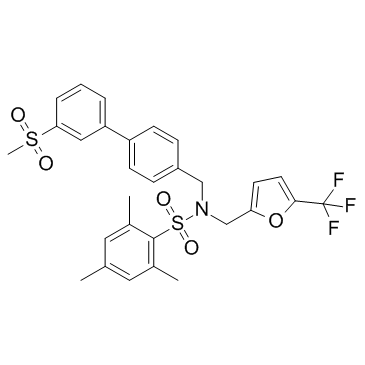
Cas No.: 1221277-90-2
Sample solution is provided at 25 µL, 10mM.
_1-3.$$$39978408@51.jpg');)
_1-9.$$$38538795@65.jpg');)
_1-9.$$$39112701@51.jpg');)
_1-7.$$$37316672@70.jpg');)
_366-372.$$$36198801@70.jpg');)
.$$$38565142@65.jpg');)
_1867-1883.$$$33248023@67.jpg');)
_eads6055.$$$39977546@45.jpg');)
_eadm9805.$$$40080571@45.jpg');)
_eadj3020.$$$39666821@45.jpg');)
_1-20.$$$39757301@28.jpg');)
_1-24.$$$38898113@28.jpg');)
_273-287.$$$36806353@46.jpg');)
_1-16.$$$37156877@44.jpg');)
_1-19.$$$37460805@44.jpg');)
_1291-1307.$$$34518654@46.jpg');)
GSK2033 is a LXR antagonist with pIC50s of 7 and 7.4 for LXRα or LXRβ, respectively.
GSK2033 is a LXR antagonist with pIC50s of 7 and 7.4 for LXRα or LXRβ, respectively. GSK2033 dose-dependently suppresses basal transcription in full-length LXRα or full-length LXRβ cotransfection assays with IC50s of 17 nM and 9 nM, respectively. GSK2033 also effectively suppresses the transcription of an ABCA1 driven luciferase reporter dose-dependently displaying IC50s of 52 nM for LXRα and 10 nM for LXRβ. GSK2033 also suppresses the expression of both of fatty acid synthase (FASN) and SREBP1[2].
One month treatment of GSK2033 does not have significant effects on hepatic triglyceride levels. Plasma triglyceride levels are also unaffected by treatment with GSK2033[2].
[1]. Zuercher WJ, et al. Discovery of tertiary sulfonamides as potent liver X receptor antagonists. J Med Chem. 2010 Apr 22;53(8):3412-6. [2]. Griffett K, et al. Promiscuous activity of the LXR antagonist GSK2033 in a mouse model of fatty liver disease. Biochem Biophys Res Commun. 2016 Oct 21;479(3):424-428.
Cell experiment: | HepG2 cells are maintained in minimal essential medium supplemented with 10% FBS and antibiotics. HepG2 cells are then treated for 24 h with GSK2033 followed by assessment of expression of genes by qPCR[2]. |
Animal experiment: | 21-week old male C57BL6 DIO mice are used. Animals are individually housed and fed a high fat diet (60% kcal/fat diet, 20% carbohydrate) for the duration of the experiment that includes GSK2033 administration for 28 days (30 mg/kg, q. d, i. p.). Body weight and food intake are monitored daily[2]. |
References: [1]. Zuercher WJ, et al. Discovery of tertiary sulfonamides as potent liver X receptor antagonists. J Med Chem. 2010 Apr 22;53(8):3412-6. | |
| Cas No. | 1221277-90-2 | SDF | |
| Canonical SMILES | O=S(C1=C(C)C=C(C)C=C1C)(N(CC2=CC=C(C3=CC=CC(S(=O)(C)=O)=C3)C=C2)CC4=CC=C(C(F)(F)F)O4)=O | ||
| Formula | C29H28F3NO5S2 | M.Wt | 591.66 |
| Solubility | DMSO : 30 mg/mL (50.70 mM) | Storage | Store at -20°C |
| General tips | Please select the appropriate solvent to prepare the stock solution according to the
solubility of the product in different solvents; once the solution is prepared, please store it in
separate packages to avoid product failure caused by repeated freezing and thawing.Storage method
and period of the stock solution: When stored at -80°C, please use it within 6 months; when stored
at -20°C, please use it within 1 month. To increase solubility, heat the tube to 37°C and then oscillate in an ultrasonic bath for some time. |
||
| Shipping Condition | Evaluation sample solution: shipped with blue ice. All other sizes available: with RT, or with Blue Ice upon request. | ||
| Prepare stock solution | |||

|
1 mg | 5 mg | 10 mg |
| 1 mM | 1.6902 mL | 8.4508 mL | 16.9016 mL |
| 5 mM | 338 μL | 1.6902 mL | 3.3803 mL |
| 10 mM | 169 μL | 845.1 μL | 1.6902 mL |
Step 1: Enter information below (Recommended: An additional animal making an allowance for loss during the experiment)
 g
μL
g
μL
Step 2: Enter the in vivo formulation (This is only the calculator, not formulation. Please contact us first if there is no in vivo formulation at the solubility Section.)
Calculation results:
Working concentration: mg/ml;
Method for preparing DMSO master liquid: mg drug pre-dissolved in μL DMSO ( Master liquid concentration mg/mL, Please contact us first if the concentration exceeds the DMSO solubility of the batch of drug. )
Method for preparing in vivo formulation: Take μL DMSO master liquid, next addμL PEG300, mix and clarify, next addμL Tween 80, mix and clarify, next add μL saline, mix and clarify.
Method for preparing in vivo formulation: Take μL DMSO master liquid, next add μL Corn oil, mix and clarify.
Note: 1. Please make sure the liquid is clear before adding the next solvent.
2. Be sure to add the solvent(s) in order. You must ensure that the solution obtained, in the previous addition, is a clear solution before proceeding to add the next solvent. Physical methods such as vortex, ultrasound or hot water bath can be used to aid dissolving.
3. All of the above co-solvents are available for purchase on the GlpBio website.
Quality Control & SDS
- View current batch:
- Purity: >99.00% Appearance: A solid
- COA (Certificate of Analysis)
- SDS (Safety Data Sheet)
- Datasheet
Average Rating: 5 (Based on Reviews and 22 reference(s) in Google Scholar.)