

HAMI3379 |
Catalog No.GC17092
 One-Click Copy Product Info
|

HAMI3379 is the first reported potent and selective cysteinyl leukotrienes (CysLT₂) receptor antagonist and also identified as an antagonist of the orphan G protein-coupled receptor GPR17.
Products are for research use only. Not for human use. We do not sell to patients.
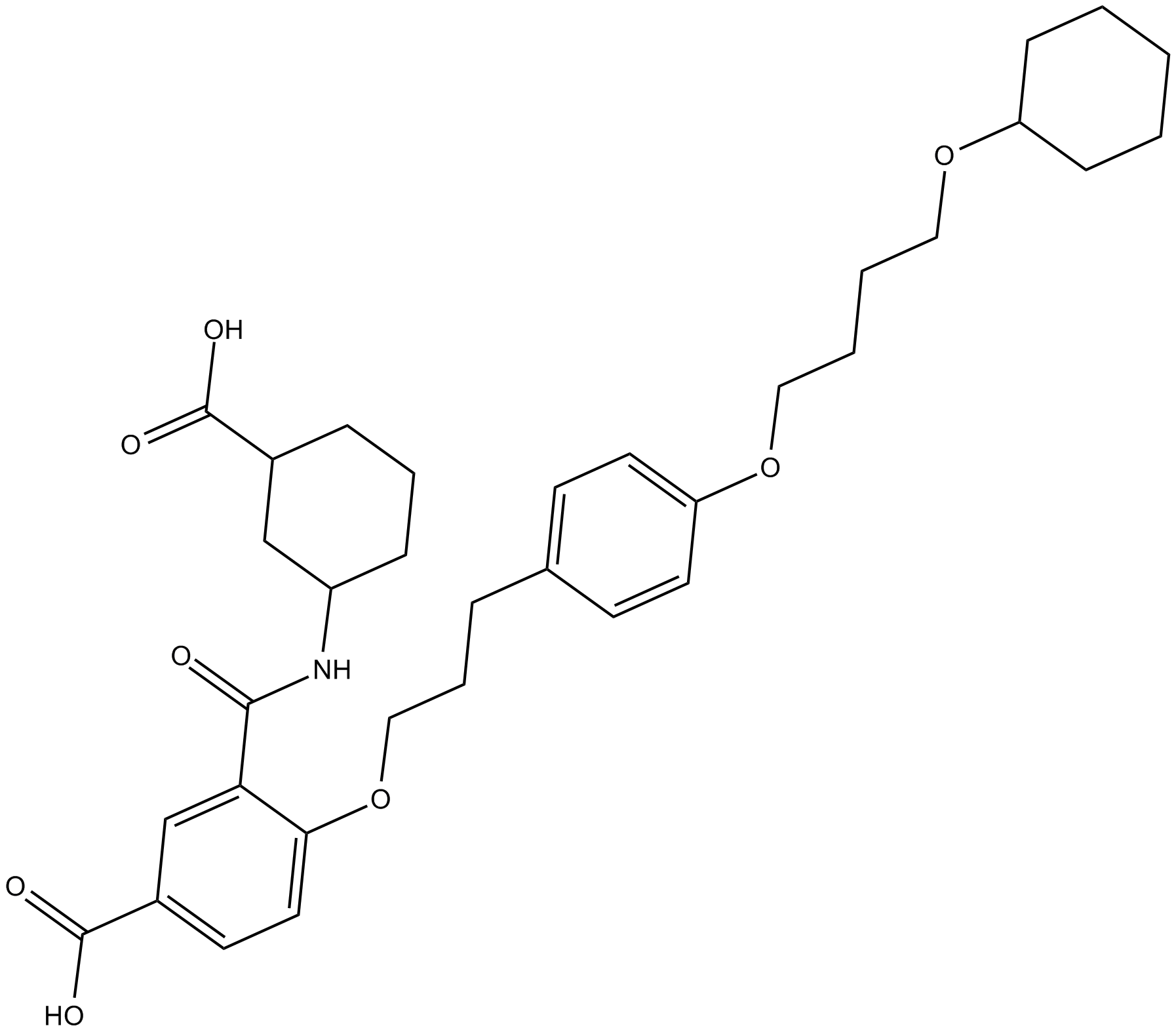
Cas No.: 1245653-57-9
Sample solution is provided at 25 µL, 10mM.
HAMI3379 is the first reported potent and selective cysteinyl leukotrienes (CysLT₂) receptor antagonist and also identified as an antagonist of the orphan G protein-coupled receptor GPR17. HAMI3379 was initially developed to treat cardiovascular and inflammatory disorders[1][2]. HAMI3379 also exerts neuroprotective effects by modulating microglial polarization and preserving blood–brain barrier integrity[3].
In vitro, HAMI3379 (1μM) pretreatment on HEK293 cells stably expressing human CysLT₂ receptors for 1h significantly inhibited leukotriene C4 (100nM; 6h) induced expression of Egr-1 and IL-8 at both mRNA and protein levels, as well as IL-8 release into the culture medium[4]. HAMI3379 pretreatment (0, 0.001, 0.01, 0.1, 1μΜ) on murine microglial BV-2 cells for 30min before 24h incubation of LPS (100ng/ml) significantly inhibited LPS-induced phagocytosis and overproduction of the proinflammatory cytokines (TNF-α, IL-6, and IL-1β)[5].
In vivo, HAMI3379 (0.1mg/kg) was administered intraperitoneally into post-stroke depression (PSD) gerbil model 30 minutes before and after transient global cerebral ischemia surgery, once daily for 14 days. HAMI3379 diminished PSD-induced neurological injury and depression-like behaviors in gerbils via suppressing the NLRP3 inflammasome/pyroptosis pathway[6]. HAMI3379 (0.025, 0.05, 0.1, 0.2 and 0.4mg/kg) was administrated into Sprague–Dawley rats via intraperitoneal injection 30min before middle cerebral artery occlusion (MCAO). HAMI3379 (0.1–0.4mg/kg) significantly reduced the infarct volume and percentage increase in the ischemic/contralateral hemispheric ratio, significantly reduced the neurological deficit score and increased the holding angle in the inclined board test at 24h in a dose-dependent manner[7].
References:
[1] Dong X W, Zhao Y M, Huang X Q, et al. Structure-based drug design using GPCR homology modeling: toward the discovery of novel selective CysLT2 antagonists. Eur J Med Chem. 2013 Apr:62:754-63.
[2] Merten N, Fischer J, Simon K, et al. Repurposing HAMI3379 to Block GPR17 and Promote Rodent and Human Oligodendrocyte Differentiation.Cell Chem Biol. 2018 Jun 21;25(6):775-786.e5.
[3] Chen K C, Lan K P, Lai S C. Neuroprotective effects of CysLT2R antagonist on Angiostrongylus cantonensis-induced edema and meningoencephalitis.Mol Biochem Parasitol. 2024 Dec:260:111649.
[4] Lin K, Fang S H, Cai B L, et al. ERK/Egr-1 signaling pathway is involved in CysLT2 receptor-mediated IL-8 production in HEK293 cells. Eur J Cell Biol. 2014 Jul;93(7):278-88.
[5] Chen L, Yang Y, Li C T, et al. CysLT2 receptor mediates lipopolysaccharide-induced microglial inflammation and consequent neurotoxicity in vitro. Brain Res. 2015 Oct 22:1624:433-445.
[6] Zhou L, Zhang J J, Han X, et al. CysLT2R Antagonist HAMI3379 Ameliorates Post-Stroke Depression through NLRP3 Inflammasome/Pyroptosis Pathway in Gerbils. Brain Sci. 2022 Jul 24;12(8):976.
[7] Shi Q J, Wang H, Liu Z X, et al. HAMI3379, a CysLT2R antagonist, dose- and time-dependently attenuates brain injury and inhibits microglial inflammation after focal cerebral ischemia in rats. Neuroscience. 2015 Apr 16:291:53-69.
| Cell experiment [1]: | |
|
Cell lines |
Murine microglial cell line BV-2 cells |
|
Preparation Method |
Cells were pre-treated with or without HAMI3379 at various concentrations (0, 0.001, 0.01, 0.1, 1μΜ) for 30min before the addition of LPS, then maintained for 24h until the end of the experiments. |
|
Reaction Conditions |
0, 0.001, 0.01, 0.1, 1μΜ; 30min |
|
Applications |
HAMI3379 significantly inhibited LPS-induced phagocytosis and overproduction of the proinflammatory cytokines in BV-2 cells. |
| Animal experiment [2]: | |
|
Animal models |
Male Sprague–Dawley rats |
|
Preparation Method |
Diluted HAMI3379 (0.025, 0.05, 0.1, 0.2 and 0.4mg/kg) were injected intraperitoneally 30min before middle cerebral artery occlusion (MCAO), and brain injury was determined 24h after reperfusion. |
|
Dosage form |
0.025, 0.05, 0.1, 0.2 and 0.4mg/kg; i.p.; 30min before MCAO |
|
Applications |
HAMI3379 at 0.1–0.4mg/kg significantly reduced the infarct volume and percentage increase in the ischemic/contralateral hemispheric ratio (an index of brain edema). HAMI3379 also significantly reduced the neurological deficit score and increased the holding angle in the inclined board test. |
|
References: |
|
| Cas No. | 1245653-57-9 | SDF | |
| Chemical Name | 3-[[(3-carboxycyclohexyl)amino]carbonyl]-4-[3-[4-[4-(cyclohexyloxy)butoxy]phenyl]propoxy]-benzoic acid | ||
| Canonical SMILES | O=C(NC1CCCC(C(O)=O)C1)C2=CC(C(O)=O)=CC=C2OCCCC(C=C3)=CC=C3OCCCCOC4CCCCC4 | ||
| Formula | C34H45NO8 | M.Wt | 595.7 |
| Solubility | ≤5mg/ml in ethanol;20mg/ml in DMSO;20mg/ml in dimethyl formamide | Storage | Store at -20°C |
| General tips | Please select the appropriate solvent to prepare the stock solution according to the
solubility of the product in different solvents; once the solution is prepared, please store it in
separate packages to avoid product failure caused by repeated freezing and thawing.Storage method
and period of the stock solution: When stored at -80°C, please use it within 6 months; when stored
at -20°C, please use it within 1 month. To increase solubility, heat the tube to 37°C and then oscillate in an ultrasonic bath for some time. |
||
| Shipping Condition | Evaluation sample solution: shipped with blue ice. All other sizes available: with RT, or with Blue Ice upon request. | ||
| Prepare stock solution | |||

|
1 mg | 5 mg | 10 mg |
| 1 mM | 1.6787 mL | 8.3935 mL | 16.787 mL |
| 5 mM | 335.7 μL | 1.6787 mL | 3.3574 mL |
| 10 mM | 167.9 μL | 839.3 μL | 1.6787 mL |
Step 1: Enter information below (Recommended: An additional animal making an allowance for loss during the experiment)
 g
μL
g
μL
Step 2: Enter the in vivo formulation (This is only the calculator, not formulation. Please contact us first if there is no in vivo formulation at the solubility Section.)
Calculation results:
Working concentration: mg/ml;
Method for preparing DMSO master liquid: mg drug pre-dissolved in μL DMSO ( Master liquid concentration mg/mL, Please contact us first if the concentration exceeds the DMSO solubility of the batch of drug. )
Method for preparing in vivo formulation: Take μL DMSO master liquid, next addμL PEG300, mix and clarify, next addμL Tween 80, mix and clarify, next add μL saline, mix and clarify.
Method for preparing in vivo formulation: Take μL DMSO master liquid, next add μL Corn oil, mix and clarify.
Note: 1. Please make sure the liquid is clear before adding the next solvent.
2. Be sure to add the solvent(s) in order. You must ensure that the solution obtained, in the previous addition, is a clear solution before proceeding to add the next solvent. Physical methods such as vortex, ultrasound or hot water bath can be used to aid dissolving.
3. All of the above co-solvents are available for purchase on the GlpBio website.
Quality Control & SDS
- View current batch:
- Purity: >98.00% Appearance: A solid
- COA (Certificate of Analysis)
- SDS (Safety Data Sheet)
- Datasheet
Average Rating: 5 (Based on Reviews and 16 reference(s) in Google Scholar.)