

HNGF6A |
Catalog No.GC14654
 One-Click Copy Product Info
|

HNGF6A is a synthetic polypeptide belonging to the Humanin analogue class.
Products are for research use only. Not for human use. We do not sell to patients.
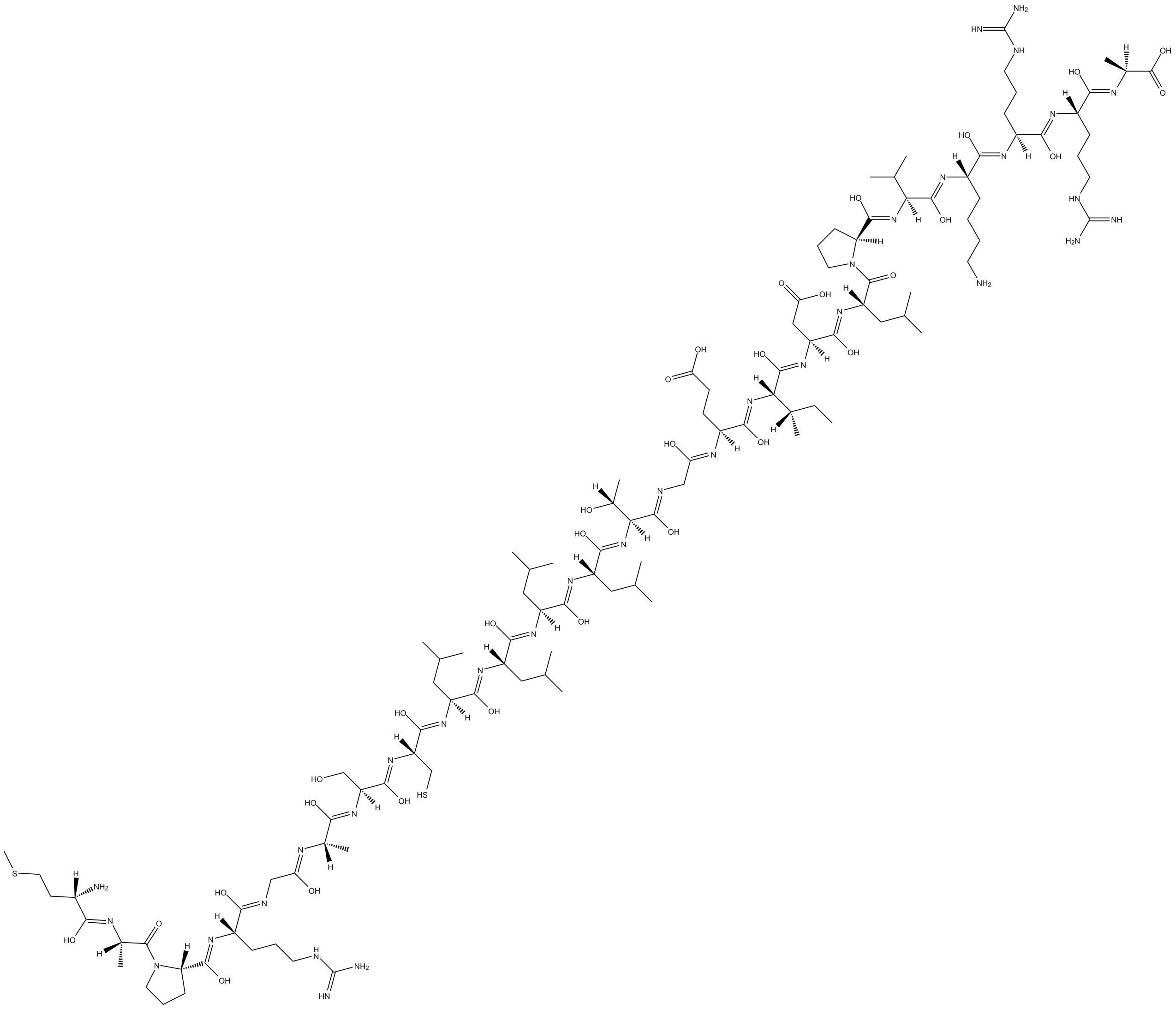
Cas No.: 1093111-54-6
Sample solution is provided at 25 µL, 10mM.
HNGF6A is a synthetic polypeptide belonging to the Humanin analogue class[1-2]. HNGF6A improves glucose metabolism and inhibits the production of reactive oxygen species (ROS). HNGF6A is used in research related to diabetes, atherosclerosis, and osteoarthritis[3].
In vitro, meniscus cells were pretreated with HNGF6A (5–100ng/ml) for 48 hours and were then stimulated with TBHP (50µM) or IL-1β (10ng/ml). HNGF6A significantly restored the expression of extracellular matrix synthesis-related genes (COL1A1, COL3A1, ACAN) and inhibited the expression of degradation-related genes (MMP1, MMP3, ADAMTS5), while maintaining mitochondrial redox homeostasis, reducing ROS levels, and decreasing cell apoptosis[4]. Murine osteoblastic cell line MC3T3-E1 cells were pretreated with HNGF6A (5–50ng/mL) for 3 days and were then exposed to H₂O₂ (400µM) for 4 hours. HNGF6A significantly inhibited apoptosis, downregulated the expression of pro-apoptotic proteins (Caspase-3, Cyto C, Bax), and upregulated the expression of the anti-apoptotic protein (Bcl-2). HNGF6A also promoted the expression of osteoblast phenotype-related proteins (ALP, BMP-2, OCN, RUNX2), enhanced alkaline phosphatase (ALP) activity, and increased mineralization nodule formation[5].
In vivo, three-month-old Sprague-Dawley rats were treated with HNGF6A (0.07mg/kg/h) via continuous intravenous infusion for 2 hours. HNGF6A significantly increased the glucose infusion rate during a hyperglycemic clamp and caused a sustained increase in plasma insulin levels. C57BL/6N mice received a single intravenous injection of HNGF6A (2mg/kg) 10 minutes before a glucose tolerance test, which showed a trend toward increased first-phase insulin secretion[6]. Apolipoprotein E (ApoE)-deficient mice fed a high-cholesterol diet were treated with HNGF6A (0.4mg/kg/day) via daily intraperitoneal injection for 16 weeks. HNGF6A significantly improved acetylcholine-induced endothelium-dependent vasodilation, reduced atherosclerotic plaque size in the proximal aorta, decreased nitrotyrosine immunoreactivity and apoptosis within the plaques, and preserved endothelial nitric oxide synthase expression[7].
References:
[1] Ding Y, Feng Y, Zhu W, et al. [Gly14]-Humanin Prevents Lipid Deposition and Endothelial Cell Apoptosis in a Lectin-like Oxidized Low-density Lipoprotein Receptor-1-Dependent Manner. Lipids. 2019 Nov;54(11-12):697-705.
[2] Chin YP, Keni J, Wan J, et al. Pharmacokinetics and tissue distribution of humanin and its analogues in male rodents. Endocrinology. 2013 Oct;154(10):3739-44.
[3] Peña Agudelo JA, Pidre ML, et al. Mitochondrial Peptide Humanin Facilitates Chemoresistance in Glioblastoma Cells. Cancers (Basel). 2023 Aug 11;15(16):4061.
[4] Liu R, Du X, Chen Y, et al. HNGF6A ameliorates oxidative stress-mediated mitochondrial dysfunction in degenerative meniscus. Bone Joint Res. 2025 Apr 7;14(4):318-330.
[5] Zhu X, Zhao Z, Zeng C, et al. HNGF6A Inhibits Oxidative Stress-Induced MC3T3-E1 Cell Apoptosis and Osteoblast Phenotype Inhibition by Targeting Circ_0001843/miR-214 Pathway. Calcif Tissue Int. 2020 May;106(5):518-532.
[6] Kuliawat R, Klein L, Gong Z, et al. Potent humanin analog increases glucose-stimulated insulin secretion through enhanced metabolism in the β cell. FASEB J. 2013 Dec;27(12):4890-8.
[7] Oh YK, Bachar AR, Zacharias DG, et al. Humanin preserves endothelial function and prevents atherosclerotic plaque progression in hypercholesterolemic ApoE deficient mice. Atherosclerosis. 2011 Nov;219(1):65-73.
| Cell experiment [1]: | |
Cell lines | MC3T3-E1 cells (murine osteoblastic cell line) |
Preparation Method | MC3T3-E1 cells were maintained in Dulbecco's Modified Eagle Medium (DMEM-H) supplemented with 10% fetal bovine serum (FBS), 100U/mL penicillin, and 100µg/mL streptomycin at 37°C under 5% CO₂. Cells were pretreated with HNGF6A (5–50ng/mL) for 3 days, and were then exposed to H₂O₂ (400µM) for 4 hours to induce oxidative stress. |
Reaction Conditions | 5–50ng/mL; 3 days. |
Applications | HNGF6A pretreatment significantly increased cell viability and reduced H₂O₂-induced apoptosis in MC3T3-E1 cells. HNGF6A promoted osteoblast phenotype by upregulating the expression of osteogenic markers (ALP, BMP-2, OCN, RUNX2), enhancing alkaline phosphatase (ALP) activity, and increasing mineralization nodule formation. Mechanistically, HNGF6A exerted its protective effects by decreasing Circ_0001843 expression, increasing miR-214 levels, and inhibiting the phosphorylation of p38 and JNK. |
| Animal experiment [2]: | |
Animal models | ApoE-deficient mice |
Preparation Method | Mice were fed a high cholesterol diet and received daily intraperitoneal injections of the HN analogue HNGF6A (0.4mg/kg/day) for 16 weeks. Vascular function, plaque size, and molecular markers in the aorta were analyzed at the end of the treatment period. |
Dosage form | 0.4mg/kg/day; i.p.; 16 weeks. |
Applications | Chronic administration of HNGF6A preserved endothelium-dependent vasorelaxation in response to acetylcholine, significantly decreased atherosclerotic plaque size in the proximal aorta, and reduced nitrotyrosine immunoreactivity (a marker of oxidative stress) and apoptosis within the plaques. HNGF6A also preserved the expression of endothelial nitric oxide synthase (eNOS). |
References: | |
| Cas No. | 1093111-54-6 | SDF | |
| Chemical Name | (6S,7Z,10Z,12S,13Z,15S,16Z,18R,19Z,21S,22Z,24S,25Z,27S,28Z,30S,31Z,33S,34Z,37Z,39S,40Z,42S,43Z,45S)-1-amino-6-((Z)-(((S)-1-((S)-2-((Z)-((S)-2-amino-1-hydroxy-4-(methylthio)butylidene)amino)propanoyl)pyrrolidin-2-yl)(hydroxy)methylene)amino)-45-((Z)-(((S)- | ||
| Canonical SMILES | CC[C@]([C@@](/N=C(O)/[C@](/N=C(O)/C/N=C(O)/[C@](/N=C(O)/[C@](/N=C(O)/[C@](/N=C(O)/[C@](/N=C(O)/[C@](/N=C(O)/[C@](/N=C(O)/[C@](/N=C(O)/[C@](/N=C(O)/C/N=C(O)/[C@](/N=C(O)/[C@]1([H])CCCN1C([C@](/N=C(O)/[C@](N)([H])CCSC)([H])C)=O)([H])CCCNC(N)=N)([H])C)([H])C | ||
| Formula | C112 H198 N34 O31 S2 | M.Wt | 2581.13 |
| Solubility | Soluble to 1 mg/ml in Water | Storage | Store at -20°C |
| General tips | Please select the appropriate solvent to prepare the stock solution according to the
solubility of the product in different solvents; once the solution is prepared, please store it in
separate packages to avoid product failure caused by repeated freezing and thawing.Storage method
and period of the stock solution: When stored at -80°C, please use it within 6 months; when stored
at -20°C, please use it within 1 month. To increase solubility, heat the tube to 37°C and then oscillate in an ultrasonic bath for some time. |
||
| Shipping Condition | Evaluation sample solution: shipped with blue ice. All other sizes available: with RT, or with Blue Ice upon request. | ||
| Prepare stock solution | |||

|
1 mg | 5 mg | 10 mg |
| 1 mM | 387.4 μL | 1.9371 mL | 3.8743 mL |
| 5 mM | 77.5 μL | 387.4 μL | 774.9 μL |
| 10 mM | 38.7 μL | 193.7 μL | 387.4 μL |
Step 1: Enter information below (Recommended: An additional animal making an allowance for loss during the experiment)
 g
μL
g
μL
Step 2: Enter the in vivo formulation (This is only the calculator, not formulation. Please contact us first if there is no in vivo formulation at the solubility Section.)
Calculation results:
Working concentration: mg/ml;
Method for preparing DMSO master liquid: mg drug pre-dissolved in μL DMSO ( Master liquid concentration mg/mL, Please contact us first if the concentration exceeds the DMSO solubility of the batch of drug. )
Method for preparing in vivo formulation: Take μL DMSO master liquid, next addμL PEG300, mix and clarify, next addμL Tween 80, mix and clarify, next add μL saline, mix and clarify.
Method for preparing in vivo formulation: Take μL DMSO master liquid, next add μL Corn oil, mix and clarify.
Note: 1. Please make sure the liquid is clear before adding the next solvent.
2. Be sure to add the solvent(s) in order. You must ensure that the solution obtained, in the previous addition, is a clear solution before proceeding to add the next solvent. Physical methods such as vortex, ultrasound or hot water bath can be used to aid dissolving.
3. All of the above co-solvents are available for purchase on the GlpBio website.
Quality Control & SDS
- View current batch:
- Purity: >98.00% Appearance: A solid
- COA (Certificate of Analysis)
- SDS (Safety Data Sheet)
- Datasheet
Average Rating: 5 (Based on Reviews and 23 reference(s) in Google Scholar.)