

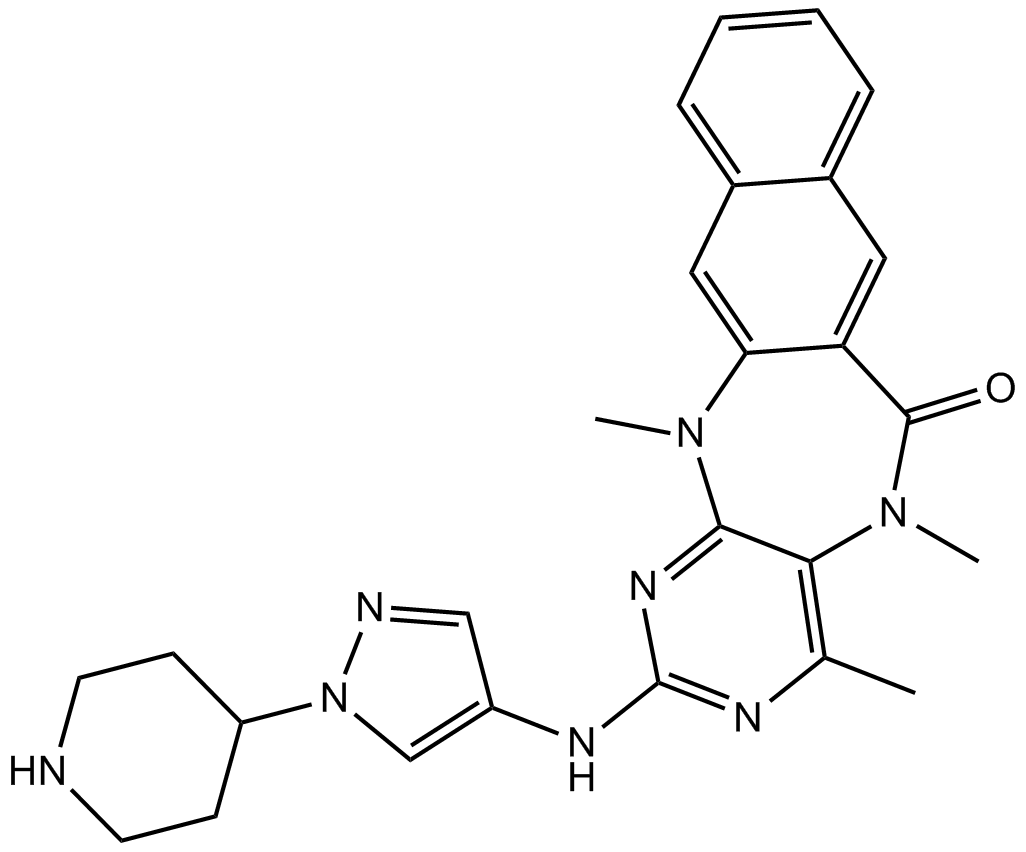
HTH-01-015 |
Catalog No.GC13185
 One-Click Copy Product Info
|

HTH-01-015 is a potent and selective inhibitor of NUAK1 with a IC50 value of 100nM and does not affect the activity of a panel of 139 other kinases, including additional AMPK family members.
Products are for research use only. Not for human use. We do not sell to patients.
Cas No.: 1613724-42-7
Sample solution is provided at 25 µL, 10mM.
_1-3.$$$39978408@51.jpg');)
_1-9.$$$38538795@65.jpg');)
_1-9.$$$39112701@51.jpg');)
_1-7.$$$37316672@70.jpg');)
_366-372.$$$36198801@70.jpg');)
.$$$38565142@65.jpg');)
_1867-1883.$$$33248023@67.jpg');)
_eads6055.$$$39977546@45.jpg');)
_eadm9805.$$$40080571@45.jpg');)
_eadj3020.$$$39666821@45.jpg');)
_1-20.$$$39757301@28.jpg');)
_1-24.$$$38898113@28.jpg');)
_273-287.$$$36806353@46.jpg');)
_1-16.$$$37156877@44.jpg');)
_1-19.$$$37460805@44.jpg');)
_1291-1307.$$$34518654@46.jpg');)
HTH-01-015 is a potent and selective inhibitor of NUAK1 with a IC50 value of 100nM and does not affect the activity of a panel of 139 other kinases, including additional AMPK family members[1].
In vitro, HTH-01-015 (1–30μM) was employed for 3–5 days in MCF-10A and MDA-MD-231 PTEN+/PTEN- isogenic breast cancer cell lines. PTEN- cell lines were indeed more sensitive to HTH-01-015 treatment than PTEN+ cell lines, with significantly lower IC50 values[2]. HTH-01-015 (10µM) treated liver cancer cell lines SNU-387 and HepG2 for 48h and significantly reduced cell motility and invasiveness. HTH-01-015 treatment also up-regulated the epithelial marker E-cadherin while down-regulating mesenchymal markers N-cadherin and Vimentin, as well as matrix metalloproteinases MMP2 and MMP9[3]. HTH-01-015 treatment (3μM) for 8h on U2OS osteosarcoma cells inhibited phosphorylation of the NUAK1 substrate MYPT1 and induced about 50% reduction in the population of cells in S-phase. HTH-01-015 treatment (3μM) for 10h also significantly inhibited mitotic entry[4].
In vivo, HTH-01-015 (10 or 20mg/kg) was administered into CCl4-induced liver fibrosis model mice by intraperitoneal injection every other day over 5–8 weeks. HTH-01-015 reduced fibrosis deposition and the expression of fibrosis-related proteins such as α-SMA and Collagen I in liver tissues[5].
References:
[1] Banerjee S, Buhrlage S J, Huang H T, et al. Characterization of WZ4003 and HTH-01-015 as selective inhibitors of the LKB1-tumour-suppressor-activated NUAK kinases. Biochem J. 2014 Jan 1;457(1):215-25.Tang YC, Ho SC, Tan E, Ng AWT, McPherson JR, Goh GYL, Teh BT, Bard F, Rozen SG. Functional genomics identifies specific vulnerabilities in PTEN-deficient breast cancer. Breast Cancer Res. 2018 Mar 22;20(1):22.
[3] Chu D X, Jin Y, Wang B R, et al. LncRNA HOTAIR Enhances Epithelial-to-mesenchymal Transition to Promote the Migration and Invasion of Liver Cancer by Regulating NUAK1 via Epigenetic Inhibition miR-145-5p Expression. J Cancer. 2023 Jul 24;14(12):2329-2343.
[4] Banerjee S, Zagórska A, Deak M, Campbell D G, Prescott A R, Alessi D R. Interplay between Polo kinase, LKB1-activated NUAK1 kinase, PP1βMYPT1 phosphatase complex and the SCFβTrCP E3 ubiquitin ligase. Biochem J. 2014 Jul 15;461(2):233-45.
[5] You Y, Gao C Q, Wu J R, et al. Enhanced Expression of ARK5 in Hepatic Stellate Cell and Hepatocyte Synergistically Promote Liver Fibrosis. Int J Mol Sci. 2022 Oct 28;23(21):13084.
| Cell experiment [1]: | |
Cell lines | Human U2OS osteosarcoma cells |
Preparation Method | U2OS cells were split and approximately equal number of cells was loaded into a 12-well plate. To study the effect of NUAK1 inhibition for mitosis, bright-field imaging was carried out with or without treatment with DMSO (control) or 3μM HTH-01-015 for 8h or 10h. |
Reaction Conditions | 3μM; 8h or 10h |
Applications | HTH-01-015 induced about 50% reduction in the population of cells in S-phase and significantly inhibited mitotic entry. |
| Animal experiment [2]: | |
Animal models | C57BL/6 mice |
Preparation Method | In the ARK5 inhibitor treatment model, liver fibrosis was induced in mice and HTH-01-015 (10mg/kg or 20mg/kg) was administered by intraperitoneal injection every other day over 5–8 weeks. |
Dosage form | 10 or 20mg/kg; i.p.; every other day over 5–8 weeks |
Applications | HTH-01-015 reduced fibrosis deposition and the expression of fibrosis-related proteins such as α-SMA and Collagen I in liver tissues of fibrosis model mice. |
References: | |
| Cas No. | 1613724-42-7 | SDF | |
| Chemical Name | 4,5,13-trimethyl-2-((1-(piperidin-4-yl)-1H-pyrazol-4-yl)amino)-5H-naphtho[2,3-e]pyrimido[5,4-b][1,4]diazepin-6(13H)-one | ||
| Canonical SMILES | CN1C(C2=CC3=CC=CC=C3C=C2N(C)C4=NC(NC5=CN(C6CCNCC6)N=C5)=NC(C)=C14)=O | ||
| Formula | C26H28N8O | M.Wt | 468.55 |
| Solubility | ≥ 23.45mg/mL in DMSO | Storage | Store at -20°C |
| General tips | Please select the appropriate solvent to prepare the stock solution according to the
solubility of the product in different solvents; once the solution is prepared, please store it in
separate packages to avoid product failure caused by repeated freezing and thawing.Storage method
and period of the stock solution: When stored at -80°C, please use it within 6 months; when stored
at -20°C, please use it within 1 month. To increase solubility, heat the tube to 37°C and then oscillate in an ultrasonic bath for some time. |
||
| Shipping Condition | Evaluation sample solution: shipped with blue ice. All other sizes available: with RT, or with Blue Ice upon request. | ||
| Prepare stock solution | |||

|
1 mg | 5 mg | 10 mg |
| 1 mM | 2.1342 mL | 10.6712 mL | 21.3424 mL |
| 5 mM | 426.8 μL | 2.1342 mL | 4.2685 mL |
| 10 mM | 213.4 μL | 1.0671 mL | 2.1342 mL |
Step 1: Enter information below (Recommended: An additional animal making an allowance for loss during the experiment)
 g
μL
g
μL
Step 2: Enter the in vivo formulation (This is only the calculator, not formulation. Please contact us first if there is no in vivo formulation at the solubility Section.)
Calculation results:
Working concentration: mg/ml;
Method for preparing DMSO master liquid: mg drug pre-dissolved in μL DMSO ( Master liquid concentration mg/mL, Please contact us first if the concentration exceeds the DMSO solubility of the batch of drug. )
Method for preparing in vivo formulation: Take μL DMSO master liquid, next addμL PEG300, mix and clarify, next addμL Tween 80, mix and clarify, next add μL saline, mix and clarify.
Method for preparing in vivo formulation: Take μL DMSO master liquid, next add μL Corn oil, mix and clarify.
Note: 1. Please make sure the liquid is clear before adding the next solvent.
2. Be sure to add the solvent(s) in order. You must ensure that the solution obtained, in the previous addition, is a clear solution before proceeding to add the next solvent. Physical methods such as vortex, ultrasound or hot water bath can be used to aid dissolving.
3. All of the above co-solvents are available for purchase on the GlpBio website.
Quality Control & SDS
- View current batch:
- Purity: >99.00% Appearance: A solid
- COA (Certificate of Analysis)
- SDS (Safety Data Sheet)
- Datasheet
Average Rating: 5 (Based on Reviews and 38 reference(s) in Google Scholar.)