

Valsartan (Synonyms: CGP 48933) |
Catalog No.GC10765
 One-Click Copy Product Info
|

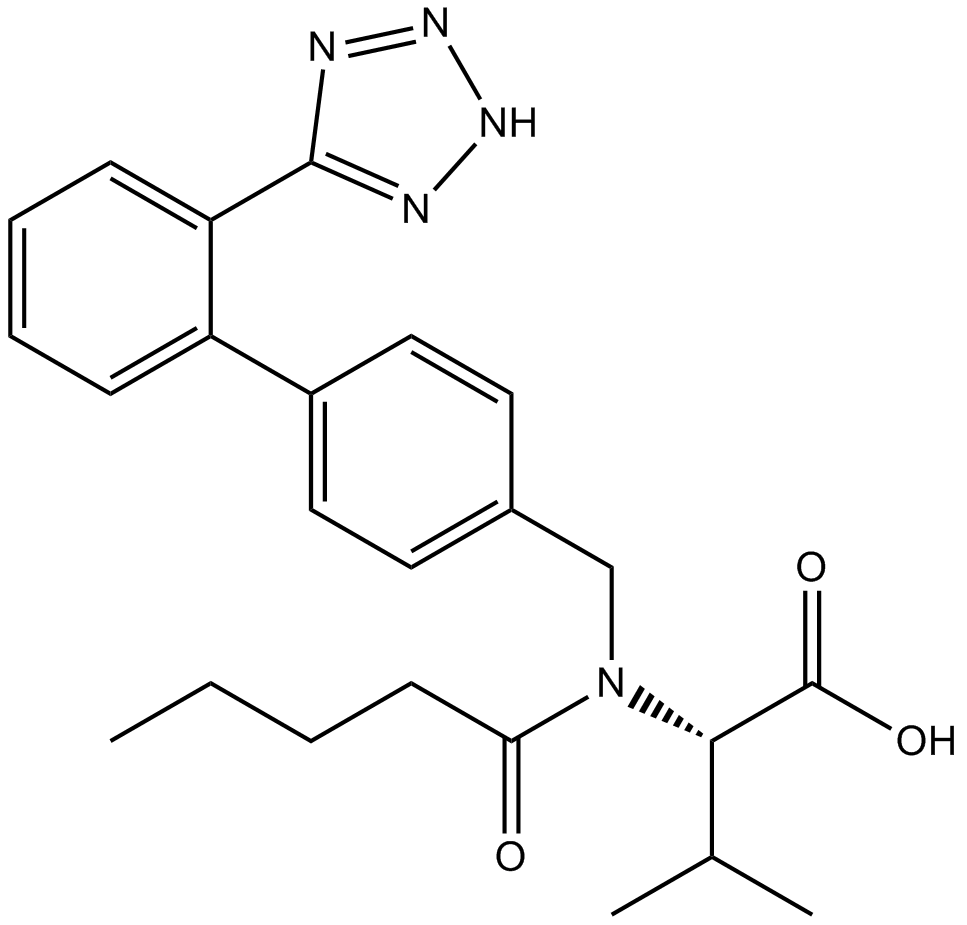
Valsartan is a nonpeptide angiotensin receptor antagonist that selectively blocks the binding of angiotensin II to the angiotensin II type 1 receptor.
Products are for research use only. Not for human use. We do not sell to patients.
Cas No.: 137862-53-4
Sample solution is provided at 25 µL, 10mM.
_1-3.$$$39978408@51.jpg');)
_1-9.$$$38538795@65.jpg');)
_1-9.$$$39112701@51.jpg');)
_1-7.$$$37316672@70.jpg');)
_366-372.$$$36198801@70.jpg');)
.$$$38565142@65.jpg');)
_1867-1883.$$$33248023@67.jpg');)
_eads6055.$$$39977546@45.jpg');)
_eadm9805.$$$40080571@45.jpg');)
_eadj3020.$$$39666821@45.jpg');)
_1-20.$$$39757301@28.jpg');)
_1-24.$$$38898113@28.jpg');)
_273-287.$$$36806353@46.jpg');)
_1-16.$$$37156877@44.jpg');)
_1-19.$$$37460805@44.jpg');)
_1291-1307.$$$34518654@46.jpg');)
Valsartan is a nonpeptide angiotensin receptor antagonist that selectively blocks the binding of angiotensin II to the angiotensin II type 1 receptor[1]. Valsartan improves cardiac remodeling by inhibiting guanine nucleotide-binding proteins and blocking EGFR activation, and contributes to the synergistic effects mediated downstream of Sacubitril via its regulation of glycogen synthase kinase-3 beta (GSK3B) and the activities of the segment polarity protein disheveled homologs DVL-1, 2, and 3[2]. Valsartan has been widely used in immune response studies to inhibit the production of reactive oxygen species (ROS) as well as the binding activity of NF-κB, and to regulate inflammation[3].
In vitro, Valsartan treatment (1μM) for 48 hours inhibited the expression of MCP-1 and TGF-β1 in rat glomerular mesangial cells (GMCs) and glomerular epithelial cells (GECs) induced by high glucose, and alleviated oxidative stress[4]. Incubation of BEAS-2B cells with 80μM Valsartan for 24 hours alleviated the decrease in cell viability triggered by 50μg/ml lipopolysaccharide (LPS), suppressed the expression of MUC5AC at both transcriptional and translational levels, and blocked the phosphorylation of p65, p38, ERK and JNK[5].
In vivo, Valsartan treatment via oral administration at a dose of 40mg/kg/day for 18 days reduced tumor volume and weight, and restrained angiogenesis in a mouse model of colorectal cancer[6]. Oral administration of Valsartan at a dose of 10mg/kg/day for 2 weeks reduced infarct size and cardiomyocyte apoptosis, and decreased plasma TNF-α levels in a rat model of myocardial ischemia-reperfusion injury[7]. Oral administration of Valsartan at a dose of 10mg/kg/day for 5 months lowered brain β-amyloid levels and improved spatial learning ability in a mouse model of Alzheimer's disease[8].
References:
[1] Black H R, Bailey J, Zappe D, et al. Valsartan: more than a decade of experience[J]. Drugs, 2009, 69(17): 2393-2414.
[2] Iborra-Egea O, Gálvez-Montón C, Roura S, et al. Mechanisms of action of sacubitril/valsartan on cardiac remodeling: a systems biology approach[J]. NPJ systems biology and applications, 2017, 3(1): 12.
[3] Dandona P, Kumar V, Aljada A, et al. Angiotensin II receptor blocker valsartan suppresses reactive oxygen species generation in leukocytes, nuclear factor-κB, in mononuclear cells of normal subjects: evidence of an antiinflammatory action[J]. The Journal of Clinical Endocrinology & Metabolism, 2003, 88(9): 4496-4501.
[4] Jiao B, Wang Y, Cheng Y, et al. Valsartan attenuated oxidative stress, decreased MCP-1 and TGF-β1 expression in glomerular mesangial and epithelial cells induced by high-glucose levels[J]. BioScience Trends, 2011, 5(4): 173-181.
[5] Zhou M, Meng L, He Q, et al. Valsartan attenuates LPS-induced ALI by modulating NF-κB and MAPK pathways[J]. Frontiers in pharmacology, 2024, 15: 1321095.
[6] Asgharzadeh F, Mostafapour A, Ebrahimi S, et al. Inhibition of angiotensin pathway via valsartan reduces tumor growth in models of colorectal cancer[J]. Toxicology and Applied Pharmacology, 2022, 440: 115951.
[7] Wu B, Lin R, Dai R, et al. Valsartan attenuates oxidative stress and NF-κB activation and reduces myocardial apoptosis after ischemia and reperfusion[J]. European journal of pharmacology, 2013, 705(1-3): 140-147.
[8] Wang J, Ho L, Chen L, et al. Valsartan lowers brain β-amyloid protein levels and improves spatial learning in a mouse model of Alzheimer disease[J]. The Journal of clinical investigation, 2007, 117(11): 3393-3402.
| Cell experiment [1]: | |
|
Cell lines |
BEAS-2B cells |
|
Preparation Method |
BEAS-2B cells were RPMI-1640 medium supplemented with 100μg/ml streptomycin, 100μg/ml penicillin and 10% fetal bovine serum at 37°C in an incubator with 5% CO2. BEAS-2B cells (5×10³/well) were seeded in the 96-well plates and cultured for 12h before 24h-starvation followed by treatment with different concentrations of Valsartan (0, 20, 40, and 80µM) in the presence of LPS (50μg/ml) for 24h. Cells were then washed twice with sterile PBS and the viability was measured. |
|
Reaction Conditions |
0, 20, 40, and 80µM; 24h |
|
Applications |
Valsartan restored the LPS-treated cell viability in BEAS-2B cells in a dose-dependent manner. |
| Animal experiment [2]: | |
|
Animal models |
BALB/c mice |
|
Preparation Method |
BALB/c mice, aged 7 weeks with weights of 22-25g, were housed in cages and maintained in air-conditioned animal quarters with a 12h light-dark cycle and free access to autoclaved tap water and a standard chow diet. 2×10⁶ CT-26 cells were injected in the right flank region of mouse and approximately two weeks, when tumors reached a volume of 80-100mm3, mice were separated into four groups randomly as below: (1) Control (Untreated mice), (2) Valsartan (treated with 40mg/kg/day; orally; 18 days). The size of tumor was assessed every other day with the digital caliper. |
|
Dosage form |
40mg/kg/day; 18 days; p.o. |
|
Applications |
Valsartan treatment reduced tumor growth in mice with CT-26 xenografts. |
References: [1] Zhou M, Meng L, He Q, et al. Valsartan attenuates LPS-induced ALI by modulating NF-κB and MAPK pathways[J]. Frontiers in pharmacology, 2024, 15: 1321095. [2] Asgharzadeh F, Mostafapour A, Ebrahimi S, et al. Inhibition of angiotensin pathway via valsartan reduces tumor growth in models of colorectal cancer[J]. Toxicology and Applied Pharmacology, 2022, 440: 115951. | |
| Cas No. | 137862-53-4 | SDF | |
| Synonyms | CGP 48933 | ||
| Chemical Name | (2S)-3-methyl-2-[pentanoyl-[[4-[2-(2H-tetrazol-5-yl)phenyl]phenyl]methyl]amino]butanoic acid | ||
| Canonical SMILES | CCCCC(=O)N(CC1=CC=C(C=C1)C2=CC=CC=C2C3=NNN=N3)C(C(C)C)C(=O)O | ||
| Formula | C24H29N5O3 | M.Wt | 435.52 |
| Solubility | ≥ 19.65mg/mL in DMSO | Storage | Store at -20°C |
| Shipping Condition | Evaluation sample solution: shipped with blue ice. All other sizes available: with RT, or with Blue Ice upon request. | ||
| Prepare stock solution | |||

|
1 mg | 5 mg | 10 mg |
| 1 mM | 2.2961 mL | 11.4805 mL | 22.9611 mL |
| 5 mM | 459.2 μL | 2.2961 mL | 4.5922 mL |
| 10 mM | 229.6 μL | 1.1481 mL | 2.2961 mL |
Step 1: Enter information below (Recommended: An additional animal making an allowance for loss during the experiment)
 g
μL
g
μL
Step 2: Enter the in vivo formulation (This is only the calculator, not formulation. Please contact us first if there is no in vivo formulation at the solubility Section.)
Calculation results:
Working concentration: mg/ml;
Method for preparing DMSO master liquid: mg drug pre-dissolved in μL DMSO ( Master liquid concentration mg/mL, Please contact us first if the concentration exceeds the DMSO solubility of the batch of drug. )
Method for preparing in vivo formulation: Take μL DMSO master liquid, next addμL PEG300, mix and clarify, next addμL Tween 80, mix and clarify, next add μL saline, mix and clarify.
Method for preparing in vivo formulation: Take μL DMSO master liquid, next add μL Corn oil, mix and clarify.
Note: 1. Please make sure the liquid is clear before adding the next solvent.
2. Be sure to add the solvent(s) in order. You must ensure that the solution obtained, in the previous addition, is a clear solution before proceeding to add the next solvent. Physical methods such as vortex, ultrasound or hot water bath can be used to aid dissolving.
3. All of the above co-solvents are available for purchase on the GlpBio website.
Quality Control & SDS
- View current batch:
- Purity: >98.00% Appearance: A solid
- COA (Certificate of Analysis)
- SDS (Safety Data Sheet)
- Datasheet
Average Rating: 5 (Based on Reviews and 39 reference(s) in Google Scholar.)