

Hydroxyphenyllactic acid |
Catalog No.GC33991
 One-Click Copy Product Info
|

Hydroxyphenyllactic acid is a tyrosine metabolite.
Products are for research use only. Not for human use. We do not sell to patients.
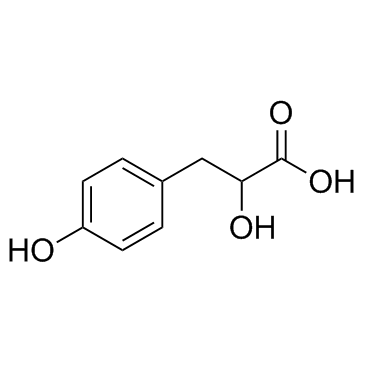
Cas No.: 306-23-0
Sample solution is provided at 25 µL, 10mM.
_1-3.$$$39978408@51.jpg');)
_1-9.$$$38538795@65.jpg');)
_1-9.$$$39112701@51.jpg');)
_1-7.$$$37316672@70.jpg');)
_366-372.$$$36198801@70.jpg');)
.$$$38565142@65.jpg');)
_1867-1883.$$$33248023@67.jpg');)
_eads6055.$$$39977546@45.jpg');)
_eadm9805.$$$40080571@45.jpg');)
_eadj3020.$$$39666821@45.jpg');)
_1-20.$$$39757301@28.jpg');)
_1-24.$$$38898113@28.jpg');)
_273-287.$$$36806353@46.jpg');)
_1-16.$$$37156877@44.jpg');)
_1-19.$$$37460805@44.jpg');)
_1291-1307.$$$34518654@46.jpg');)
Hydroxyphenyllactic acid is a tyrosine metabolite [1]. Hydroxyphenyllactic acid inhibits the production of reactive oxygen species (ROS) in mitochondria and neutrophils, thereby exerting a natural antioxidant effect [2]. Hydroxyphenyllactic acid is primarily used to treat fungi [3-4].
In AML-12 cells, Hydroxyphenyllactic acid (0.1μg/mL, 0.5μg/mL; 24h) treatment protects against ethanol-induced damage [5].
In C57BL/6 mice, Hydroxyphenyllactic acid (42mg; sc; 30d) has embryogenic activity [6].
References:
[1]. Mu W, Yu S, Zhu L, et al. Production of 3-phenyllactic acid and 4-hydroxyphenyllactic acid by Pediococcus acidilactici DSM 20284 fermentation[J]. European Food Research and Technology, 2012, 235(3): 581-585.
[2]. Beloborodova N, Bairamov I, Olenin A, et al. Effect of phenolic acids of microbial origin on production of reactive oxygen species in mitochondria and neutrophils[J]. Journal of biomedical science, 2012, 19(1): 89.
[3]. Lunavath R, Mohammad S H, Bhukya K K, et al. Antimycotic effect of 3-phenyllactic acid produced by probiotic bacterial isolates against Covid-19 associated mucormycosis causing fungi[J]. PLoS One, 2023, 18(3): e0279118.
[4]. Li C, Deng Y, Wang J, et al. Effects of p-hydroxyphenylacetic acid and p-hydroxybenzoic acid on soil bacterial and fungal communities[J]. Sustainability, 2023, 15(12): 9285.
[5]. Zhang C, Chen Y, Huang S, et al. 3, 4-hydroxyphenyl lactic acid from Lactiplantibacillus plantarum prevents alcoholic liver injury in mice[J]. bioRxiv, 2025: 2025.03. 12.642873.
[6]. Rauschenbach M O, Zharova E I, Sergeeva T I, et al. Blastomogenic activity of p-hydroxyphenyllactic acid in mice[J]. Cancer research, 1975, 35(3): 577-585.
| Cell experiment [1]: | |
|
Cell lines |
AML-12 cells |
|
Preparation Method |
To investigate the protective effect of Hydroxyphenyllactic acid on ethanol-damaged AML-12 cells, the cells were divided into control, model, and experimental groups. AML-12 cells (2×10⁵ cells/well) were incubated in six-well plates for 24 hours. Fresh medium was replaced with medium containing different concentrations of Hydroxyphenyllactic acid (0.1μg/mL and 0.5μg/mL) and incubated for an additional 24 hours. Subsequently, medium containing varying concentrations of ethanol was added, and the cells were incubated for an additional 24 hours before conducting subsequent experiments. |
|
Reaction Conditions |
0.1μg/mL, 0.5μg/mL; 24h |
|
Applications |
Hydroxyphenyllactic acid treatment protects against ethanol-induced damage. |
| Animal experiment [2]: | |
|
Animal models |
C57BL/6 mice |
|
Preparation Method |
Six-week-old male and female non-inbred C57BL/6 mice were used. These mice were kept in an isolator animal housing facility, 10 per metal cage. All experimental and control groups were fed a standard diet and had free access to water. The metabolite was dissolved in distilled water at a concentration of 10mg/mL. Each mouse received 2.5mg of the metabolite dissolved in 0.25mL of water and injected subcutaneously into the back twice weekly. The total dose of Hydroxyphenyllactic acid was 42mg (233μmol) per mouse, and the total dose of phenyllactic acid was 50mg (301μmol) per mouse. |
|
Dosage form |
42mg; sc; 30d |
|
Applications |
Hydroxyphenyllactic acid has embryogenic activity. |
|
References: |
|
| Cas No. | 306-23-0 | SDF | |
| Canonical SMILES | O=C(O)C(O)CC1=CC=C(O)C=C1 | ||
| Formula | C9H10O4 | M.Wt | 182.17 |
| Solubility | DMSO : 125 mg/mL (686.17 mM) | Storage | Store at -20°C, away from moisture and light |
| General tips | Please select the appropriate solvent to prepare the stock solution according to the
solubility of the product in different solvents; once the solution is prepared, please store it in
separate packages to avoid product failure caused by repeated freezing and thawing.Storage method
and period of the stock solution: When stored at -80°C, please use it within 6 months; when stored
at -20°C, please use it within 1 month. To increase solubility, heat the tube to 37°C and then oscillate in an ultrasonic bath for some time. |
||
| Shipping Condition | Evaluation sample solution: shipped with blue ice. All other sizes available: with RT, or with Blue Ice upon request. | ||
| Prepare stock solution | |||

|
1 mg | 5 mg | 10 mg |
| 1 mM | 5.4894 mL | 27.4469 mL | 54.8938 mL |
| 5 mM | 1.0979 mL | 5.4894 mL | 10.9788 mL |
| 10 mM | 548.9 μL | 2.7447 mL | 5.4894 mL |
Step 1: Enter information below (Recommended: An additional animal making an allowance for loss during the experiment)
 g
μL
g
μL
Step 2: Enter the in vivo formulation (This is only the calculator, not formulation. Please contact us first if there is no in vivo formulation at the solubility Section.)
Calculation results:
Working concentration: mg/ml;
Method for preparing DMSO master liquid: mg drug pre-dissolved in μL DMSO ( Master liquid concentration mg/mL, Please contact us first if the concentration exceeds the DMSO solubility of the batch of drug. )
Method for preparing in vivo formulation: Take μL DMSO master liquid, next addμL PEG300, mix and clarify, next addμL Tween 80, mix and clarify, next add μL saline, mix and clarify.
Method for preparing in vivo formulation: Take μL DMSO master liquid, next add μL Corn oil, mix and clarify.
Note: 1. Please make sure the liquid is clear before adding the next solvent.
2. Be sure to add the solvent(s) in order. You must ensure that the solution obtained, in the previous addition, is a clear solution before proceeding to add the next solvent. Physical methods such as vortex, ultrasound or hot water bath can be used to aid dissolving.
3. All of the above co-solvents are available for purchase on the GlpBio website.
Quality Control & SDS
- View current batch:
- Purity: >98.00% Appearance: A solid
- COA (Certificate of Analysis)
- SDS (Safety Data Sheet)
- Datasheet
Average Rating: 5 (Based on Reviews and 37 reference(s) in Google Scholar.)